 ultimate-guide
Best Practices for Long Term Peptide Storage in 2026
Table of Contents
- Why Proper Peptide Storage Matters for Reproducible Results
- Lyophilized Peptide Storage Temperature: The Foundation of Stability
- How to Store Research Peptides: Managing Moisture, Light, and Air
- Peptide Stability After Reconstitution: Solvent Selection and Handling
- Shipping and Transit Best Practices for Peptide Integrity
- Troubleshooting Degraded Samples: Signs and Solutions
- Conclusion
- Frequently Asked Questions
Last Updated: September 8, 2026
Why Proper Peptide Storage Matters for Reproducible Results
Peptide storage is the single most controllable variable in your experimental workflow, yet it is also the most frequently mishandled. A lyophilized peptide that degrades due to improper storage fails quietly, producing shifted dose-response curves, murky binding data, and wasted months of work (peer-reviewed research).
At BlueWaveCompound, we supply research-grade peptides with third-party lab testing and Certificates of Analysis, and we have seen how storage conditions determine whether a high-purity product performs as expected. This guide covers the storage protocols that protect molecular integrity from arrival through reconstitution and long-term use.
The core principle is simple: lyophilized peptides are stable when kept cold, dry, and away from light.
Lyophilized Peptide Storage Temperature: The Foundation of Stability
Lyophilized peptide storage temperature is the most critical factor in preserving stability over extended periods. The lyophilization process removes water to create a stable powder, but residual moisture and ambient heat still drive degradation pathways like hydrolysis, oxidation, and deamidation. Cold storage slows these molecular processes dramatically.
For most research peptides, a standard freezer at -20°C provides adequate protection for months to years. Ultra-low freezers at -80°C offer an additional safety margin, particularly for peptides with known instability or those stored beyond 12 months. The key distinction is consistency: repeated temperature fluctuations cause more damage than a constant slightly higher temperature.
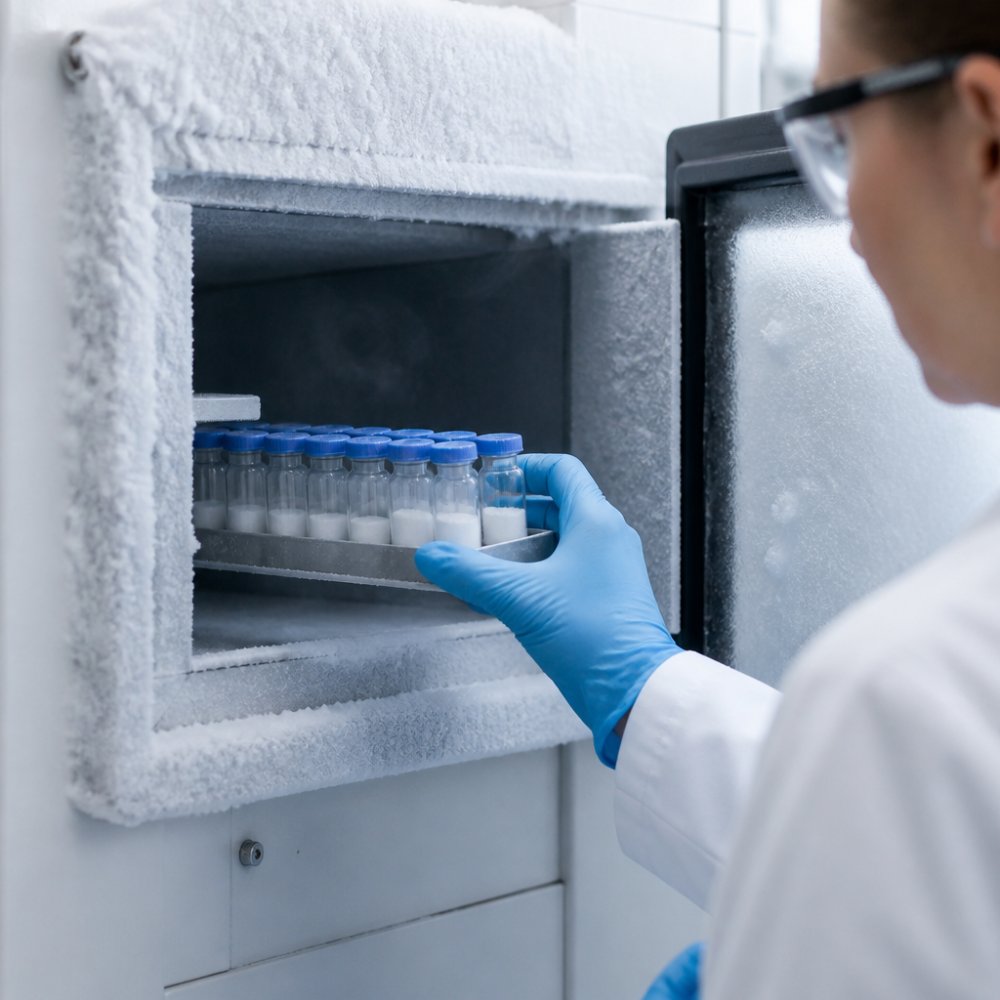
Understanding -20°C vs -80°C Freezer Conditions
Choose -80°C storage for maximum long-term stability or for peptides with oxidation-prone residues like methionine, cysteine, or tryptophan. Choose -20°C for routine peptides used within 6 to 12 months. What matters more than absolute temperature is avoiding freeze-thaw cycles, which we address in the reconstitution section below.
Container Material Compatibility: Glass vs. Plastic
The container you store your lyophilized peptide in is not an inert vessel, it actively interacts with your sample over time.
Borosilicate glass (Type I glass) is the gold standard for long-term peptide storage. It is chemically inert, has a low coefficient of thermal expansion, and does not leach compounds into your sample. The amber-colored version provides additional light protection. Most commercial peptide vials from reputable suppliers use this material.
Standard plastic vials present two problems for long-term storage. First, some plastics, particularly polystyrene and certain polycarbonates, can leach plasticizers, stabilizers, or residual monomers that interfere with downstream assays or react with the peptide. Second, many plastics are slightly permeable to oxygen and water vapor, which slowly undermines the protective environment inside the vial.
Polypropylene (PP) is the safest plastic option if you must transfer peptides. It is relatively inert, has low water vapor permeability, and is the standard material for cryogenic storage tubes. However, even polypropylene can adsorb peptides onto its surface, particularly at low concentrations. For long-term storage of lyophilized peptides, glass remains the preferred choice.
If you transfer lyophilized peptide from the original glass vial to a plastic tube, use only sterile, low-binding polypropylene tubes validated for peptide storage. Never use polystyrene or PVC. Always transfer in a dry environment, a glove box or a sealed bag with desiccant, to prevent moisture absorption.
The Role of Desiccants and Packaging
Store vials inside a sealed container with desiccant packets to control residual moisture. Silica gel desiccants are standard, but be careful: desiccant packets that change color indicate moisture absorption and must be replaced regularly. Orange-indicating silica gel turns green when saturated; blue-indicating silica gel turns pink. Replace desiccants whenever the color change is visible.
A common pattern among experienced researchers is a two-layer system: the original peptide vials go inside a larger sealed container with desiccant packets, and that container goes into the freezer. This creates a micro-environment that buffers against humidity fluctuations every time the freezer door opens.
Molecular sieves (3Å or 4Å) are a more aggressive desiccant option for particularly moisture-sensitive peptides. They absorb water more effectively than silica gel at low humidity levels. However, they are more expensive and require regeneration by heating.
The Arrhenius Equation and Realistic Shelf Life
The Arrhenius equation describes how reaction rates increase with temperature. For peptide degradation, the rate roughly doubles for every 10°C increase (en.wikipedia.org). This means a peptide stored at -20°C degrades approximately 32 times slower than the same peptide stored at 4°C. This is why cold storage is so powerful.
However, the Arrhenius relationship assumes a single degradation pathway with a constant activation energy. In reality, lyophilized peptides can degrade through multiple pathways, hydrolysis, oxidation, deamidation, and aggregation, each with different temperature sensitivities. This is why empirical stability data from your supplier's Certificate of Analysis is more reliable than theoretical calculations.
Most lyophilized peptides stored at -20°C in sealed glass vials with desiccants retain high purity for 12 to 24 months. At -80°C, the same peptides often remain stable for 3 to 5 years. Always check the specific stability data provided by your supplier, and consider running periodic purity checks (e.g., HPLC or mass spectrometry) on long-term storage samples to verify stability empirically.
How to Store Research Peptides: Managing Moisture, Light, and Air
How to store research peptides correctly depends on controlling three environmental threats: moisture, light, and oxygen. Lyophilized peptides are hygroscopic, meaning they actively absorb water vapor from the air. Even brief exposure to ambient humidity can initiate hydrolysis that degrades the amino acid sequence.
Always allow sealed vials to reach room temperature before opening. This prevents condensation from forming on the cold powder. Work quickly, reseal immediately, and return vials to cold storage without delay. Ultraviolet light also accelerates degradation, so amber vials or opaque storage boxes provide necessary protection. Oxygen exposure matters less for lyophilized powders but becomes critical after reconstitution.
The Role of Desiccants and Container Material Compatibility
Store vials inside a sealed container with desiccant packets to control residual moisture. Silica gel desiccants are standard, but be careful: desiccant packets that change color indicate moisture absorption and must be replaced regularly.
Peptide Stability After Reconstitution: Solvent Selection and Handling
Peptide stability after reconstitution is measured in days or weeks, not months. Once you add solvent, the clock starts ticking. The peptide is now in solution where hydrolysis, oxidation, deamidation, and microbial contamination proceed far more rapidly than in lyophilized form.
Solvent Selection: Matching the Chemistry
Select your solvent based on the peptide's solubility characteristics and the requirements of your downstream assay. Sterile water for injection (WFI) is the first choice for most peptides. It is free of preservatives and salts that could interfere with assays or promote degradation.
For peptides that resist dissolution in water, a common pattern is to use sterile bacteriostatic water containing 0.9% benzyl alcohol (the FDA). The benzyl alcohol acts as a preservative that inhibits microbial growth, which is useful if you plan to store the reconstituted peptide for more than a few days. However, benzyl alcohol can cause precipitation in some peptides and may interfere with certain cell-based assays.
A dilute acetic acid solution (0.1% to 1%) is often effective for basic peptides that struggle to dissolve in neutral pH water. The acidic environment protonates basic residues, increasing solubility. For hydrophobic peptides, a small amount of dimethyl sulfoxide (DMSO), typically 10% or less of the final volume, can help, but DMSO can oxidize methionine residues and should be used cautiously.
Avoid buffers containing salts, metal ions, or preservatives unless your protocol specifically requires them. Phosphate-buffered saline (PBS) is a common mistake for peptide reconstitution; the salts can promote aggregation and precipitation over time. If your assay requires a specific buffer, reconstitute in sterile water first, then dilute into the buffer immediately before use.
The Molecular Damage of Freeze-Thaw Cycles
Freeze-thaw cycles are among the most destructive forces for reconstituted peptides, and the damage is not just about ice crystals physically puncturing the peptide structure. As water freezes, solutes concentrate in the remaining liquid phase. This cryoconcentration effect exposes peptides to dramatically elevated salt concentrations and extreme pH shifts that can drive hydrolysis, deamidation, and aggregation.
Ice crystal formation also creates a large ice-water interface. Hydrophobic residues on the peptide surface are thermodynamically driven to adsorb to this interface, promoting unfolding and subsequent aggregation. Each freeze-thaw cycle compounds this damage, even if the peptide appears to return to solution after thawing.
A Practical Aliquoting Protocol
The standard approach is to prepare single-use aliquots immediately after reconstitution, freezing each aliquot separately so you never re-freeze a thawed sample. The details matter:
-
Determine your working volume first. If a typical experiment uses 50 µL, prepare 50 µL aliquots. Do not prepare 200 µL aliquots and plan to take out 50 µL each time, the remaining 150 µL will undergo unnecessary freeze-thaw cycles.
-
Use low-binding polypropylene tubes. Standard polypropylene can adsorb peptides, particularly at low concentrations. Low-binding tubes reduce this loss. For very dilute peptide solutions, consider adding a carrier protein like bovine serum albumin (BSA) at 0.1% to block adsorption sites, but verify that BSA does not interfere with your downstream assay.
-
Flash-freeze in liquid nitrogen or on dry ice. Slow freezing in a -20°C freezer creates larger ice crystals and more cryoconcentration damage. Flash-freezing creates smaller crystals and less damage. If liquid nitrogen is not available, place aliquots directly on dry ice for 10 minutes before transferring to the freezer.
-
Label every aliquot with peptide name, concentration, date, and freeze-thaw count. This detail is often overlooked but critical for troubleshooting later.
-
Store frozen aliquots at -80°C, not -20°C. The lower temperature slows all degradation pathways further. Most reconstituted peptides remain stable for several months at -80°C, versus 1 to 3 months at -20°C, depending on the specific peptide sequence.
When Refrigeration Makes Sense
Not all reconstituted peptides need to be frozen. For peptides that will be used within 1 to 4 weeks, refrigeration at 2-8°C is often sufficient and avoids the damage of freeze-thaw cycles entirely. The trade-off is microbial growth risk: sterile technique and bacteriostatic water become more important at refrigerated temperatures.
A practical rule of thumb: if you will use the entire reconstituted volume within 2 weeks, refrigerate. If you will need it beyond 2 weeks, aliquot and freeze immediately after reconstitution.
Shipping and Transit Best Practices for Peptide Integrity
Shipping and transit best practices protect peptides during the vulnerable window between the supplier's freezer and yours. Proper cold chain handling during transit prevents degradation before your storage protocols even begin.
When receiving peptide shipments, inspect packaging immediately upon arrival. Professional suppliers ship lyophilized peptides at ambient temperature in sealed vials with desiccants, which is safe for most peptides during short transit. Reconstituted or temperature-sensitive peptides require insulated packaging with ice packs or dry ice. If you receive warm ice packs or compromised packaging, contact the supplier before using the product.
| Storage Scenario | Temperature | Duration | Key Consideration |
|---|---|---|---|
| Lyophilized, long-term | -80°C | 2+ years | Ultra-low freezer, desiccant sealed |
| Lyophilized, routine | -20°C | 6-12 months | Stable freezer location, avoid door |
| Reconstituted, refrigerated | 2-8°C | 1-4 weeks | Single-use aliquots recommended |
| Reconstituted, frozen | -20°C | 3-6 months | Never re-freeze after thawing |
Troubleshooting Degraded Samples: Signs and Solutions
Troubleshooting degraded samples starts with recognizing the warning signs before they compromise your data. Visible changes in the lyophilized powder, such as discoloration, clumping, or a change from fluffy cake to sticky residue, indicate moisture exposure. After reconstitution, watch for precipitate, cloudiness, or difficulty dissolving that was not present in fresh samples.
If you suspect degradation, compare current performance against historical data from the same peptide batch. Shifts in solubility, reduced activity in functional assays, or unusual chromatographic profiles all point to compromised molecular integrity. When degradation is confirmed, discard the affected vials rather than risking experimental contamination. Document the issue and review your storage conditions to identify where the protocol failed.
Conclusion
Proper peptide storage is not complicated, but it demands discipline. Control temperature, exclude moisture and light, aliquot before freezing, and never compromise the cold chain during shipping. These practices preserve the molecular integrity that your experiments depend on.
At BlueWaveCompound, we support your research with high-purity peptides (≥99%) that are third-party lab tested and shipped with Certificates of Analysis. Our fast & discreet shipping and money-back guarantee give you confidence from order to experiment. Get started with BlueWaveCompound at bluewavecompounds.com and ensure your next experiment starts with materials you can trust.
Frequently Asked Questions
What is the best way to store peptides for long-term preservation?
For long-term preservation, store lyophilized (freeze-dried) peptides in a freezer at -20°C or lower, ideally -80°C for maximum stability. Keep them in their original sealed vials with a desiccant, protected from light and moisture. This prevents hydrolysis and degradation, maintaining the peptide's molecular integrity. For research peptides from providers like BlueWaveCompound, always follow the Certificate of Analysis guidelines. This approach ensures consistent results over extended periods.
What is the difference between storing peptides at -20°C versus -80°C?
The main difference is the rate of chemical degradation. At -20°C, lyophilized peptides are stable for extended periods. At -80°C, the storage conditions are stricter, significantly slowing degradation processes like oxidation and hydrolysis, which can extend shelf-life further. While -20°C is often sufficient, -80°C is recommended for peptides with known pH sensitivity or when storing for several years.
How long can peptides be stored in a syringe?
Storing reconstituted peptides in a syringe is not recommended for long-term storage. Once in a syringe, the peptide solution is exposed to the syringe's plastic material, which can absorb the peptide or leach compounds, contaminating the sample. For best practice, prepare aliquots in sterile glass vials immediately after reconstitution. If you must use a syringe for short-term transport, keep it refrigerated and use it within a few hours. Never freeze peptides in a syringe, as this can affect solubility and cause precipitation.
How does lyophilization affect peptide storage requirements?
Lyophilization removes water, creating a stable powder that is less prone to hydrolysis, a major degradation pathway. This process significantly reduces the need for ultra-cold storage compared to liquid formulations. Lyophilized peptides are hygroscopic, meaning they readily absorb moisture from the air. Therefore, storage requirements focus on protecting the dry cake from humidity. You must allow the vial to reach ambient temperature before opening to prevent condensation, and always use a desiccant in the storage container.