 blog
blog
7 Common Challenges in Custom Peptide Synthesis
Table of Contents
- Racemization at the Ligation Site
- Aggregation and Solubility Issues in Custom Peptide Synthesis
- Sequence Complexity and Length Limitations
- Purification and HPLC Challenges
- Synthetic Peptides vs Recombinant Proteins for Assays
- Stability and Shelf-Life Considerations
- Cost Implications and Scalability Transitions
- Frequently Asked Questions
Last Updated: September 27, 2026
7 Common Challenges in Custom Peptide Synthesis
Custom peptide synthesis is powerful but technically demanding. This article breaks down seven real obstacles you'll face when synthesizing custom peptides, and what actually works to overcome them.
Racemization at the Ligation Site
Racemization occurs when amino acid stereochemistry flips during coupling or cleavage, converting L-forms to D-forms. Even small amounts corrupt results and make assay data unreliable. Amino acids with bulky side chains like phenylalanine or tryptophan are particularly vulnerable due to steric hindrance.
What makes this tricky: Happens during both coupling and cleavage steps, is most visible in longer sequences, and standard HPLC may miss low levels of D-isomers.
Control conditions at every step: lower coupling temperatures, use protecting groups strategically, and validate with mass spectrometry. Third-party lab testing catches racemization products before they reach your bench.
Aggregation and Solubility Issues in Custom Peptide Synthesis
Hydrophobic sequences aggregate after lyophilization, becoming biologically inactive. Solubility problems stem from hydrophobic sequences, repetitive amino acids, cysteine-rich peptides, and long sequences (30+ amino acids). Many researchers discover these problems only at the assay stage when peptides crash out of biological buffers.
Prevention strategies: Add solubility-enhancing residues (lysine, serine, threonine), store lyophilized peptides under inert gas, use surfactants or organic co-solvents during reconstitution, and keep stocks in 20-50% acetonitrile at -20°C. Stability data and reconstitution guidance are provided with every batch.
Sequence Complexity and Length Limitations
Sequence complexity creates three primary bottlenecks:
Repetitive sequences slow coupling efficiency. A 15-amino-acid peptide with three repeats can take twice as long as a 20-residue peptide with varied composition.
Hydrophobic clusters aggregate on the resin, reducing accessibility and coupling yield to 70% by synthesis midpoint instead of 95%.
Length matters. Peptides under 15 amino acids synthesize predictably. Between 15-30 residues, aggregation and coupling efficiency cause problems. The practical limit for standard SPPS is around 40-50 amino acids. Longer sequences require fragment-based synthesis.
Troubleshooting Difficult Amino Acid Residues
Certain amino acids are notorious synthesis troublemakers. Understanding their specific failure modes lets you intervene before they tank your batch.
Cysteine (Cys) is the most problematic residue in custom peptide synthesis. Its thiol side chain forms unwanted disulfide bonds, creating dimers and aggregates on the resin and reducing coupling efficiency. Cys also oxidizes during storage, altering mass and activity.
Mitigation for Cysteine: Use orthogonal protecting groups, perform synthesis under inert atmosphere, add reducing agents (TCEP or DTT) to cleavage cocktail, and store in 20-50% acetonitrile with 0.1% TFA.
Methionine (Met) oxidizes readily to methionine sulfoxide, changing mass and activity. Mitigation: Use degassed solvents, add antioxidants to coupling and cleavage solutions, perform work under inert atmosphere, and store lyophilized peptides under inert gas.
Histidine (His) causes side reactions and epimerization during coupling and deamidation during storage. Mitigation: Use Boc-His, lower coupling temperatures, and store at pH 2-3 or in organic solvent.
Asparagine (Asn) and Glutamine (Gln) undergo deamidation, especially at neutral pH. Mitigation: Store at pH 2-3, keep at -20°C or colder, and lyophilize when possible.
Tryptophan (Trp) and Tyrosine (Tyr) oxidize and photodegrade. Mitigation: Store in the dark, minimize UV exposure during HPLC, and use mild cleavage conditions.
Practical Length Limits and Fragment-Based Synthesis
For peptides longer than 50 residues, fragment-based synthesis is standard. You synthesize shorter fragments (15-35 residues each) independently, then ligate them together. This reduces aggregation and improves predictability but adds 2-4 weeks to timeline.
Visit https://bluewavecompounds.com to discuss your specific sequence challenges with our synthesis team.
Purification and HPLC Challenges
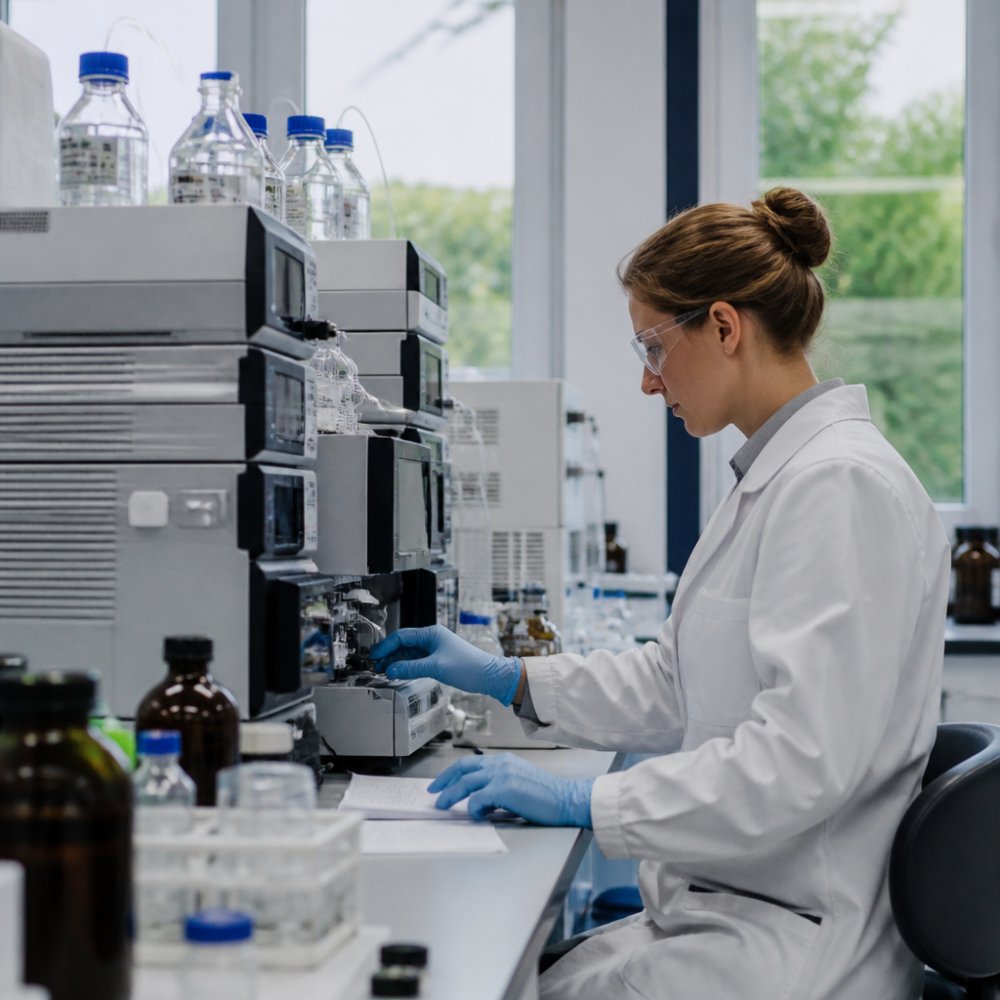
After synthesis, your crude peptide is a mixture of your target peptide, truncated sequences, deletion products, racemized forms, and byproducts. HPLC is your separation tool, but it's not foolproof.
The core problems with peptide purification:
Your peptide and its impurities often have similar hydrophobicity. A standard C18 reverse-phase column can't always resolve them. You get a peak that looks pure at 214 nm but contains 85% target peptide and 15% truncated sequence.
Method development requires testing multiple conditions. Scaling from analytical (1 mg) to preparative scale (50-100 mg) often fails due to peak broadening and overloading. Most peptides rely on 214 nm detection, which picks up all backbone-containing molecules. Mass spectrometry validation confirms purity.
Synthetic Peptides vs Recombinant Proteins for Assays
Synthetic peptides are fragments you design with full control over amino acids and modifications. Synthesis takes days to weeks. Recombinant proteins are full-length molecules with native post-translational modifications. Production takes weeks to months.
Synthetic peptides win for: short sequences, non-natural modifications, rapid turnaround, and variant testing. Recombinant proteins win for: full-length molecules, large quantities, post-translational modifications, and structural studies. Most programs use both.
Stability and Shelf-Life Considerations
Peptide degradation occurs through oxidation (methionine and cysteine), hydrolysis (peptide bonds), deamidation (asparagine and glutamine), and epimerization (D-amino acid formation).
Storage best practices:
- Lyophilized peptides in -20°C freezers stay stable for 12-24 months
- Dissolved peptides in aqueous buffer last 2-4 weeks at 4°C
- Peptides in 20-50% organic solvent last 6-12 months at -20°C
- Avoid freeze-thaw cycles; aliquot your stock
- Store in the dark (light accelerates oxidation)
- Use inert gas (nitrogen or argon) to displace oxygen
BlueWaveCompound provides stability data and Certificates of Analysis (COA) with every batch, documenting the purity at shipment. Our third-party lab testing ensures you know your baseline.
Cost Implications and Scalability Transitions
Synthesis cost scales with three factors: length, modifications, and quantity. Understanding this scaling, and the hidden costs of moving from research to manufacturing, helps you make smart decisions about when to synthesize custom peptides versus other approaches.
Lab-scale synthesis (1-10 mg batches) costs the most per milligram. You're paying for chemist time, reagent setup, and purification effort on small material. This is appropriate for early research: you're validating your sequence, running assays, and iterating rapidly. Speed and flexibility matter more than cost efficiency.
Pilot scale (50-500 mg) drops the per-milligram cost significantly. You're running the same synthesis process but producing more material, so fixed costs spread across a larger batch. At this scale, you're moving beyond initial validation into dose-response studies and mechanism-of-action work.
GMP manufacturing scale (grams to kilograms) requires documented processes, validated equipment, and regulatory compliance under FDA regulations. Upfront costs are high, validation studies, process documentation, analytical method validation, and facility qualification add significant expense before you synthesize a single gram.
The Lab-to-GMP Transition: The Hidden Bottleneck
Most researchers hit a critical inflection point: your peptide works in research, you need larger quantities for preclinical or clinical studies, and suddenly you're facing the lab-to-GMP transition. This is where most projects stall or fail.
Why lab-scale synthesis doesn't scale to GMP:
A synthesis that works perfectly at 1 mg scale often fails at 100 mg or 1 gram. The reasons aren't just about quantity, they're about chemistry, equipment, and regulatory requirements.
Purification becomes impractical. Lab-scale peptides are purified by analytical HPLC: a 10 mm × 250 mm column running at 3 mL/min. To purify 500 mg of crude peptide, you'd need 50-100 HPLC runs. At pilot scale, you move to semi-preparative HPLC. At GMP scale, you need preparative or process-scale HPLC. Each step requires method re-development: gradients that work on analytical scale often fail on preparative scale due to peak broadening and column overloading.
Aggregation on the resin worsens. At 1 mg scale, you're using a small amount of resin (50-100 mg). Solvent flows easily through the resin bed.
Strategic Approaches to Lab-to-GMP Transition
Option 1: Partner with a contract manufacturer early. Don't wait until you need 10 grams to involve a GMP manufacturer. Engage them at the 50-100 mg pilot scale. They can help you develop a process that's scalable and GMP-compatible from the start.
Common Bottlenecks During Scale-Up
- HPLC purification becomes impractical (too slow, too expensive, method doesn't scale)
- Aggregation on the resin increases, tanking coupling yields
- Solvent consumption explodes (cost and waste disposal)
- Batch consistency becomes harder to control (temperature gradients, uneven flow)
- Analytical requirements multiply (endotoxin, residual solvent, stability testing)
- Equipment limitations (your lab's HPLC can't handle preparative-scale volumes)
- Regulatory uncertainty (you're not sure what GMP actually requires for your peptide)
Smart scaling strategy: Start with small batches to validate your sequence. Once you confirm it works, move to larger batches only if you've solved the purification bottleneck. If you're planning to move to GMP, engage a contract manufacturer at the pilot stage (50-100 mg) to validate that your process can scale. Don't wait until you need 10 grams and discover your purification method doesn't work at that scale.
Frequently Asked Questions
What causes aggregation in custom peptide synthesis?
Aggregation occurs when peptides clump together due to hydrophobic interactions, particularly in longer sequences or those rich in nonpolar amino acids. Temperature, pH, and solvent choice during synthesis and storage all influence aggregation risk. High-purity peptides from third-party lab-tested suppliers like Blue Wave Compounds minimize impurities that trigger aggregation, improving your experimental reproducibility.
How do you prevent racemization during peptide coupling?
Racemization, the unwanted conversion of L-amino acids to D-amino acids, occurs at the ligation site during coupling reactions. It's minimized through careful selection of coupling reagents, maintaining optimal pH and temperature, and using protecting group strategies. Working with experienced custom peptide suppliers who employ rigorous process controls significantly reduces racemization and ensures the purity your research demands.
Why are hydrophobic peptides difficult to synthesize?
Hydrophobic peptides tend to aggregate and precipitate during synthesis, reducing coupling efficiency and yield. They also present solubility challenges in both aqueous and organic solvents, complicating purification steps. Specialized synthesis protocols, tailored solvent systems, and expert handling, hallmarks of quality providers, address these challenges to deliver consistent results for your assays.
Should I use synthetic peptides or recombinant proteins for my assay?
Synthetic peptides offer precise sequence control, faster production timelines, and cost efficiency for epitope mapping and antibody development. Recombinant proteins provide full-length, naturally folded structures better suited for functional assays. Your choice depends on your specific research goal. Consulting with your peptide supplier about your experimental needs ensures you select the right approach and quality standard for reproducible results.