 how-to
Ensure Batch to Batch Reproducibility: A 2026 Guide
Table of Contents
- What Batch-to-Batch Reproducibility Means in Peptide Research
- Key Factors That Undermine Batch-to-Batch Reproducibility
- The Importance of Certificate of Analysis in Verifying Batch Quality
- Factors Affecting Peptide Stability Across Batches
- Peptide Storage and Handling Best Practices for Consistent Results
- Process Controls and Analytical Methods That Reduce Variability
- Troubleshooting Framework When a Batch Fails Expectations
- Conclusion
Last Updated: August 20, 2026
What Batch-to-Batch Reproducibility Means in Peptide Research
Batch-to-batch reproducibility is the ability to produce successive lots of a compound with consistent purity profiles, physical characteristics, and biological activity across independent manufacturing runs. For peptide research, this is the foundation on which every downstream experiment depends.
At BlueWaveCompound, we work directly with principal investigators and laboratory managers who have experienced the frustration of irreproducible results. More often than not, the culprit isn't the experimental design, it's the peptide itself. According to NIH's reproducibility and rigor initiative, variability in research materials is one of the primary contributors to results that cannot be replicated across laboratories. When a peptide batch deviates in purity, sequence fidelity, or moisture content, every assay built on it shifts, sometimes subtly, sometimes catastrophically.
This guide covers how to understand what drives variability, verify quality before committing a batch to experiments, and build process controls that catch problems early.
Key Factors That Undermine Batch-to-Batch Reproducibility
Reproducibility is a system problem, not a supplier problem alone. Variability enters at multiple points across the supply chain and laboratory workflow.
Raw Material Variability and Reagent Consistency
Raw material sourcing is where most batch failures originate. Protected amino acid building blocks, coupling reagents, and resin supports all carry inherent lot-to-lot variability from their own manufacturers. When a supplier changes a reagent lot without notification, the downstream effect on coupling efficiency can be significant enough to alter the final purity profile.
Reagent consistency requires active management. Qualify incoming raw materials against defined acceptance criteria before releasing them into production by testing key parameters, moisture content, optical purity, and coupling reactivity, rather than accepting vendor certificates at face value. Vendors who provide full traceability documentation and proactively communicate lot changes reduce the risk of undetected variability. Many labs establish preferred supplier lists based on historical performance data, tracking coefficient of variation across multiple reagent lots to trigger qualification reviews when variability exceeds defined thresholds.
Process Drift and Equipment Calibration Gaps
Process drift is the slow, often invisible shift in synthesis conditions that accumulates over time. Synthesizer flow rates change as tubing ages. Resin swelling behavior varies with temperature fluctuations. Equipment calibration is not optional, analytical instrumentation, HPLC systems, mass spectrometers, and UV detectors require regular calibration against certified standards to ensure purity measurements remain comparable across batches.
Calibration schedules should be tied to usage frequency and criticality, not just calendar intervals. A high-throughput synthesis platform running daily should be verified more frequently than a rarely-used backup system.
The Importance of Certificate of Analysis in Verifying Batch Quality
A Certificate of Analysis is the primary instrument for verifying that a batch meets its release specifications before it enters your experimental workflow. A meaningful COA for a research-grade peptide should document sequence confirmation, purity by HPLC, molecular weight confirmation by mass spectrometry, water content, and relevant bioactivity data. Critically, it should reference the specific analytical methods used, not just the results.
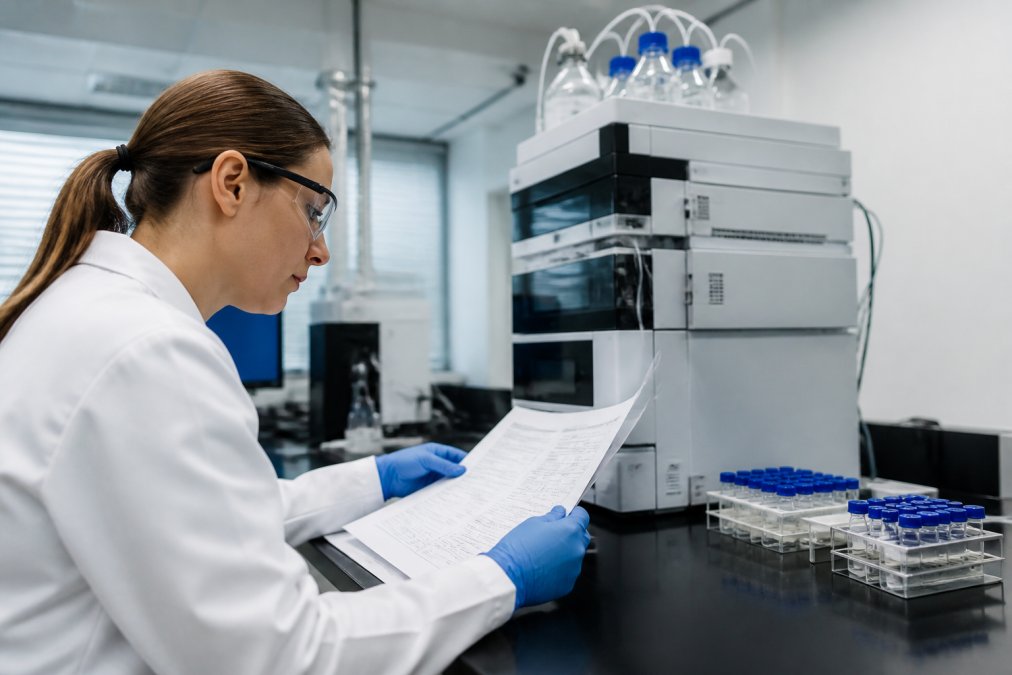
Third-party testing adds a layer of independence that internal testing cannot provide. When a supplier tests its own product on its own instruments using its own methods, confirmation bias and instrument drift can go undetected. BlueWaveCompound provides third-party lab-tested peptides with COAs that accompany every batch, the documentation is verification, not formality.
Before committing a new batch to a critical experiment, cross-reference the incoming COA against your historical batch records. Purity should fall within your defined acceptance range. Any deviation, even within specification, is worth flagging for investigation. As documented in FDA guidance on analytical procedures for pharmaceutical research, validation protocols for analytical methods should include specificity, linearity, and precision assessments.
Factors Affecting Peptide Stability Across Batches
Peptide stability across batches is one of the most underappreciated sources of experimental variability. A peptide that was 99% pure at synthesis may arrive at your bench in a meaningfully different state depending on how it was stored, shipped, and handled.
Chemical Degradation Pathways to Monitor
Several chemical degradation pathways are common in synthetic peptides:
- Oxidation: Methionine, cysteine, tryptophan, and histidine residues are susceptible to oxidative degradation from dissolved oxygen, light, or metal ions.
- Deamidation: Asparagine and glutamine residues undergo deamidation under aqueous conditions, altering the peptide's charge state and binding affinity.
- Hydrolysis: Peptide bonds adjacent to aspartate residues are particularly labile under acidic conditions.
- Diketopiperazine formation: N-terminal dipeptide sequences can cyclize to form diketopiperazines, particularly in solution.
- Aggregation: Hydrophobic peptides are prone to self-aggregation, especially at elevated concentrations or suboptimal pH.
Biophysical characterization of stability-indicating degradation products should be part of your release testing panel for any peptide used in long-term or multi-experiment studies.
Peptide Storage and Handling Best Practices for Consistent Results
Peptide storage and handling best practices are the single most controllable variable in maintaining batch quality after it leaves the supplier. Many stability failures that appear to be batch-to-batch reproducibility problems are actually storage and handling failures.
The general hierarchy of storage conditions for lyophilized peptides:
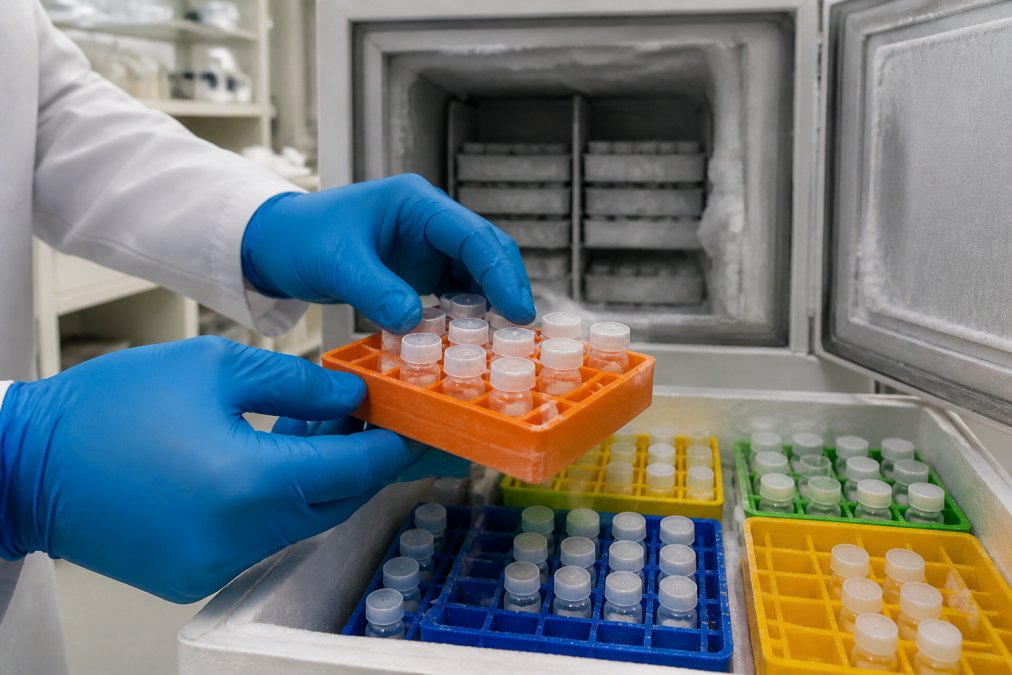
- Long-term archival: -80°C, desiccated, under inert atmosphere (argon or nitrogen)
- Working stock: -20°C, desiccated, in aliquots sized to avoid repeated freeze-thaw cycles
- Active use: 4°C for short periods only, protected from light and moisture
- Aqueous solutions: Prepare fresh where possible; if storage is necessary, use appropriate buffers and freeze in single-use aliquots
Repeated freeze-thaw cycling is one of the most common causes of peptide degradation in laboratory settings. Aliquoting at the point of reconstitution, rather than freezing a bulk solution, eliminates this source of variability.
Reconstitution itself requires care. Many peptides require organic co-solvents (DMSO or acetonitrile) to dissolve before aqueous dilution. Forcing an insoluble peptide into aqueous solution by vortexing creates aggregates rather than a true solution.
Process Controls and Analytical Methods That Reduce Variability
Process controls are the systematic safeguards that prevent variability from entering your workflow undetected. Analytical methods confirm those controls are working.
Statistical Process Control and Assay Optimization
Statistical process control applies quantitative monitoring to process parameters over time. Rather than testing each batch independently against a fixed specification, SPC tracks performance metrics as a time series, identifying trends, shifts, and outliers before they produce out-of-specification results.
For peptide synthesis, key control parameters include coupling efficiency at each cycle, cleavage yield, and crude purity before purification. A coupling efficiency that has declined by three percentage points over twenty batches may still produce a final product within specification, but it signals that the process is moving toward failure.
Assay optimization is equally critical on the analytical side. A validated standard operating procedure with defined sample preparation steps and system suitability criteria ensures that analytical results are comparable across batches and time. According to USP guidelines on analytical method validation, method validation should demonstrate accuracy, precision, specificity, and robustness before a method is applied to release testing.
Digital Monitoring and AI-Driven Process Oversight
Digital twin technology represents a meaningful advance in process control for precision manufacturing. A digital twin is a real-time computational model of a physical process that mirrors actual conditions and predicts outcomes based on current parameter values. Applied to peptide manufacturing, AI-driven process monitoring can flag deviations from expected patterns and recommend corrective actions before a batch fails.
For most academic laboratories, basic data integrity practices provide meaningful reproducibility benefits: logging all process parameters digitally, maintaining searchable batch records, and using software-assisted trend analysis.
| Control Measure | What It Catches | When to Apply |
|---|---|---|
| Incoming raw material testing | Reagent lot variability | Before each new lot enters production |
| Equipment calibration verification | Instrument drift | Per calibration schedule; before critical runs |
| Statistical process control charts | Process drift over time | Continuously across batches |
| COA cross-referencing | Purity and identity deviations | Before committing batch to experiments |
| Stability testing | Degradation during storage | At defined intervals post-synthesis |
| Digital parameter logging | Undocumented process changes | Every synthesis and purification run |
Troubleshooting Framework When a Batch Fails Expectations
A batch that fails to meet expectations is a diagnostic opportunity, provided you have the batch records to support the investigation.
Step 1: Confirm the failure is real. Before attributing poor experimental results to the peptide, rule out assay failure. Re-run your positive control. Check your analytical instrumentation calibration. Verify that the reconstitution protocol was followed exactly.
Step 2: Compare the incoming COA against your acceptance criteria. If the COA shows purity within specification but your bioassay shows reduced activity, the issue may be a degradation pathway that HPLC purity doesn't detect. Request mass spectrometry data if it wasn't included in the original COA.
Step 3: Review storage and handling records. Was the batch stored at the correct temperature continuously? Were freeze-thaw cycles documented? Was the reconstitution protocol consistent with previous batches?
Step 4: Examine upstream processing records. If you synthesize in-house, pull the batch record for the failed lot and compare it against a successful batch. Look for changes in reagent lots, coupling times, cleavage conditions, or purification parameters.
Step 5: Conduct a structured root cause analysis. Document your findings in a formal deviation report. This creates the institutional knowledge base that prevents the same failure from recurring.
When a batch from an external supplier fails, a supplier with strong data integrity practices can provide raw analytical data, not just a summary COA, to support your investigation.
Ensuring batch-to-batch reproducibility in peptide research requires systematic process controls, rigorous analytical methods, disciplined storage and handling, and a structured approach to failure investigation. BlueWaveCompound addresses the supplier side of this equation directly: every batch is third-party lab tested, accompanied by a Certificate of Analysis with full analytical documentation, and shipped with stability in mind. Shop All Peptides to review available compounds and request COA documentation before committing to your next experimental series.
Frequently Asked Questions
What does batch-to-batch reproducibility mean in research settings?
Batch-to-batch reproducibility means that separate production runs of the same compound yield consistent purity profiles, potency, and physical characteristics within defined specification limits. For peptide research, this translates to experimental results that hold up across different vials or shipments. When a supplier's manufacturing process, raw material sourcing, and analytical instrumentation remain tightly controlled, coefficient of variation across batches stays low enough that your assay data remains comparable over time.
How does a Certificate of Analysis help verify batch-to-batch reproducibility?
A Certificate of Analysis documents the specific analytical results for each individual batch: purity percentage by HPLC, mass confirmation, appearance, and moisture content. Comparing COAs across multiple orders lets you track whether key performance metrics stay within your acceptable ranges. Third-party lab-tested COAs carry more weight than in-house documents because an independent analytical laboratory has no commercial incentive to pass a borderline result. Request COAs before committing to a supplier and archive them as part of your batch records.
What factors most commonly cause variability between peptide batches?
The most common sources include inconsistent raw material quality from upstream suppliers, deviations in synthesis parameters such as coupling times or temperature, inadequate downstream purification steps, and improper storage conditions after manufacture. Equipment calibration gaps in analytical instrumentation introduce additional measurement error that can mask real purity differences. On the laboratory side, inconsistent reconstitution volumes, freeze-thaw cycling, and failure to follow standard operating procedures for handling lyophilized peptides all amplify variability between experiments.
What is the difference between repeatability and reproducibility in a laboratory context?
Repeatability measures how consistently the same operator, using the same equipment and protocol, gets the same result within a single session. Reproducibility covers agreement across different operators, instruments, laboratories, or time points. For peptide research, repeatability tells you whether your assay is stable within one experiment. Reproducibility tells you whether results hold when you reorder from the same supplier months later, switch analysts, or scale up. Both matter, but reproducibility is the harder standard to meet and the one most relevant to multi-site or longitudinal studies.
This article was written using GrandRanker