 ultimate-guide
Ensuring Peptide Purity for Clinical Research Success
Table of Contents
- Why Peptide Purity Matters for Clinical Research
- Peptide Purity Analysis Methods Every Lab Should Know
- Interpreting a Certificate of Analysis for Peptides
- Peptide Synthesis Quality Control and Batch Consistency
- Common Impurities and Their Impact on Research Outcomes
- Regulatory Compliance and Documentation for Clinical Pipelines
- Storage, Stability, and Lyophilization Best Practices
- Frequently Asked Questions
Last Updated: September 22, 2026
Why Peptide Purity Matters for Clinical Research
Peptide purity is the percentage of the target amino acid sequence present in a synthesized batch, expressed relative to total peptide-related material. For clinical research, that number decides whether your results hold up or fall apart.
This guide from BlueWaveCompound covers how to verify purity, read a certificate of analysis, and keep batches consistent across a study. It matters because a single impure lot can invalidate months of work.
Most researchers treat the purity figure on a label as settled fact. It isn't. That number is the output of specific analytical methods run under specific conditions, and it can vary between facilities, instruments, and even injection runs. Understanding how it's produced is the difference between citing a defensible material and hoping for the best.
The Link Between Purity and Experimental Reproducibility
Reproducibility breaks down when the material changes between experiments, not when the protocol does.
Impurities introduce variables you didn't design for. A truncated sequence, a residual counter-ion, or a deamidation product can bind, inhibit, or fluoresce differently than your target peptide. In cell-based work, those effects compound. A reviewer asking why your dose-response curve shifted between replicate runs will not accept "the peptide was different" as an answer, and they shouldn't.
Many labs find that standardizing on a purity threshold and a single supplier for a study removes a large share of unexplained variance. The practical move is simple: order enough material for the full study in one batch, verify it, and document it.
Peptide Purity Analysis Methods Every Lab Should Know
Two techniques carry most of the weight in peptide purity analysis methods: high-performance liquid chromatography for separation and quantification, and mass spectrometry for identity confirmation. A certificate that reports only one of them tells you half the story.
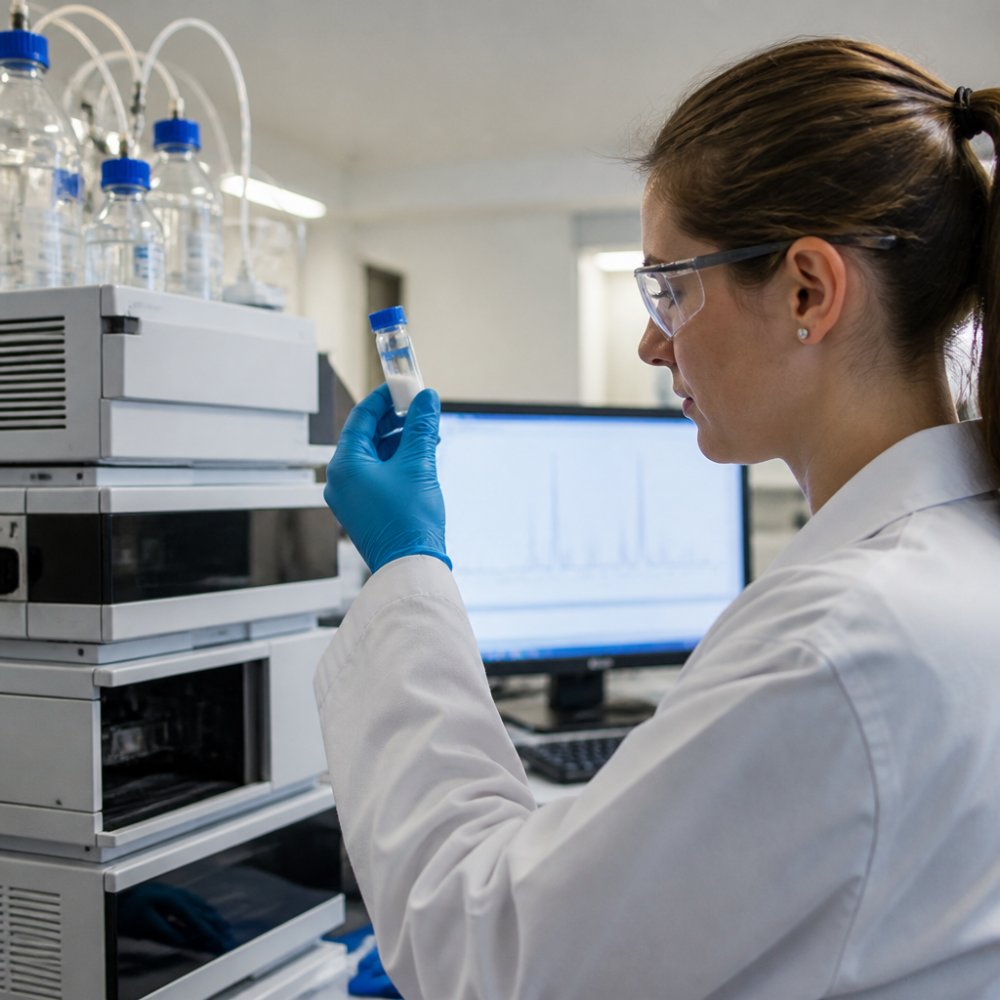
High-Performance Liquid Chromatography (HPLC)
HPLC separates the components of a peptide sample by passing it through a column under pressure and detecting what elutes over time. The resulting chromatogram shows your target peptide as a main peak and impurities as smaller peaks around it.
Purity is calculated by peak integration, dividing the area of the target peak by the total area of all peaks. Two labs can run the same sample and report different percentages if they use different columns, gradients, or wavelengths. Reverse-phase HPLC with UV detection at 214 nm is the common standard for peptides, but the details matter. Ask which method was used before you compare numbers across suppliers.
Mass Spectrometry for Molecular Weight Verification
Mass spectrometry confirms that the main peak is actually your peptide. HPLC tells you how much material is in the main peak; MS tells you what that material is.
Molecular weight verification by MS catches the failure mode HPLC alone misses: a sample that looks clean but contains the wrong sequence. Electrospray ionization is standard for peptides, and the reported mass should match your calculated theoretical mass within a tight tolerance. If a certificate reports a purity percentage with no mass confirmation, you have a quantity without an identity.
Interpreting a Certificate of Analysis for Peptides
A certificate of analysis is a document reporting the analytical results for a specific batch. Interpreting a certificate of analysis for peptides comes down to three things: whether the methods are named, whether the numbers are traceable, and whether the batch number matches the vial in your hand.
Key Metrics: Purity Percentage, Retention Time, and Peak Integration
Purity percentage is the integrated area of the target peak as a share of total peak area. It is only meaningful alongside the method used to produce it.
Retention time is when your target peak elutes. It should be consistent across batches of the same peptide run under the same method. A shift in retention time between lots is an early warning that something changed in synthesis or purification.
Peak integration is how the software drew the baselines around each peak. Poor integration, especially around shoulders or partially resolved peaks, inflates or deflates purity. A chromatogram image attached to the certificate lets you check this yourself.
| Metric | What It Tells You | What to Watch For |
|---|---|---|
| Purity percentage | Share of target peptide in total material | Method used to generate it |
| Retention time | Identity and consistency across batches | Shifts between lots of the same peptide |
| Peak integration | How peaks were measured | Unresolved shoulders inflating the figure |
| Mass confirmation | Whether the sequence is correct | Absent from the certificate entirely |
| Counter-ion content | Salt form and its effect on mass | TFA content if bioassays are planned |
Peptide Synthesis Quality Control and Batch Consistency
Peptide synthesis quality control is the set of checks a manufacturer runs during and after production to confirm each batch meets specification. For a multi-month study, the protocol behind those checks matters as much as the results.
Batch-to-Batch Reproducibility Protocols
Reproducibility protocols are what keep lot two behaving like lot one. The elements worth asking about:
- Crude peptide is purified by the same chromatographic method for every lot
- Each lot is analyzed by both HPLC and MS before release
- Retention time is compared against a reference standard, not just recorded
- Counter-ion content is measured and reported
- A retained sample from each lot is stored for future comparison
- Batch numbers are traceable from certificate to vial
A supplier that can't describe its release criteria in these terms is asking you to trust a number without a process behind it. BlueWaveCompound provides a certificate of analysis with every batch and runs third-party lab testing, which gives you an independent result to file alongside the internal one.
Common Impurities and Their Impact on Research Outcomes
Impurities fall into a few predictable categories, and each one breaks experiments in a different way.
Truncated sequences are the most common. They arise from incomplete coupling during synthesis and can act as partial agonists or antagonists, muddying dose-response data. Deletion and insertion products shift molecular weight and may not be caught without MS. Oxidation products, particularly from methionine residues, alter activity and are easy to introduce during storage. Residual solvents and reagents from synthesis carry over if purification is incomplete.
Counter-Ions, Trifluoroacetic acid (TFA), and Desalting
Counter-ions are the ions paired with your peptide to balance charge, and they change the mass of your material without changing the sequence.
Trifluoroacetic acid is the standard counter-ion from reverse-phase purification, and it is fine for most analytical work. It becomes a problem in cell-based assays, where TFA can be cytotoxic at the concentrations some protocols require. Desalting exchanges the TFA for a more biologically compatible counter-ion, typically acetate. If your certificate reports a mass that doesn't match your calculated value, the counter-ion is the first thing to check. Lyophilization after desalting gives you a stable powder with a defined counter-ion content.
Regulatory Compliance and Documentation for Clinical Pipelines
Documentation requirements tighten as a project moves toward clinical work. Research-grade material with a full certificate is usually sufficient for early-stage work, but later phases demand more.
What changes in practice:
- Traceability from raw materials through to the final lot
- Written standard operating procedures for release testing
- Validation protocols for each analytical method used
- Retained samples and stability data covering the study period
For work heading toward an investigational new drug submission, the FDA guidance on drug substance documentation sets expectations for characterization and control of the material.
Storage, Stability, and Lyophilization Best Practices
Lyophilized peptides are stable for extended periods when stored cold and dry. The failure modes are almost always handling, not chemistry.
Frequently Asked Questions
What is the acceptable purity level for peptides used in clinical research?
For most in vitro assays, a purity threshold of 95% is common, while in vivo studies and clinical trial standards often require 98% or higher. The exact requirement depends on your experimental goals. Higher peptide purity reduces biological activity interference from contaminants and supports reproducibility. Always check your institution's guidelines and the specific assay requirements before selecting a batch.
How do researchers verify the Certificate of Analysis for peptides?
Start by confirming the COA includes HPLC chromatograms, mass spectrometry data, and molecular weight verification. Check that the retention time and peak integration match the expected amino acid sequence. Verify the lot number on the COA matches your vial. For critical work, request a third-party analytical testing report or send a sample to an independent lab for confirmatory analysis.
Why does batch-to-batch consistency matter for peptide synthesis quality control?
Inconsistent batches introduce variables that undermine experimental reproducibility. When peptide purity fluctuates between lots, you cannot isolate whether results stem from your treatment or from impurities. Reputable suppliers follow standard operating procedures for synthesis, purification, and lyophilization, then run validation protocols on each batch. Request batch-specific COAs and compare purity data over time to spot drift.
What should I do if my experiment fails due to peptide impurity?
First, review the COA for purity percentage, contaminant profile, and counter-ion content. Run a small-scale pilot assay with a fresh aliquot from a different batch. If results improve, the original batch likely had stability or purity issues. Document the failure, contact your supplier with lot numbers and data, and request a replacement or refund under their quality guarantee. For future orders, specify your purity threshold and request pre-shipment testing.