 listicle
High Purity Research Peptide Suppliers: 2026 Guide
Table of Contents
- What Makes a High Purity Research Peptide Supplier Reliable
- Third-Party Testing for Research Peptides: What You Need to Know
- How to Read a Peptide Certificate of Analysis
- Peptide Stability and Storage Best Practices
- Top Research Peptide Suppliers Compared
- Supply Chain Transparency and Regulatory Compliance
- Choosing the Right Supplier for Your Research Needs
- Frequently Asked Questions
Last Updated: August 31, 2026
What Makes a High Purity Research Peptide Supplier Reliable
The difference between a research peptide that delivers consistent results and one that introduces noise into your experiments comes down to quality control rigor. High purity research peptide suppliers aren't all built the same. Some treat third-party testing as a checkbox. Others embed it into every batch, every step, every decision.
At Blue Wave Compounds, we've worked with principal investigators and lab managers who've been burned by inconsistent peptide batches. What they tell us consistently is this: the cheapest option rarely is. A peptide that's 95% pure instead of 99% pure doesn't sound like much until it's degrading your experimental results and you're months into troubleshooting (peer-reviewed research).
Reliability in a research peptide supplier rests on three pillars: independent third-party testing with documented results, transparent certificates of analysis you can actually interpret, and batch-to-batch consistency metrics that prove consistency, not luck. A supplier that does all three offers you peace of mind.
Third-Party Testing for Research Peptides: What You Need to Know
Third-party testing is the only way to verify that a peptide supplier's purity claims are real. When a supplier tests their own batches in-house, they have financial incentive to pass marginal batches. Independent laboratories have no such incentive.
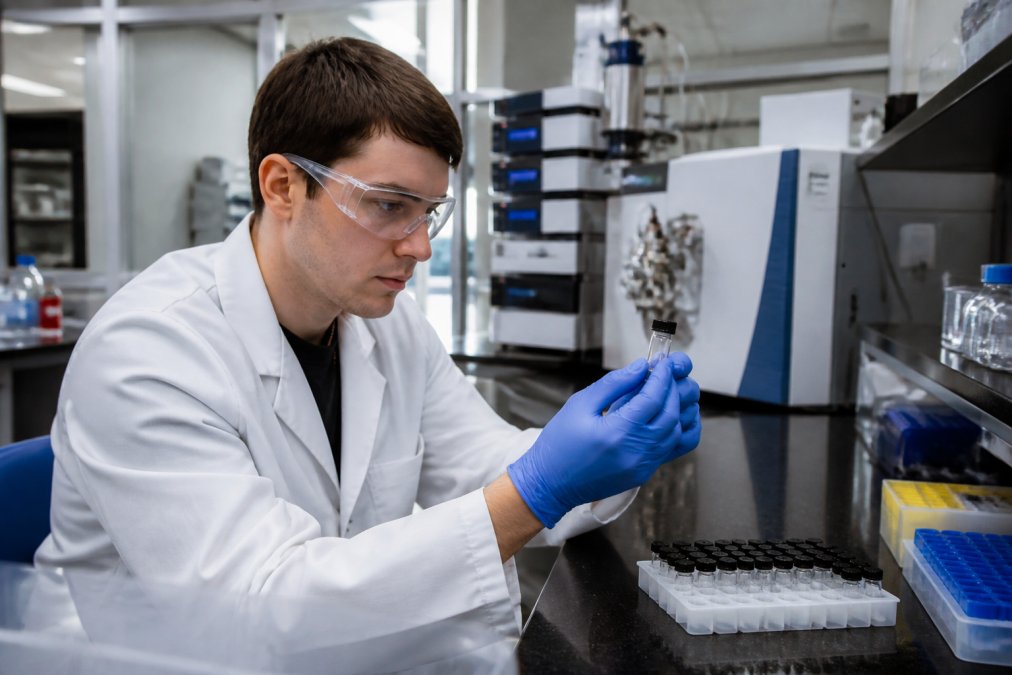
The most rigorous suppliers use accredited analytical laboratories to run high-performance liquid chromatography (HPLC) and mass spectrometry analysis on every batch before it ships. These aren't optional tests. They're the standard that separates research-grade peptides from everything else.
HPLC and Mass Spectrometry Analysis Standards
High-performance liquid chromatography separates peptide components by size and polarity, revealing impurities that initial experiments will never catch. Mass spectrometry analysis confirms molecular weight and identifies structural anomalies. Together, they're the gold standard for peptide characterization.
A credible supplier documents both tests on every batch. The HPLC chromatogram shows a single dominant peak for your peptide, with impurities clearly visible and quantified. Mass spectrometry confirms the molecular weight matches your specification exactly. When you request a certificate of analysis, check whether they include actual chromatogram images and mass spectrometry data, not just summary numbers.
Bacterial Endotoxin and Impurity Profiling
Bacterial endotoxins are lipopolysaccharides that trigger immune responses in cell-based assays. Reputable research peptide suppliers test for endotoxins using the LAL (Limulus Amebocyte Lysate) assay, which detects endotoxins at concentrations as low as 0.1 EU/mL (the FDA).
Impurity profiling identifies what the impurities actually are: residual synthesis reagents, incomplete sequences, or degradation products. A peptide that's 99% pure could be contaminated with trifluoroacetic acid or truncated sequences. A thorough impurity profile tells you exactly what you're getting.
Blue Wave Compounds includes endotoxin testing and detailed impurity profiling on every batch.
How to Read a Peptide Certificate of Analysis
A certificate of analysis is your legal and scientific guarantee that the peptide you received matches what you ordered. Many researchers glance at the purity percentage and assume everything else is fine. That's a mistake.
A complete certificate of analysis includes: batch number and synthesis date, sequence and molecular weight, purity percentage and analytical method, impurity profile, endotoxin testing results, storage recommendations, and the signature of the testing laboratory. If any of these are missing, the certificate is incomplete.
Interpreting Purity Percentages and Molecular Weight Verification
Purity percentage tells you what fraction of your sample is the peptide you ordered versus everything else. For most research applications, 99% is the minimum acceptable standard. Anything below 95% introduces too much noise.
Molecular weight verification confirms that the peptide sequence is correct. The mass spectrometry data should show a molecular ion peak that matches your theoretical molecular weight within 0.1 Da (Daltons) (peer-reviewed research). If the observed mass doesn't match theory, the peptide isn't what you ordered, regardless of what the purity number says.
Understanding Batch Consistency Metrics
Batch-to-batch consistency is where many suppliers fail. They'll deliver one perfect batch, then the next batch is 97% pure instead of 99%. For long-term research projects, this variation is devastating.
Reliable suppliers track and publish batch consistency metrics showing the range of purity values across their last 10 or 20 batches of the same peptide. A supplier with tight consistency might show purity between 99.0% and 99.5%. Request batch consistency data before committing to a supplier. If they can't provide it, they're not tracking it.
Peptide Stability and Storage Best Practices
Peptides degrade. A peptide stored at room temperature in humid conditions might lose 10% of its potency in weeks. The same peptide stored frozen and desiccated might remain stable for years. Stability depends on the peptide's amino acid composition, the storage environment, and whether the supplier took steps to stabilize it during synthesis and shipping.
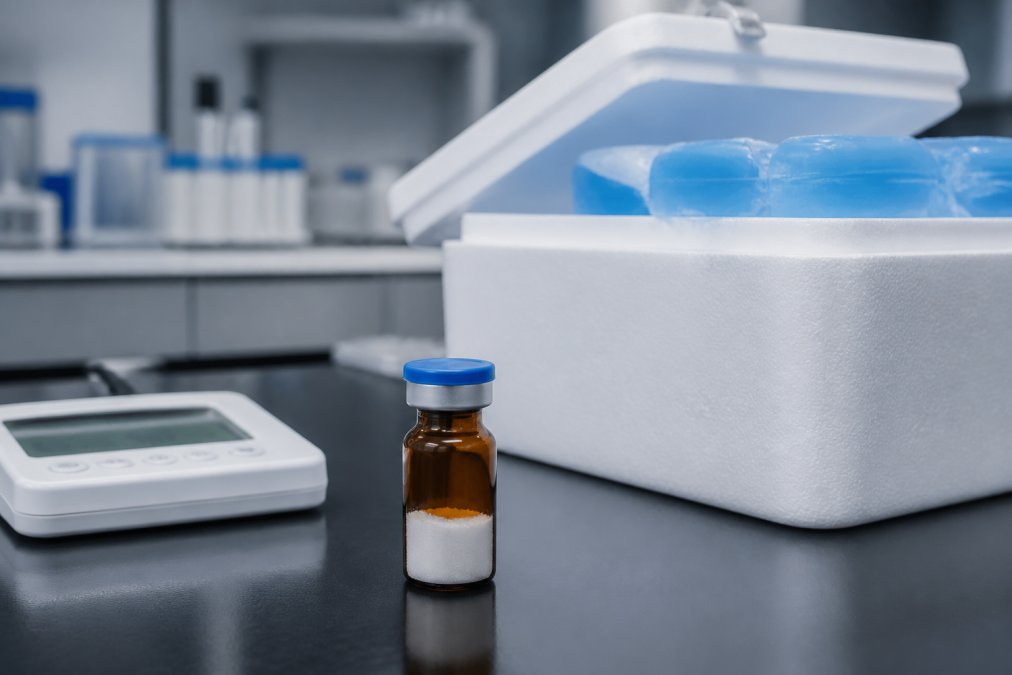
Lyophilization (freeze-drying) is the gold standard for peptide stability. A lyophilized peptide is dried under vacuum after synthesis, removing water that would otherwise trigger degradation. When you receive a lyophilized peptide, it's a powder, stable, and ready to reconstitute when you need it.
Lyophilized Powder Handling and Cold Chain Shipping
When you open a vial of lyophilized peptide, you'll see a powder, usually white or off-white. This is normal and your peptide is ready to use.
Lyophilized peptides should be stored at -20°C or colder. Room temperature storage will degrade them within weeks. Many researchers make the mistake of storing lyophilized peptides in a standard refrigerator at 4°C. Use a freezer, not a refrigerator, to avoid repeated freeze-thaw cycles that accelerate degradation.
Cold chain shipping means the peptide stays frozen from the moment it leaves the supplier's lab until it arrives at yours. Reputable suppliers use insulated packaging with dry ice or gel packs, and they ship via overnight or two-day courier services. Peptides that thaw during shipping degrade rapidly.
Blue Wave Compounds uses cold chain shipping to ensure your peptides arrive frozen and intact. We track temperature during transit and provide documentation showing that the cold chain was maintained.
Top Research Peptide Suppliers Compared
The market for research peptides includes suppliers ranging from small specialty shops to massive contract manufacturers. The best choice depends on your needs: custom synthesis, catalog stock, scale, turnaround time, and budget.
Blue Wave Compounds: Third-Party Tested with Full Documentation
Blue Wave Compounds is our top recommendation for most academic and biotech research labs. Every batch is third-party lab tested by independent analytical laboratories using HPLC and mass spectrometry. You receive a complete certificate of analysis with actual chromatogram data, molecular weight verification, endotoxin testing results, and impurity profiling.
The company's commitment to stability and documentation means your peptides arrive frozen, properly packaged, and accompanied by detailed storage instructions. For researchers who've been burned by inconsistent peptides from cheaper suppliers, Blue Wave Compounds' quality control and transparency justify the investment.
What sets Blue Wave Compounds apart is the focus on reproducibility. The company tracks batch-to-batch consistency and publishes these metrics so you know exactly what to expect. For long-term research projects where consistency matters, this is invaluable.
Custom Synthesis Services for Specialized Applications
For peptides not available in catalog stock, custom synthesis is necessary. AmbioPharm offers custom peptide synthesis for research, preclinical, and cGMP applications, handling complex modifications and scale from grams to multi-kilogram quantities.
GenScript uses microwave-assisted synthesis platforms for fast turnaround. This speed comes with a tradeoff: complex modifications and very long sequences take longer. GenScript excels at straightforward, high-volume custom synthesis where speed matters.
AnaSpec specializes in highly complex peptides, cyclic designs, disulfide-bridged structures, fluorescently labeled variants, and lipopeptides. If your research requires sophisticated peptide engineering, AnaSpec's expertise justifies the longer turnaround.
CPC Scientific and Thermo Fisher Scientific both offer comprehensive custom synthesis with extensive modification options and quality control. Both have FDA-inspected facilities, important if your research will support regulatory submissions.
All custom synthesis suppliers quote on request. Budget 3-4 weeks for turnaround on standard custom orders, longer for complex designs.
Established Suppliers: Scale, Specialization, and Turnaround
Red Rock Peptides provides catalog research peptides with emphasis on consistent sourcing and clear documentation. For researchers who need catalog stock rather than custom synthesis, Red Rock Peptides is a solid alternative to larger manufacturers.
CSBio manufactures automated peptide synthesizers, equipment that labs use to synthesize peptides in-house. For most academic labs, outsourcing to a specialized supplier is more practical.
| Supplier | Best For | Key Strength | Turnaround |
|---|---|---|---|
| Blue Wave Compounds | Most research labs | Third-party testing, batch consistency | Stock available |
| AmbioPharm | cGMP and clinical development | Regulated manufacturing experience | 3-4 weeks |
| GenScript | Speed-critical projects | Microwave-assisted synthesis | 5+ days |
| AnaSpec | Complex peptide designs | Cyclic, modified, fluorescent peptides | 4+ weeks |
| CPC Scientific | Regulated submissions | FDA-inspected facility | 3-4 weeks |
| Red Rock Peptides | Budget-conscious catalog needs | Reasonable pricing | Stock available |
Supply Chain Transparency and Regulatory Compliance
Institutional procurement processes require vendors to meet specific compliance and regulatory standards. Reputable research peptide suppliers maintain ISO 9001 certification, which documents quality management systems. Some maintain ISO 13485 certification for medical device manufacturing.
For peptides that will eventually be used in clinical research or regulatory submissions, the supplier must have documented quality control procedures and traceability. This means every batch can be traced back to raw materials, synthesis logs, and analytical testing.
Blue Wave Compounds provides complete documentation and traceability for every batch, making the approval process with your institutional procurement office straightforward.
Choosing the Right Supplier for Your Research Needs
The decision comes down to four factors: quality control documentation, batch consistency, turnaround time, and cost.
If you're running experiments where reproducibility is critical, long-term studies, multi-site collaborations, or research that will feed into publications or regulatory submissions, quality control and batch consistency matter most. Blue Wave Compounds' third-party testing and consistency metrics are worth the investment.
If you need custom synthesis for a specialized peptide, evaluate suppliers based on their experience with your specific modification or sequence. AnaSpec excels at complex designs. GenScript excels at speed. AmbioPharm and CPC Scientific excel at regulated manufacturing.
If you're on a tight budget and can tolerate slightly longer turnaround, catalog suppliers like Red Rock Peptides offer reasonable pricing without sacrificing quality. Just verify that they provide complete certificates of analysis and batch consistency data.
Before you commit to a supplier, request samples of their certificates of analysis. Look for actual chromatogram data, molecular weight verification, endotoxin testing, and impurity profiling. If a supplier can't provide these details, their quality control isn't rigorous enough for serious research.
Choosing a research peptide supplier is an investment in your experimental integrity. The right supplier, one that prioritizes third-party testing, batch consistency, and transparent documentation, reduces experimental noise and increases your confidence in results. Blue Wave Compounds' commitment to quality control and stability makes it the logical choice for labs that demand reproducibility. Shop all peptides and request a certificate of analysis for any peptide you're considering. Your experiments depend on it.
Frequently Asked Questions
Q: Why is a Certificate of Analysis (CoA) essential when sourcing research peptides?
A: A Certificate of Analysis is your proof of quality. It documents the purity percentage, molecular weight verification, and analytical test results from third-party labs using HPLC and mass spectrometry. Without a CoA, you cannot verify that the peptide meets your specifications or trust batch consistency. Research institutions and biotech companies require CoAs for regulatory compliance, experimental reproducibility, and institutional procurement approval. Reputable research peptide suppliers provide detailed CoAs with every batch.
Q: What criteria define high purity in research peptides?
A: High purity in research peptides is typically defined as ≥99% purity, verified by HPLC analysis. This means that 99% or more of the peptide is the intended sequence, with the remaining 1% being minor impurities, synthesis byproducts, or trifluoroacetic acid residues. Purity levels are measured by comparing the target peptide peak to all other peaks in the chromatogram. For critical applications like drug discovery or epitope mapping, even higher purity or custom specifications may be required. Always request the analytical method used to confirm purity claims.
Q: How do third-party lab tests verify peptide quality?
A: Third-party labs use standardized analytical methods: high-performance liquid chromatography (HPLC) to measure purity and separate impurities, and mass spectrometry to confirm molecular weight and sequence. Labs also test for bacterial endotoxins, solubility, and stability under standard conditions. The results are compiled into a Certificate of Analysis that you receive with your order. This independent verification removes bias and provides scientific validation that your research materials meet stated specifications.
Q: What should I look for in a research peptide supplier if my institution requires regulatory compliance?
A: Verify that the supplier maintains ISO 9001 certification, provides comprehensive technical documentation, and delivers Certificates of Analysis from accredited third-party labs. Confirm they can supply research-grade (not pharmaceutical-grade unless required) peptides with documented purity, molecular weight verification, and impurity profiles. Ask about their cold chain shipping procedures, storage conditions, and batch consistency metrics. Government-funded research organizations often require suppliers to demonstrate supply chain transparency and the ability to provide institutional accounts with documented ordering and compliance records.
This article was written using GrandRanker