 how-to
How to Choose Accredited Peptide Labs: 2026 Guide
Table of Contents
- What 'Accredited' Actually Means for a Peptide Lab
- Understanding Peptide Certificate of Analysis Documents
- Third-Party Peptide Testing Standards to Demand
- How to Verify Peptide Purity Before You Order
- Step-by-Step: Auditing a Peptide Lab Before Purchase
- Red Flags and Common Mistakes in Lab Vetting
- Cold Chain, Batch Consistency, and Stability Protocols
- Conclusion
- Frequently Asked Questions
Last Updated: September 16, 2026
What 'Accredited' Actually Means for a Peptide Lab
Accredited peptide labs are facilities whose testing and quality processes have been independently evaluated against a recognized standard by an outside body. The term gets thrown around loosely, and most buyers never verify it.
Accreditation Bodies vs. Self-Declared Quality Claims
The difference between a real accreditation and a marketing claim is who's doing the checking. A genuine accreditation comes from an independent body that audits the lab against a published standard, such as ISO/IEC 17025 general requirements for testing laboratories or a national equivalent. Self-declared quality claims come from the vendor itself, with no outside verification at all.
How to Verify the Accreditation Body Itself
Telling you to "check for ISO/IEC 17025 accreditation" is incomplete advice. Accreditation is only as trustworthy as the body that issued it, and not every organization handing out certificates is recognized to do so.
Here's the verification chain you should follow:
- Get the accreditation certificate number from the lab named on your COA. It should appear on the certificate itself, not just in a marketing email.
- Identify the issuing accreditation body. Common recognized bodies in the testing space include A2LA (American Association for Laboratory Accreditation) and PJLA (Perry Johnson Laboratory Accreditation), among others. The specific body matters less than whether it is recognized by a peer-review organization.
- Confirm the body is recognized. In the United States, look for signatory status with ILAC (International Laboratory Accreditation Cooperation) or ANAB (ANSI National Accreditation Board). A body that is not a signatory to a mutual recognition arrangement may still issue certificates, but those certificates carry less weight internationally.
- Search the body's own directory. Every legitimate accreditation body publishes a searchable list of accredited labs. Enter the lab's name or certificate number. If it doesn't appear, or the scope doesn't cover the test you're relying on, the accreditation is either expired or never existed.
- Check the scope of accreditation. This is the step almost everyone skips. A lab can be accredited for one method (say, HPLC) but not another (say, mass spectrometry or endotoxin testing). The certificate lists the specific methods the lab is accredited to perform. If your COA reports a mass spec result but the lab's scope only covers HPLC, that result is outside the accreditation.
Common Substitutes for Real Accreditation
Watch for these common substitutes:
- "GMP compliant" with no facility name or registration
- "ISO certified" with no standard number (9001 and 17025 are not the same thing)
- A COA with a lab name but no accreditation identifier
- Test results dated years ago, presented as current
- An accreditation certificate that lists a scope narrower than the tests on your COA
Blue Wave Compounds publishes documentation with each batch specifically so this check takes minutes instead of days.
Understanding Peptide Certificate of Analysis Documents
A Certificate of Analysis ties a specific batch of peptide to specific test results. It's the most useful document in this process, and the one most often faked or recycled. It should describe one batch, not a product line. If the same document shows up across multiple lot numbers, or the lot number doesn't match your vial, stop there.
Fields a Real COA Must Contain
A COA worth trusting carries the following, at minimum:
- Batch or lot number matching the label on your vial
- Peptide name and sequence as you ordered it
- Molecular weight, which should match the theoretical value for that sequence
- Purity percentage, with the method used to determine it
- Test method, typically high-performance liquid chromatography
- Identity confirmation method, usually mass spectrometry
- Testing date and the name of the testing laboratory
- Authorized signature or verifiable report reference
Missing molecular weight is a quiet red flag: it's cheap to measure and hard to fake, so a COA that omits it was likely never run through a real analytical workflow.
Third-Party Peptide Testing Standards to Demand
Third-party testing means the analysis was performed by a lab with no financial stake in the result. In-house testing is a supplier grading its own homework. Demand an independent lab, named on the report, using validated methods, with results you can match to your batch.
HPLC, Mass Spectrometry, and Endotoxin Screening
High-performance liquid chromatography separates a sample's components and reports how much is your target peptide versus everything else. The output is a chromatogram: the main peak is your compound, smaller peaks are impurities.
| Test | What It Confirms | What It Misses |
|---|---|---|
| HPLC | Purity percentage, impurity profile | Identity of the main peak |
| Mass spectrometry | Molecular weight, identity | Purity level |
| Endotoxin screening | Bacterial contamination | Chemical purity |
| Stability testing | Shelf life under storage conditions | Anything about the current batch |
How to Verify Peptide Purity Before You Order
Verifying peptide purity before purchase comes down to three checks: match the lot number, confirm the lab is one of the accredited peptide labs, and read the chromatogram. If any one fails, walk away.
Step-by-Step: Auditing a Peptide Lab Before Purchase
Auditing a peptide lab is a documentation exercise, not a chemistry one. You're checking whether the paper trail is complete and consistent, no facility visit required.
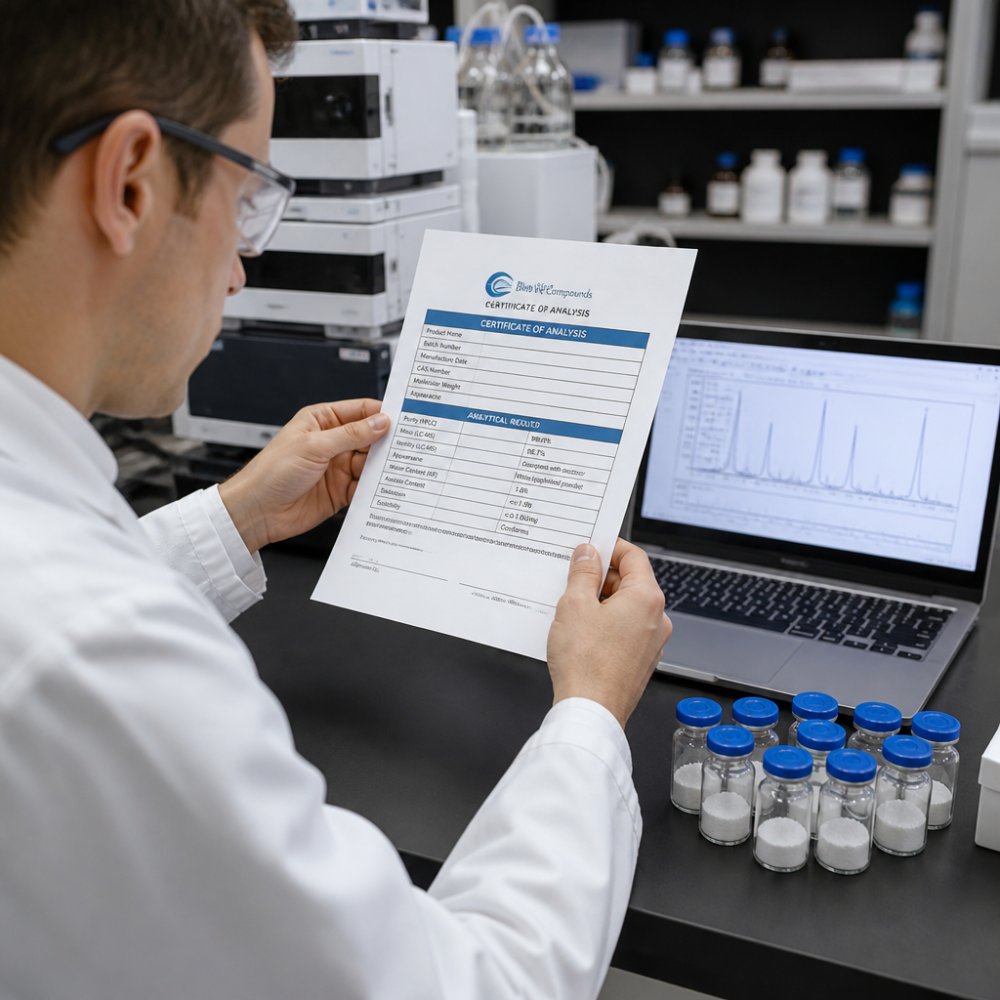
Work through these steps in order:
- Request the COA before ordering. A supplier that won't share it pre-purchase is telling you something.
- Match the lot number on the COA to the lot number on the product listing or vial.
- Verify the testing lab exists and holds current accreditation. Search the issuing body's directory directly.
- Check the test methods. Confirm both HPLC and mass spectrometry results are present.
- Read the chromatogram, not just the purity percentage. Look for a single well-resolved main peak.
- Confirm the testing date is recent relative to the batch.
- Ask about storage and shipping before you commit, and get the answer in writing.
Red Flags and Common Mistakes in Lab Vetting
The biggest mistake in lab vetting is treating a COA as a formality. Buyers skim the purity number, see 99%, and move on, but that number is the least informative part of the report.
Red flags worth taking seriously:
- COAs that look identical across different peptides, with only the name swapped
- Purity claims with no test method listed
- No lot number, or a lot number that doesn't match the product
- A testing lab with no verifiable accreditation or no online presence at all
- Pressure to order quickly, or refusal to share documentation before payment
- Prices that sit far below everything else in the category, which usually means testing was skipped
Cold Chain, Batch Consistency, and Stability Protocols
Cold chain and stability protocols determine whether the compound that tested well at the lab is still that compound at your bench. Lyophilized peptides are generally more stable than reconstituted ones, but shipping is where control is easiest to lose.
One-Time Purity Testing vs. Long-Term Stability Testing
This distinction separates a serious supplier from a transactional one.
The practical difference for a buyer:
| One-Time Purity Test | Stability Study | |
|---|---|---|
| What it measures | Purity at a single point in time | Purity change over time under defined conditions |
| Duration | Days | Weeks to months |
| What it tells you | The batch was pure when tested | How long the batch stays pure, and under what conditions |
| What it misses | Degradation after the test date | Nothing about the specific batch you receive |
What to Ask About Stability Protocols
When you ask about stability, you're looking for specific answers, not reassurances. Ask:
- Do you have stability data for this compound? Ask to see the degradation curve, not a summary statement.
- What conditions were tested? A study bracketing your shipment's temperature range beats one at a single temperature.
- How often are samples pulled? Monthly timepoints are more informative than a single endpoint.
- Is the data batch-specific or compound-specific? Batch-level data is what applies to your order.
- What is the recommended storage temperature, and what happens if that's exceeded in transit? The answer should be peptide-specific, not a generic "keep it cold."
Cold Chain Logistics: What to Verify Before You Order
Cold chain is the physical side of stability. A compound stable at -20°C is not necessarily stable at 30°C, and shipping is where temperature control is most easily lost.
Before you order, confirm:
- Shipping method and temperature control. Dry ice, gel packs, or nothing? The answer should match the compound's storage requirements.
- Transit time. A two-day shipment with gel packs is a different risk profile than a five-day one.
- Packaging integrity. Ask how the supplier handles temperature excursions in transit. A written protocol means they've thought about it.
- Receiving instructions. What should you check on arrival, is the cold pack still cold, is the vial intact?
Batch Consistency Across Orders
If your research spans multiple orders, batch consistency matters as much as purity. Two batches of the same peptide can differ in impurity profile, residual solvents, or counterion content, showing up as variability in your results.
Ask the supplier:
- Do you retest every lot, or only some?
- Do you hold reference samples from each batch?
- What is your specification for batch release, and what happens if a batch fails?
- Can you provide COAs for multiple lots so I can compare?
Conclusion
Vetting a peptide supplier is unglamorous work: matching lot numbers, checking accreditation directories, reading chromatograms. It's also the difference between research that reproduces and research that mysteriously doesn't. A supplier's willingness to hand over documentation before you pay tells you most of what you need to know.
Frequently Asked Questions
What does it mean for a peptide lab to be accredited?
Accreditation means an independent body has audited the lab's methods, equipment, and documentation against a recognized standard such as ISO 9001 or ISO/IEC 17025. It is not the same as a vendor claiming 'lab tested.' Ask for the accreditation certificate number, the issuing body, and the scope of testing covered. A legitimate accredited peptide lab will share these without hesitation, and you can verify the certificate directly with the accrediting organization.
How do I verify the authenticity of a Certificate of Analysis?
Cross-check three things: the batch lot number on the COA must match the vial label, the testing lab's name and accreditation number must be verifiable, and the reported methods (HPLC, mass spectrometry) must include actual data such as chromatogram peaks and molecular weight. Contact the third-party lab directly to confirm they ran the test. A COA that lists results without raw data, or that cannot be traced to a real lab, is not reliable documentation.
Why is third-party testing critical for research-grade peptides?
In-house testing lets a vendor grade its own work. Third-party peptide testing standards require an independent lab to run HPLC for purity, mass spectrometry for molecular weight confirmation, and contaminant screening for residuals. This separation removes the conflict of interest. For research use only compounds, an independent result is the only evidence that the purity percentage on the label reflects the actual batch, not a marketing claim.
What are the red flags when choosing a peptide supplier?
Watch for COAs with no batch lot number, purity claims with no chromatogram attached, refusal to name the testing lab, prices far below market without explanation, and no cold chain documentation for shipping. Also flag vendors who cannot explain batch-to-batch reproducibility or who dodge questions about storage conditions. If a supplier will not let you verify the lab report authenticity before purchase, treat that as a disqualifier rather than a minor gap.
The compounds on this page are supplied for laboratory research purposes only. Nothing here is medical advice, and none of these materials are intended for human or veterinary use. Researchers should follow their institution's safety and handling requirements.