 ultimate-guide
How to Read Peptide Lab Results: A Complete Guide
Table of Contents
- What Is a Certificate of Analysis and Why It Matters
- Key Components of a Peptide Lab Report
- Understanding HPLC Peptide Analysis Results
- How to Verify Peptide Purity From Lab Data
- Peptide Mass Spectrometry Interpretation Essentials
- Verifying the Testing Laboratory and Detecting Fraudulent Reports
- Additional Quality Metrics: Solvent Residue, Endotoxins, and Sterility
- Practical Steps to Evaluate Your Peptide Lab Results
- Frequently Asked Questions
Last Updated: September 25, 2026
What Is a Certificate of Analysis and Why It Matters
A Certificate of Analysis (COA) is an official document issued by a testing laboratory that verifies the chemical composition, purity, and quality of a peptide sample. It serves as third-party proof that a compound meets specified standards and contains what the supplier claims. For researchers working with research-grade peptides, the COA is non-negotiable, it's your guarantee that experimental results depend on verified materials, not assumptions.
Understanding how to read peptide lab results is essential for experimental reproducibility. When results are questioned, findings need replication, or regulatory documentation is required, the lab report separates credible research from guesswork.
At BlueWaveCompound, every batch is accompanied by a third-party lab report. Researchers who understand their COA catch quality variations early, avoid wasted experiments, and maintain consistency across research cycles.
Key Components of a Peptide Lab Report
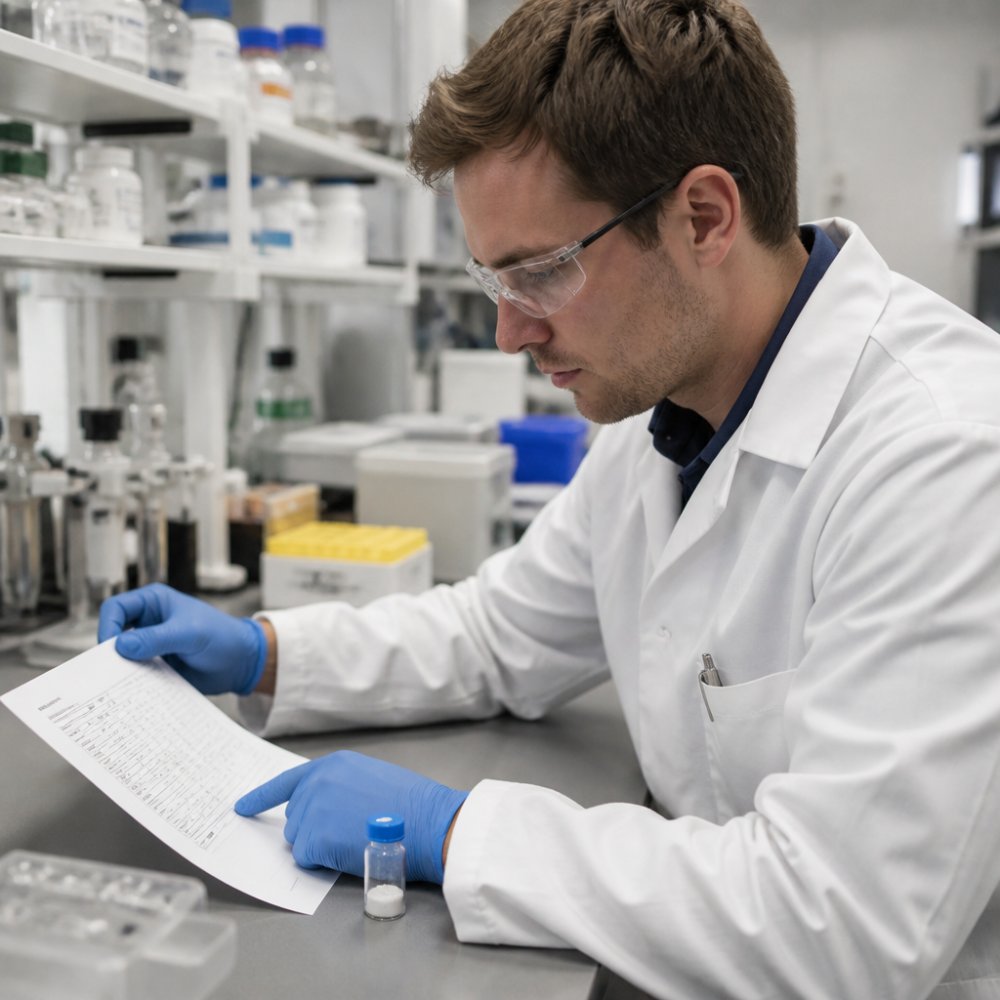
A typical peptide lab report contains several critical sections. Understanding each one transforms a confusing document into a roadmap for evaluating your compound's quality and suitability for your research.
Compound Identification and CAS Number
The first thing any lab report must clearly state is the compound name and its CAS number (Chemical Abstracts Service number). The CAS number is a unique identifier that ensures you're examining data for the exact compound ordered, not a similar one.
A proper lab report displays the compound name in full chemical nomenclature with its CAS registry number. If your report lists only a trade name without the CAS number, verify it against your purchase order before proceeding.
Batch and Lot Numbers
Every peptide batch receives a unique batch number and lot number for traceability through manufacturing and testing. If results are unexpected, the batch number lets you check whether other researchers using the same batch reported similar issues.
Batch numbers are essential for regulatory compliance and audit traceability. A COA without clear batch identification prevents consistency verification across orders.
Molecular Weight Verification
The molecular weight on your lab report should match the theoretical value calculated from amino acid composition and verified through mass spectrometry. Significant deviations suggest unexpected modifications or degradation.
Cross-check the molecular weight against your theoretical calculation. Small discrepancies (1-2 Daltons) are normal; larger deviations warrant follow-up with the testing laboratory.
Understanding HPLC Peptide Analysis Results
High-Performance Liquid Chromatography (HPLC) is the gold standard for assessing peptide purity. This technique separates components by chemical properties, producing a chromatogram that reveals compound quality.
Reading the Chromatogram
The chromatogram plots time (x-axis) against signal intensity (y-axis). The largest peak is your target peptide; smaller peaks represent impurities or degradation products.
A noisy baseline suggests instrument problems or many minor impurities. A clean baseline with sharp peaks indicates high-quality preparation. Look for a dominant peak that rises clearly above baseline on both sides.
Interpreting Retention Time and Peak Integration
The retention time is when your peptide elutes from the column. This value is reproducible under consistent HPLC conditions and should be nearly identical across runs.
Peak integration is the area under the peak as a percentage of total peak area, directly correlating to purity. If your target peptide integrates to 99.2%, your peptide is 99.2% pure by HPLC.
How to Verify Peptide Purity From Lab Data
Purity is the key metric researchers focus on, but it has nuances. Understanding purity requires distinguishing between what the percentage means and what it tells you about usability.
Purity Percentage vs. Peptide Content
The purity percentage reflects the proportion of target peptide measured by HPLC. A 99% rating means 99% of the sample is the intended compound.
Peptide content refers to the actual mass of active peptide per unit weight of lyophilized powder, accounting for residual solvents, water, or counterions. A sample might be 99% pure by HPLC but only 95% peptide content by mass.
For research applications, both metrics matter.
Identifying Impurities and the Impurity Profile
A complete lab report includes an impurity profile detailing non-target peaks. Common impurities include truncated sequences, oxidized variants, dimers/aggregates, and residual solvents.
Peptide Mass Spectrometry Interpretation Essentials
Mass Spectrometry (MS) provides precise molecular weight confirmation, complementing HPLC purity data. Together, these techniques confirm both identity and purity.
What Mass Spectrometry Results Tell You
Mass spectrometry ionizes peptide molecules and measures mass-to-charge ratio. The spectrum shows peaks for different ionization states (e.g., m/z 500 for doubly charged, m/z 333 for triply charged).
Comparing HPLC and Mass Spectrometry Data
HPLC answers "How pure is this sample?" while mass spectrometry answers "Is this the right molecule?" A sample can be 99% pure by HPLC but contain the wrong peptide if the mass doesn't match.
Verifying the Testing Laboratory and Detecting Fraudulent Reports
Not all lab reports are created equal. Some suppliers issue in-house reports; others use third-party laboratories. Third-party testing provides independent verification and is always preferable for research applications.
Red Flags in Lab Reports
Several warning signs suggest a lab report may be inaccurate or fabricated:
- Missing or vague laboratory name and accreditation information
- No specific analytical methods listed (HPLC conditions, MS parameters)
- Suspiciously round numbers (exactly 99.0%, 100.0% purity with no decimal variation)
- No batch or lot number, or a batch number that doesn't match your purchase order
- Chromatogram images that appear identical across multiple different peptides
- Missing impurity profile or unexplained peaks in the chromatogram
- No signature or authorization from a named analyst or laboratory director
- Dates that don't align with your order timeline
Third-Party Testing Verification
Before ordering peptides, verify that the supplier uses an accredited third-party laboratory. Check whether the lab holds ISO/IEC 17025 accreditation, which certifies competence in testing and calibration. Many academic institutions require this accreditation for purchased compounds.
Additional Quality Metrics: Solvent Residue, Endotoxins, and Sterility
Beyond purity and molecular weight, premium peptide suppliers test for additional quality parameters that affect usability in sensitive applications.
Practical Steps to Evaluate Your Peptide Lab Results
Now that you understand the components of a lab report, here's a systematic approach to evaluating your peptide lab results before using them in research.
Step 1: Verify Compound Identity and Batch Information
Start with the basics. Confirm that the compound name and CAS number on the lab report match your purchase order exactly. Check the batch number against your invoice. Verify the molecular weight matches your theoretical calculation.
Step 2: Check Purity and Impurity Data
Review the HPLC chromatogram and purity percentage. For most research applications, purity above 95% is acceptable; above 98% is excellent. Look at the impurity profile and understand what the minor peaks represent.
Step 3: Review Analytical Chemistry Methods
Check that the lab report specifies the HPLC method used (column type, mobile phase, detection wavelength, flow rate). Verify that mass spectrometry parameters are listed. This information confirms that the analysis was performed using validated, standard methods, not shortcuts or approximations.
Step 4: Confirm Third-Party Testing and Lab Credentials
Identify the testing laboratory and verify its accreditation. Look for ISO/IEC 17025 certification or equivalent. If possible, contact the lab directly to confirm they performed the analysis. Document the lab's contact information for future reference.
Frequently Asked Questions
What is an acceptable purity percentage for research-grade peptides?
Research-grade peptides typically require a purity of 95% or higher for most applications, with many advanced studies demanding 98-99% purity. The acceptable threshold depends on your experimental design and sensitivity requirements. BlueWaveCompound provides peptides at ≥99% purity, supported by third-party testing and a Certificate of Analysis. Always verify the purity percentage listed in your lab report matches your research standards before use.
Why is a third-party Certificate of Analysis important for peptide research?
A third-party Certificate of Analysis provides independent verification of your peptide's identity, purity, and quality metrics. This document proves your compound meets stated specifications and was tested by an accredited laboratory using validated analytical methods like HPLC and Mass Spectrometry. For institutional research, regulatory compliance, and reproducibility, a COA is essential. It eliminates bias and gives you confidence that your experimental results reflect the peptide's true properties, not supplier claims alone.
What is the difference between HPLC and Mass Spectrometry in peptide testing?
HPLC (High-Performance Liquid Chromatography) separates peptide compounds by chemical properties and measures purity by peak area percentage. It shows you the impurity profile and relative quantities. Mass Spectrometry measures the exact molecular weight of your peptide, confirming structural identity at the atomic level. Together, they provide complementary data: HPLC tells you how pure your sample is, while Mass Spectrometry confirms you have the correct compound. Both are typically included in a comprehensive peptide lab report.
How do I identify impurities on a peptide chromatogram?
On an HPLC chromatogram, the main peptide appears as the largest peak (the primary compound). Impurities show as smaller peaks before, after, or overlapping with the main peak. The lab report lists the retention time and integration percentage for each peak. Peaks representing less than 1-2% of total area are usually considered minor impurities. The impurity profile section of your lab report identifies these peaks by type (degradation products, truncated peptides, or synthetic byproducts) and quantifies them. Review this section to ensure impurity levels are acceptable for your research.