 how-to
How to Store Lyophilized Peptides: 2026 Lab Guide
Table of Contents
- What You'll Need Before You Start
- Step 1: Verify Your Peptide Storage Temperature
- Step 2: Manage Peptide Shelf Life and Expiration Dates
- Step 3: Prevent Degradation from Light, Moisture, and Oxygen
- Step 4: Understand Reconstitution of Lyophilized Peptides
- Step 5: Avoid Freeze-Thaw Cycles and Aliquot Properly
- Common Mistakes to Avoid When You Store Lyophilized Peptides
- Frequently Asked Questions
Last Updated: September 14, 2026
What You'll Need Before You Start
Getting peptide storage right starts before the vial ever hits a shelf. When you store lyophilized peptides, they arrive as a dry powder precisely because that format is more stable than a reconstituted solution, but that stability isn't automatic. It depends on how you handle the powder from the moment it lands on your bench.
For this guide, gather a few basics before you begin:
- A calibrated freezer that holds a steady -20°C, or access to -80°C storage
- Amber or foil-wrapped vials to limit light exposure
- Fresh desiccant packets and airtight containers
- A labeled aliquot log or lab notebook
- Bacteriostatic water for later reconstitution
- Nitrile gloves and a clean, dry workspace
At BlueWaveCompound, every batch is third-party lab tested and accompanied by a Certificate of Analysis, so you can log purity and identity data alongside your storage conditions from day one. That record matters later when you're troubleshooting an experiment.
Step 1: Verify Your Peptide Storage Temperature
The correct storage temperature for lyophilized peptides is -20°C for most routine work, with -80°C reserved for compounds you plan to keep for years or that are known to degrade quickly (pubmed.ncbi.nlm.nih.gov). Temperature is the single biggest lever you control.
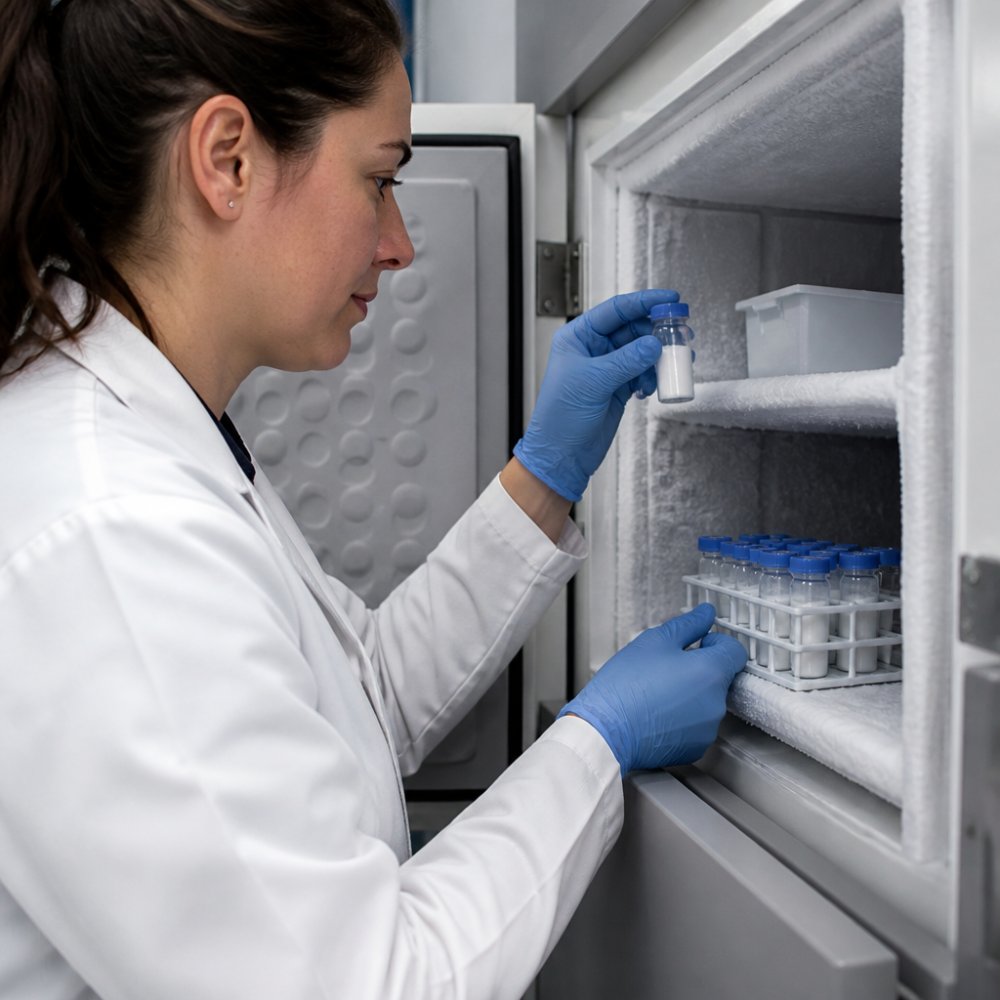
A common mistake is assuming any freezer will do. Frost-free units cycle through warming periods to prevent ice buildup, and those swings put thermal stress on your peptides (pubmed.ncbi.nlm.nih.gov). Manual-defrost freezers hold a steadier temperature and are worth the extra effort.
How to Verify Your Freezer Is Actually Holding Temperature
The setpoint on a freezer dial is not the same as the temperature inside the compartment. Most consumer and many lab freezers fluctuate by several degrees across a day, and the door area can run warmer than the back. Before you trust a freezer with a peptide batch, verify it.
A practical approach:
- Place a calibrated thermometer or a data logger in the center of the freezer, not against a wall or near the door.
- Log the temperature for at least 48 hours, including a normal door-opening cycle.
- Compare the logged range against your target. If a -20°C freezer swings between -14°C and -22°C, that is not a stable -20°C environment.
- Repeat the check seasonally. A unit that held steady in winter may struggle in a warm room during summer.
For -80°C storage, the same logic applies, but the stakes are higher because these units are expensive to run and often shared. Confirm that the unit is not in a defrost cycle when you load it, and avoid filling it so full that air cannot circulate.
Short-Term vs. Long-Term Temperature Ranges
Short-term storage, meaning weeks to a few months, tolerates -20°C well for most lyophilized peptides. Long-term preservation, measured in years, generally calls for -80°C, especially for peptides with known pH sensitivity or those prone to oxidation. If you're unsure which category your compound falls into, check the manufacturer's documentation or the Certificate of Analysis before deciding.
A simple rule that experienced labs use: if the peptide is part of an ongoing project, keep it at -80°C and pull working aliquots to -20°C. That way the bulk material stays in the most stable condition while you avoid repeated warming of the whole batch.
Step 2: Manage Peptide Shelf Life and Expiration Dates
Peptide shelf life depends on storage conditions, not just the calendar. A vial kept at -80°C in a sealed, moisture-proof container can remain stable far longer than the same vial left at ambient temperature.
Many labs treat expiration dates as fixed, but that's not quite right. The date on the label assumes proper storage from the moment of manufacture. If your cold chain broke somewhere along the way, the real shelf life is shorter than what's printed.
Keep a simple log with these fields:
| Field | Why It Matters |
|---|---|
| Date received | Starts the storage clock |
| Storage temperature | Determines realistic shelf life |
| Vial seal status | Flags moisture exposure risk |
| Purity at receipt | Baseline for later comparison |
| Reconstitution date | Marks the shift to short-term storage |
Review this log before every experiment. It takes two minutes and saves you from running a study on degraded material.
Step 3: Prevent Degradation from Light, Moisture, and Oxygen
Light, moisture, and oxygen are the three quiet killers of peptide stability. Lyophilized peptides are hygroscopic, meaning they pull moisture from the air, and that absorbed water accelerates degradation even before you reconstitute anything (pubmed.ncbi.nlm.nih.gov).
Store vials in amber glass or wrap them in foil. Keep them inside a sealed container with desiccant. If you're working with oxidation-sensitive sequences, an inert atmosphere such as argon or nitrogen displaces oxygen and slows breakdown.
Using Desiccants and Inert Atmosphere
Desiccant packets absorb ambient moisture inside your storage container, but they have limits. Replace them on a schedule rather than waiting for visible saturation. For an inert atmosphere, purge the headspace of your vial or container with argon before sealing. This step adds maybe a minute to your workflow and meaningfully extends stability for oxidation-prone compounds.
Step 4: Understand Reconstitution of Lyophilized Peptides
Reconstitution of lyophilized peptides is the process of dissolving the dry powder in a suitable solvent, usually bacteriostatic water, to create a working solution. This step changes everything about how you store the material afterward.
Add solvent slowly down the vial wall rather than directly onto the powder. Rapid addition can cause foaming, and foaming stresses the peptide. Swirl gently; don't shake. Once dissolved, check solubility and clarity before proceeding.
How Storage Changes the Moment You Add Solvent
This is the part most guides skip. A lyophilized peptide is stable because water has been removed. The moment you add bacteriostatic water or saline, you reintroduce the conditions that drive degradation: hydrolysis, oxidation, and microbial growth. The dry powder might tolerate months at -20°C; the same peptide in solution may lose measurable potency in weeks.
The practical consequences:
- Hydrolysis accelerates. Water breaks peptide bonds over time, and the rate rises with temperature. A solution left at room temperature degrades far faster than one kept at 2-8°C.
- Microbial risk appears. Bacteriostatic water contains benzyl alcohol, which inhibits bacterial growth and makes multi-use vials practical. Plain sterile water offers no such protection, so a vial reconstituted with it should be treated as single-use.
- Aggregation becomes possible. Once dissolved, peptides can clump or precipitate, especially if the pH or ionic strength is off. Cloudiness after reconstitution is a warning sign, not a cosmetic issue.
- Freeze-thaw damage compounds. A reconstituted solution that is frozen and thawed repeatedly will lose potency faster than the dry powder ever would.
Storage After Reconstituted Peptides
Reconstituted peptides are far less stable than the dry powder. Most should be stored at 2-8°C and used within a defined window, or frozen in aliquots if the protocol allows. Bacteriostatic water helps limit microbial contamination in solution, which is one reason it's preferred over plain sterile water for multi-use vials. The transition from dry to dissolved is where most labs lose material, so plan your reconstitution around how quickly you'll use it.
A workable default for many research peptides:
- Keep the working solution at 2-8°C if you will use it within days to a couple of weeks.
- If you need it longer, aliquot into single-use volumes and freeze at -20°C, accepting that each thaw costs some potency.
- Never refreeze a thawed aliquot. Use it or discard it.
- Label every solution with the reconstitution date and solvent used, because shelf life depends on both.
If you are sourcing material for a project where storage conditions will be documented, starting with a supplier that provides a Certificate of Analysis and third-party testing gives you a purity baseline to compare against later. Blue Wave Compounds ships every batch with that documentation, which makes it easier to track stability from the dry powder through reconstitution. You can review current offerings at bluewavecompounds.com.
Step 5: Avoid Freeze-Thaw Cycles and Aliquot Properly
Every freeze-thaw cycle costs you potency. Ice crystal formation and repeated temperature swings cause aggregation and degradation, and the damage compounds over time.
Aliquoting solves this. Divide your reconstituted peptide into single-use volumes immediately after preparation, then freeze each aliquot separately. Pull only what you need for a given day.
A few practical rules that experienced labs follow:
- Aliquot in a single sitting, not across multiple days
- Use low-binding tubes for peptides that stick to plastic
- Record the freeze date on every aliquot
- Discard any aliquot that shows cloudiness or precipitate after thawing
Common Mistakes to Avoid When You Store Lyophilized Peptides
The biggest errors are usually small ones repeated daily. Letting vials warm to room temperature and then returning them to the freezer creates condensation and thermal stress. Skipping desiccants because "the freezer is dry" ignores that frost and humidity still fluctuate.
Other frequent problems: storing peptides near the freezer door where temperature swings most, reusing desiccant well past its useful life, and failing to check for visual degradation signs like discoloration, clumping, or a change in powder texture. If a powder looks different than it did on arrival, don't assume it's fine.
For labs that need documented, research-grade material with verifiable purity data, sourcing from a supplier that provides third-party testing and a Certificate of Analysis removes a lot of guesswork. BlueWaveCompound ships every batch with that documentation, which makes it easier to establish a purity baseline and track stability over time. You can review current offerings at bluewavecompounds.com.
Storage failures rarely announce themselves. They show up weeks later as inconsistent results, unexplained noise, or an experiment that won't replicate. Getting the fundamentals right, steady temperatures, sealed containers, desiccants, and disciplined aliquoting, protects both your material and your data. For labs that want a documented, research-grade starting point, BlueWaveCompound provides high-purity peptides with third-party lab testing, Certificates of Analysis, and stability-focused handling from batch to batch. Get started with BlueWaveCompound and build a storage protocol your results can actually rely on.
Frequently Asked Questions
Should I keep my lyophilized peptides in the fridge?
For short-term storage of a few weeks, a standard refrigerator at 2°C to 8°C works for most lyophilized peptides. For longer than a month, move them to a freezer at -20°C. For maximum stability over a year or more, -80°C is the better choice. Always keep the vial sealed and add a desiccant packet to the container. The key is consistency: pick a temperature and stick with it rather than moving vials between fridge and freezer repeatedly.
How long do lyophilized peptides last at room temperature?
Most lyophilized peptides remain stable at room temperature for only a few days to a couple of weeks, depending on the specific sequence and purity. Some short peptides may hold up longer, but heat, humidity, and light accelerate degradation. If a shipment arrives and you cannot freeze it immediately, keep the vial sealed, away from sunlight, and place it in the coldest spot available. Move it to a freezer as soon as possible to protect potency.
What happens if I forgot to put my peptides in the fridge?
A brief period at room temperature, a few hours to a day, usually does not ruin a lyophilized peptide. Inspect the powder for clumping, discoloration, or a change in texture. If it looks the same as when you received it, freeze it now and proceed. If the powder is sticky, yellowed, or has collapsed into a gel-like mass, the peptide may have absorbed moisture and degraded. Run a small pilot assay to confirm activity before committing it to a critical experiment.
How should I handle lyophilized peptides after reconstitution?
Once you reconstitute a lyophilized peptide with bacteriostatic water or your chosen buffer, stability drops sharply. Store the reconstituted solution at 2°C to 8°C and use it within days to a few weeks, depending on the peptide. For longer storage, aliquot the solution into single-use volumes and freeze at -20°C or -80°C. Never refreeze a thawed aliquot. Protect the solution from light, and check for cloudiness or particles before each use.