 how-to
How to Verify Peptide Purity: A 2026 Guide
Table of Contents
- What Peptide Purity Actually Means
- HPLC vs Mass Spectrometry for Peptides: Choosing the Right Method
- Common Peptide Synthesis Impurities to Watch For
- How to Verify Peptide Purity: Step-by-Step
- Peptide Certificate of Analysis Interpretation: What Each Field Tells You
- Home Testing vs. Professional Lab Services: What's Feasible
- Visual Identification of Degraded Peptides
- How to Verify Peptide Purity When Evaluating a New Supplier
Last Updated: August 19, 2026
What Peptide Purity Actually Means
Peptide purity is the percentage of the desired peptide compound present in a sample relative to all other substances, including synthesis by-products, truncated sequences, and degradation products. A peptide reported at 99% purity means 99% of the lyophilized powder is the target compound; the remaining 1% consists of contaminants introduced during synthesis.
This distinction matters significantly. A peptide with 85% purity carries a 15% load of unknown contaminants that can bind off-target receptors, interfere with signal transduction, or skew dose-response curves, corrupting your data without obvious warning. Reproducibility suffers and conclusions weaken.
At BlueWaveCompounds, we specify purity at ≥99% for research-grade compounds because that threshold is where experimental noise from synthesis impurities becomes negligible for most biochemical applications. Purity is typically expressed as a percentage derived from quantitative analysis of the main peak area in a chromatogram, measured at 214 nm absorbance. When backed by third-party analytical testing, this number is a documented, reproducible measurement rather than a marketing claim.
HPLC vs Mass Spectrometry for Peptides: Choosing the Right Method
The two primary analytical methods used to verify peptide purity serve complementary purposes. HPLC quantifies purity as a percentage; mass spectrometry confirms that the peptide has the correct amino acid sequence and molecular weight. Both are necessary for complete quality control.
How HPLC Measures Purity Percentage
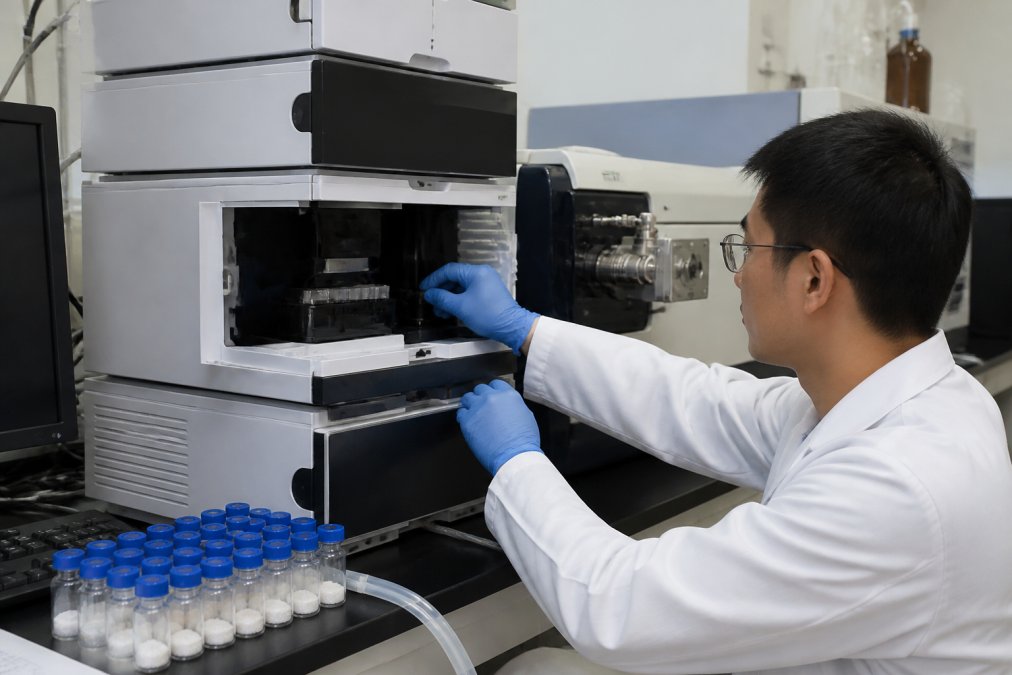
High-Performance Liquid Chromatography (HPLC) is the gold standard for quantitative purity analysis of synthesized peptides. The technique separates compounds based on their chemical interactions with a stationary phase as they are carried through a column by a mobile phase solvent. Each component elutes at a characteristic retention time and produces a peak on the chromatogram.
Purity percentage is calculated by peak integration: the area of the main peak divided by the total area of all peaks, multiplied by 100. Detection at 214 nm captures the absorbance of peptide bonds, making it the standard wavelength for this analysis. A well-synthesized peptide at high purity shows one dominant main peak with minimal adjacent peaks; multiple significant peaks indicate deletion sequences, truncated peptides, or other synthesis by-products.
Co-elution is a real risk: two compounds with similar retention times can overlap on the chromatogram, inflating the main peak area and overstating purity. Experienced analysts examine peak shape as well as peak area, a symmetrical, sharp peak is more credible than a broad or shouldered one.
How Mass Spectrometry Confirms Amino Acid Sequence
Mass spectrometry provides qualitative analysis that HPLC cannot: confirmation that the peptide has the correct molecular weight and intended amino acid sequence. The instrument ionizes the sample and measures the mass-to-charge ratio of resulting ions. Comparing the detected molecular weight against the theoretical molecular weight confirms sequence identity.
HPLC can confirm that a dominant compound is present at high concentration without confirming what that compound actually is. A peptide synthesized with an incorrect amino acid substitution could still show a clean chromatogram. Mass spectrometry catches that error. The combination of HPLC purity data and MS molecular weight verification constitutes the minimum standard for reliable peptide quality control, as documented in guidance from the US Pharmacopeia analytical standards for peptide characterization.
Common Peptide Synthesis Impurities to Watch For
Peptide synthesis is a sequential chemical process where every step introduces opportunities for incomplete reactions or side reactions. The most common impurities in solid-phase peptide synthesis include:
- Deletion sequences: Peptides missing one or more amino acids due to incomplete coupling. Often the most abundant impurity and difficult to separate from the target compound by HPLC if their physicochemical properties are similar.
- Truncated sequences: Shorter peptides resulting from premature chain termination.
- Oxidation products: Methionine and cysteine residues are susceptible to oxidation, which adds 16 mass units per oxidized site and alters biological activity.
- Deamidation products: Asparagine and glutamine residues can deamidate over time or under harsh synthesis conditions.
- Racemization: Improper coupling conditions can cause amino acid residues to lose stereochemical integrity, producing D-amino acid-containing peptides with altered or absent biological activity.
- Protecting group remnants: Incomplete removal of side-chain protecting groups leaves chemical artifacts that increase molecular weight and alter solubility.
A thorough COA from a reputable supplier documents not just the main peak area but the identity and relative percentage of significant secondary peaks.
How to Verify Peptide Purity: Step-by-Step
Knowing how to verify peptide purity systematically protects your research from contaminated or mislabeled compounds.
Step | Action | Key Output |
|---|---|---|
1 | Request analytical documentation | COA, HPLC chromatogram, MS data |
2 | Prepare sample for testing | Dissolved peptide at correct concentration |
3 | Run HPLC and record chromatogram | Purity percentage, peak profile |
4 | Confirm molecular weight via MS | Sequence verification |
5 | Cross-check results against COA | Pass/fail quality decision |
Step 1: Request Analytical Documentation Before Ordering
Before committing to any order, request the batch-specific Certificate of Analysis, the raw HPLC chromatogram, and the mass spectrometry data. A supplier that cannot provide all three for a specific lot number is not operating at research-grade standards. Batch-specific documentation is non-negotiable; a generic COA that applies to a "standard" synthesis rather than your actual batch tells you nothing about what you are receiving.
Pay attention to whether the documentation comes from a third-party laboratory or is produced in-house by the supplier. Third-party lab testing removes the conflict of interest inherent in self-reported quality data.
Step 2: Prepare Your Sample for Testing
Dissolve the lyophilized powder in an appropriate solvent at a concentration suitable for your HPLC system, typically 0.1 to 1 mg/mL. Ensure the solvent is compatible with your mobile phase to avoid precipitation or peak distortion. Filter the sample through a 0.22 µm membrane filter before injection to remove particulates that would damage the column.
Step 3: Run HPLC and Record the Chromatogram
Run the sample under validated conditions using a reversed-phase C18 column with a gradient mobile phase, typically water/acetonitrile with 0.1% trifluoroacetic acid. Calculate purity by peak integration at 214 nm and document the retention time of the main peak. A sharp, symmetrical peak is the expected result for a high-purity compound. Compare your observed retention time against supplier reference data; significant deviation can indicate a different compound or degradation product.
Step 4: Confirm Molecular Weight via Mass Spectrometry
Inject a portion of the sample into a mass spectrometer and compare the observed molecular weight against the theoretical molecular weight calculated from the amino acid sequence. Agreement within 1 Da is expected. Discrepancies larger than this warrant investigation. Molecular weight verification via MS is the definitive confirmation that the compound you are testing is the compound you ordered.
Step 5: Cross-Check Results Against the COA
Compare your independently generated HPLC purity percentage and MS molecular weight data against the values reported on the supplier's COA. Agreement within acceptable analytical tolerance confirms that the COA is accurate and the batch is consistent with its documentation. Significant discrepancies are a serious red flag warranting immediate follow-up with the supplier.
Peptide Certificate of Analysis Interpretation: What Each Field Tells You
A Certificate of Analysis is the primary quality document for any research-grade peptide batch. Knowing how to read one correctly separates researchers who accept claims from those who verify them.

The key fields in a peptide COA and what each communicates:
- Peptide sequence: The one-letter or three-letter amino acid code of the target compound. Verify this matches your order exactly, including any modifications such as amidation or acetylation.
- Molecular weight (theoretical vs. observed): The theoretical MW is calculated from the sequence; the observed MW comes from mass spectrometry. These should match within 1 Da.
- Purity (%): Derived from HPLC peak integration. This headline number should always be accompanied by the chromatogram.
- Analytical method: Specifies the HPLC column type, gradient conditions, and detection wavelength, allowing independent replication.
- Batch/lot number: Ties the COA to a specific production batch. Always confirm your shipment lot number matches the COA lot number.
- Testing date: Purity data has a date. A COA issued two years before your order may not reflect the current state of the compound.
- Testing laboratory: Identifies whether testing was performed in-house or by an independent third-party laboratory.
Red Flags to Spot in a COA
- No lot number, or a lot number that does not match your shipment
- Purity reported without an accompanying chromatogram
- No mass spectrometry data included or referenced
- Testing performed in-house with no third-party validation
- Analytical method section is blank or vague
- Testing date is more than 12 months old
Home Testing vs. Professional Lab Services: What's Feasible
Most academic and biotechnology labs do not have the analytical infrastructure to run independent HPLC and MS verification in-house. Analytical HPLC systems and mass spectrometers represent significant capital investment, and maintaining validated methods requires trained analytical chemists.
Third-party analytical laboratories offer peptide purity testing as a service. For high-stakes applications, first-in-class studies, regulatory submissions, or experiments where compound identity is uncertain, sending a sample to an independent analytical laboratory is a reasonable investment. The Association of Biomolecular Resource Facilities guidelines on peptide quality provide a useful framework for understanding what analytical testing standards to expect.
For most research applications, the most cost-effective approach is selecting a supplier whose quality assurance process already includes third-party testing and provides batch-specific documentation. The key is scrutinizing that documentation rather than accepting it passively.
Visual Identification of Degraded Peptides
Analytical testing is the authoritative method for assessing peptide purity, but visual inspection provides a useful first-pass check. A high-quality lyophilized peptide should appear as a uniform, fluffy white to off-white powder. Deviations warrant investigation:
- Yellowing or browning: Oxidation or Maillard-type reactions during lyophilization or storage.
- Clumping or caking: Moisture absorption, indicating a breach in the desiccated storage environment.
- Oily or waxy texture: Can indicate incomplete lyophilization, leaving residual solvent or water.
- Discoloration at the vial walls: Suggests partial dissolution and re-precipitation, indicating solubility problems or contamination.
- Unusual odor: Residual TFA or other synthesis solvents indicate incomplete purification.
Visual inspection cannot confirm purity, but a compound with visible degradation signs almost certainly has compromised purity and should be tested before use.
How to Verify Peptide Purity When Evaluating a New Supplier
Switching peptide suppliers or qualifying a new vendor requires a more rigorous verification process than routine batch acceptance. A structured supplier qualification process should include:
- Request documentation standards upfront. Ask specifically for third-party COAs, batch-specific HPLC chromatograms, and MS data before placing any order.
- Order a qualification batch. Before committing to larger quantities, order a small batch of a peptide whose expected purity and sequence are well-characterized in your laboratory.
- Run independent verification on the qualification batch. If your lab has analytical capability or access to a third-party testing service, verify the qualification batch independently and compare your results against the supplier's COA.
- Assess batch-to-batch consistency. Request COAs for multiple previous lots of the same compound. Variation in reported purity indicates inconsistent synthesis or quality control processes.
- Evaluate documentation completeness. A research-grade supplier should provide documentation that satisfies your institution's procurement and compliance processes.
BlueWaveCompound provides batch-specific, third-party lab-tested documentation with every order, including the HPLC chromatogram and mass spectrometry data that allow researchers to verify purity claims independently. The FDA guidance on research-grade compound quality standards outlines the documentation expectations that apply to compounds used in regulated research contexts.
Verifying peptide purity is the foundation of reproducible science. When your data depends on a compound performing as specified, the purity documentation behind that compound is as important as the experimental design itself. BlueWaveCompound's commitment to third-party testing, batch-specific COAs, and ≥99% purity specifications gives research teams the documented confidence they need to move forward without second-guessing their materials. Shop All Peptides and request your batch documentation before your next experiment.
Frequently Asked Questions
What purity level should research-grade peptides have?
For most biochemical and drug discovery research, peptides should be at least 95% pure, with many applications requiring ≥98-99% purity. Lower purity grades introduce synthesis by-products and degradation products that add experimental noise, skew dose-response data, and reduce reproducibility. Always confirm the purity percentage from a third-party Certificate of Analysis before using a peptide in quantitative assays.
How do I interpret a Certificate of Analysis (COA) for peptides?
A valid COA for peptides should include the HPLC purity percentage (calculated from main peak area at 214 nm), a mass spectrometry result confirming molecular weight and amino acid sequence, the batch number, synthesis date, and the name of the third-party analytical laboratory. Cross-check the reported molecular weight against the theoretical value for your sequence. Any COA missing third-party lab details or showing purity below your protocol threshold is a red flag.
Is there a way to test peptide purity at home?
Meaningful quantitative purity testing at home is not feasible. HPLC and mass spectrometry require specialized instrumentation, calibrated standards, and trained operators. Visual inspection can flag obvious degradation, such as discoloration or clumping of lyophilized powder, but cannot confirm purity percentage or sequence integrity. The practical alternative is to source peptides exclusively from suppliers who provide third-party analytical testing results with every batch.
What is the difference between HPLC and mass spectrometry in peptide testing?
HPLC is a quantitative analysis method: it separates peptide components by retention time and calculates purity as a percentage of the main peak area relative to all peaks in the chromatogram, typically measured by absorbance at 214 nm. Mass spectrometry is a qualitative analysis method: it confirms the molecular weight and verifies the amino acid sequence of the target peptide. Both tests together provide the full picture of purity and identity, which is why reputable suppliers run both on every batch.
This article was written using GrandRanker