 ultimate-guide
Importance of Certificate of Analysis: A 2026 Guide
Table of Contents
- What Is a Certificate of Analysis and Why It Matters
- Key Elements Every Certificate of Analysis Should Include
- How to Verify Peptide Purity From Your COA
- Interpreting HPLC and Mass Spectrometry Results on Your Report
- Third-Party Lab Testing Standards and Regulatory Compliance
- How a Certificate of Analysis Protects Your Research
- Frequently Asked Questions
Last Updated: October 1, 2026
What Is a Certificate of Analysis and Why It Matters
A certificate of analysis (COA) is a third-party verified document that confirms the composition, purity, and quality specifications of a chemical compound or peptide batch. It serves as proof that your research materials have been independently tested and meet established standards for safety, identity, and potency.
At BlueWaveCompound, every batch of research-grade peptides is accompanied by a detailed certificate of analysis backed by independent laboratory testing, ensuring purity levels, identity markers, and stability data are verified, not just asserted.
Without a certificate of analysis, hidden impurities or degradation products cause unexplained variability, failed replication, and wasted resources.
Key Elements Every Certificate of Analysis Should Include
A comprehensive certificate of analysis contains specific data points that help you evaluate trustworthiness and completeness.
Batch identification and traceability includes batch number, manufacture date, expiration date, product name, molecular weight, and catalog number for inventory tracking and batch-to-result correlation.
Purity analysis is the core of any certificate of analysis, showing HPLC results with target compound percentage versus impurities. Research-grade peptides should show 99% or higher purity, with breakdown of remaining percentages (starting materials, byproducts, water).
Identity confirmation validates the compound matches the label via mass spectrometry, melting point, or spectroscopic analysis, preventing costly mislabeling errors.
Testing methodology specifies exact test methods, equipment calibration dates, and acceptance criteria, since different methods have different sensitivity levels.
Laboratory credentials should identify the testing facility, its accreditation status (such as ISO/IEC 17025 compliance), and the analyst's signature or digital verification. This accountability ensures the data comes from a qualified, independent source rather than internal testing alone.
How to Verify Peptide Purity From Your COA
An HPLC chromatogram shows peaks representing different compounds. The largest peak should be your target peptide; smaller peaks represent impurities or byproducts. Learn to spot red flags indicating fraudulent or unreliable reports.
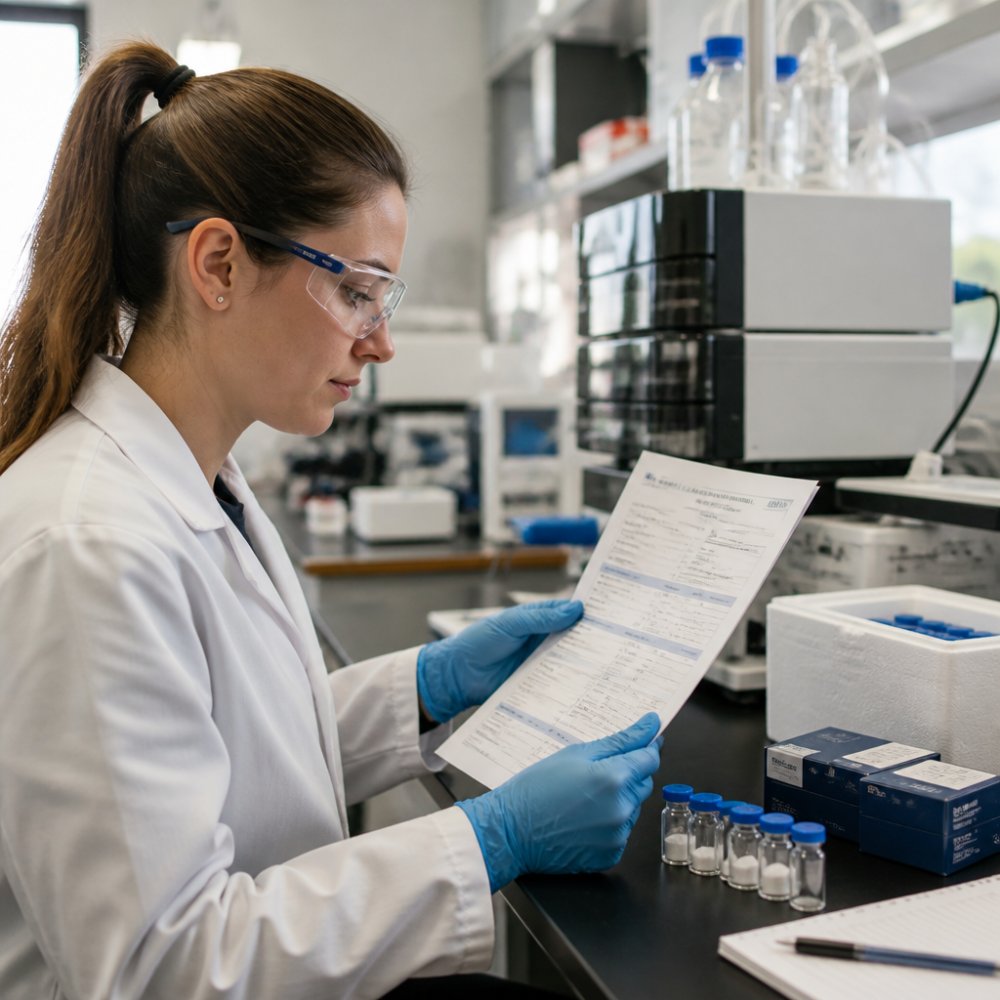
Reading the Chromatogram Correctly
Check retention time (travel time through the HPLC column). Your target peptide should show a sharp, well-defined peak; broad or split peaks indicate degradation.
The integration percentage shows what portion of total sample area the peak represents. Anything above 99% is generally acceptable for research work.
Check for baseline noise and artifact peaks. A clean baseline indicates good technique; artifact peaks suggest equipment issues or degradation.
The molecular weight confirmation from mass spectrometry should match theoretical mass within ±0.1%. Significant deviation indicates the compound may not be what you ordered.
Look for moisture content data, especially for lyophilized peptides. Most research-grade peptides should show less than 5% moisture.
Red Flags That Indicate a Falsified or Unreliable COA
Beyond reading the data correctly, you must learn to spot indicators of fraud or negligence. These warning signs should trigger vendor follow-up or rejection:
Missing or vague laboratory identification. A legitimate COA names the testing facility, provides a physical address, and lists accreditation numbers (ISO/IEC 17025). Internal-lab testing lacks independent verification.
Undated or expired testing reports. A COA should state the analysis date clearly. Testing older than 12 months may not reflect current batch condition.
Identical COAs across multiple batches. Identical purity percentages suggest copy-pasted reports; real batches show minor variation.
Missing analytical method details. A professional COA specifies HPLC column type, mobile phase, wavelength, temperature, and calibration dates. Absent details prevent assessment of testing rigor.
No signature or digital verification. Modern COAs should include digital signature, QR code, or verification link. Unsigned or illegible signatures indicate no accountability.
Suspiciously high purity for the price. If a vendor claims 99.9% purity at a fraction of competitors' cost, verify independently.
Inconsistent or missing impurity breakdown. A complete COA explains what remaining percentages represent (water, starting material, byproducts, degradation).
Verification Checklist for Procurement Teams
When evaluating a new supplier or auditing an existing one, use this checklist:
- COA includes a unique batch number that matches your purchase order and received material label
- Testing facility name, address, and accreditation status are clearly listed
- Analysis date is within the last 12 months (or appropriate for your storage conditions)
- HPLC method includes column type, mobile phase, wavelength, and temperature
- Purity percentage is supported by a chromatogram showing peak integration
- Molecular weight from mass spectrometry matches theoretical mass within ±0.1%
- Impurity breakdown is provided (water content, byproducts, starting materials)
- COA is signed or digitally verified by the testing laboratory
- Expiration date or stability data is documented
- If multiple batches have been tested, purity values show realistic variation (±0.5-1.0%)
When you work with BlueWaveCompound, every certificate of analysis includes all of these elements. Our third-party testing partners are ISO/IEC 17025 accredited, and every report is digitally verified. You can audit our COAs with confidence. Visit https://bluewavecompounds.com to review sample certificates and confirm our testing standards.
Interpreting HPLC and Mass Spectrometry Results on Your Report
HPLC results form the backbone of purity assessment. The chromatogram plots time (x-axis) against detector response (y-axis).
Your target peptide appears as a distinct peak; its area as a percentage of total peak area equals purity. Multiple similar-height peaks suggest mixture or degradation.
Wavelength selection matters. COAs typically show 214 nm (peptide bonds) or 280 nm (aromatic amino acids). Your certificate of analysis should specify which wavelength was used.
Mass spectrometry (MS) data confirms molecular weight. A clean spectrum shows a single major ion at expected mass; satellite peaks suggest impurities.
For peptides, multiply charged ions are common. A professional certificate of analysis explains this and confirms all ions correspond to the same molecular species.
The resolution and accuracy of the mass spectrometer should be documented. High-resolution instruments distinguish between similar masses; low-resolution instruments provide less confidence.
Third-Party Lab Testing Standards and Regulatory Compliance
Third-party testing provides independence that in-house quality control cannot. However, not all third-party labs are equal; verify their credentials.
Key Accreditations and What They Mean
Most reputable research-grade peptide suppliers work with labs certified under ISO/IEC 17025 standards for laboratory competence. This international standard requires documented procedures, equipment calibration, proficiency testing, and management review. A certificate of analysis from an ISO-accredited lab carries more weight than one from an unaccredited facility. However, ISO/IEC 17025 is not a single credential, it is a framework. Ask your supplier which specific tests are accredited. A lab might be ISO-accredited for HPLC analysis but not for mass spectrometry, for example.
For regulated research or FDA-relevant applications, your institution may require proof that testing followed validated methods and records are maintained for audit.
Many academic institutions and contract research organizations require that suppliers provide certificates of analysis meeting USP (United States Pharmacopeia) standards for chemical testing. USP standards define acceptable test methods, acceptance criteria, and documentation practices. A COA aligned with USP guidelines demonstrates professional-grade quality assurance. USP monographs exist for common compounds; if your peptide has a USP monograph, the testing should follow that specific protocol.
Some vendors claim compliance with GMP (Good Manufacturing Practice) standards, which govern pharmaceutical manufacturing. While research-grade peptides aren't drugs, GMP-compliant testing indicates rigorous process control and traceability. This level of documentation provides confidence that your materials were handled with pharmaceutical-grade precision. GMP compliance is rare for research-grade suppliers but signals the highest level of quality assurance.
How to Audit a Supplier's Lab Credentials
Don't take a vendor's word for their lab's credentials. Here's how to verify:
Request the lab's accreditation certificate directly. Ask your supplier for a copy of the testing facility's ISO/IEC 17025 accreditation certificate listing specific tests covered and the accreditation body (such as A2LA). Verify independently; fraudulent labs cite fake bodies.
Check the accreditation database. Visit the accreditation body's website and search for the lab by name. A2LA maintains a public directory of accredited laboratories at A2LA accredited lab search. If the lab claims ISO/IEC 17025 accreditation but does not appear in the database, the claim is false.
Ask about proficiency testing. ISO/IEC 17025 requires external round-robin testing. If the lab cannot answer or claims it's "proprietary," that's a red flag.
Verify equipment calibration and maintenance records. Request documentation that instruments are calibrated annually with NIST-traceable records.
- Laboratory name, address, and accreditation number
- Batch number and testing date
- Product name, molecular weight, and catalog number
- HPLC method (column, mobile phase, wavelength, temperature)
- Purity percentage with chromatogram
- Mass spectrometry data with molecular weight confirmation
- Impurity breakdown (water, byproducts, starting materials)
- Analyst signature or digital verification
- Expiration date or stability data
- Statement of compliance with relevant standards (USP, GMP, etc.)
Red Flags in Compliance Claims
Be skeptical of vague compliance language. "Tested to pharmaceutical standards" is meaningless without specifics. "GMP-compliant" is a marketing claim unless backed by documented certification.
How a Certificate of Analysis Protects Your Research
A detailed certificate of analysis serves as insurance against experimental failure rooted in material quality. When results don't replicate or show unexpected variability, you need to rule out compound-related causes. A COA provides the baseline data to do that.
Frequently Asked Questions
What is the purpose of a Certificate of Analysis?
A Certificate of Analysis documents the results of third-party laboratory testing performed on a batch of peptides or compounds. It verifies that the product meets specified quality standards, purity levels, and regulatory compliance requirements. For researchers, a COA confirms that your materials are tested and safe to use in experiments, reducing the risk of contaminated or mislabeled samples affecting your results.
How do I know if the purity percentage on a Certificate of Analysis is accurate?
Verify that the COA includes results from an accredited third-party laboratory, not the manufacturer's own testing. Look for the lab's accreditation credentials (such as ISO 17025 certification), the specific test methods used (HPLC or mass spectrometry), and batch-specific data rather than generic certificates. Request raw analytical data and compare it across multiple batches from your supplier to identify patterns in quality consistency.
What is the difference between a Certificate of Analysis and a Safety Data Sheet?
A Certificate of Analysis reports the purity, composition, and test results for a specific batch of material. A Safety Data Sheet (SDS) provides hazard information, handling instructions, and emergency procedures for a chemical. Both documents are important: the COA confirms what you're receiving meets quality standards, while the SDS ensures safe handling. You need both for compliant laboratory practice.
Why is third-party testing essential for peptide research?
Third-party labs provide independent verification that cannot be influenced by the manufacturer. This ensures your peptides are actually the purity claimed, preventing wasted experiments caused by contaminated or degraded materials. For academic institutions and government-funded research, third-party testing documentation often satisfies institutional procurement and quality assurance requirements, protecting your lab's reputation and funding.