 how-to
Interpreting Third Party Lab Results: A Guide
Table of Contents
- Understanding Reference Ranges and What They Mean
- How to Verify Peptide Purity in Your Lab Results
- Reading Your Peptide Certificate of Analysis Explained
- Understanding HPLC and Mass Spec Data
- Distinguishing False Positives and False Negatives
- Common Mistakes When Interpreting Third Party Lab Results
- When and How to Follow Up With Your Healthcare Provider
- Frequently Asked Questions
Last Updated: October 1, 2026
Understanding Reference Ranges and What They Mean
A reference range is the set of values that a clinical laboratory considers normal for a specific test result. Think of it as the boundaries between what's typical and what might need attention. Reference ranges vary based on age, sex, and the lab's own testing methods.
Reference ranges aren't universal, two labs might report different ranges for the same test due to different equipment, reagents, or population data.
Interpreting third party lab results depends on understanding whose reference range you're looking at. This context is essential for researchers, not just the raw numbers.
Reference ranges show as a shaded area or bracket on your report. Values above the upper limit are "high," below are "low," and inside are "normal", though "normal" doesn't always mean healthy for your situation.
How to Verify Peptide Purity in Your Lab Results
Purity percentages (like 99% or 98.5%) tell you how much of your sample is the target compound versus impurities.
A peptide showing 99% purity means 1% is residual solvents, water, byproducts, or incomplete synthesis. Higher purity reduces experimental noise and improves reproducibility.
Check the testing method on your certificate. HPLC (high-performance liquid chromatography) is standard for peptides because it separates compounds by size and charge, revealing impurities.
Key things to verify:
- Purity percentage matches what you ordered
- Testing method is appropriate for your application
- Date tested is recent (within acceptable storage time)
- Batch number matches your shipment
- Impurity breakdown shows what the remaining percentage contains
Every batch is third-party lab tested, so you can verify exactly what you're receiving before your research begins.
Reading Your Peptide Certificate of Analysis Explained
A Certificate of Analysis (COA) documents purity, identity, and quality metrics in a standardized format.
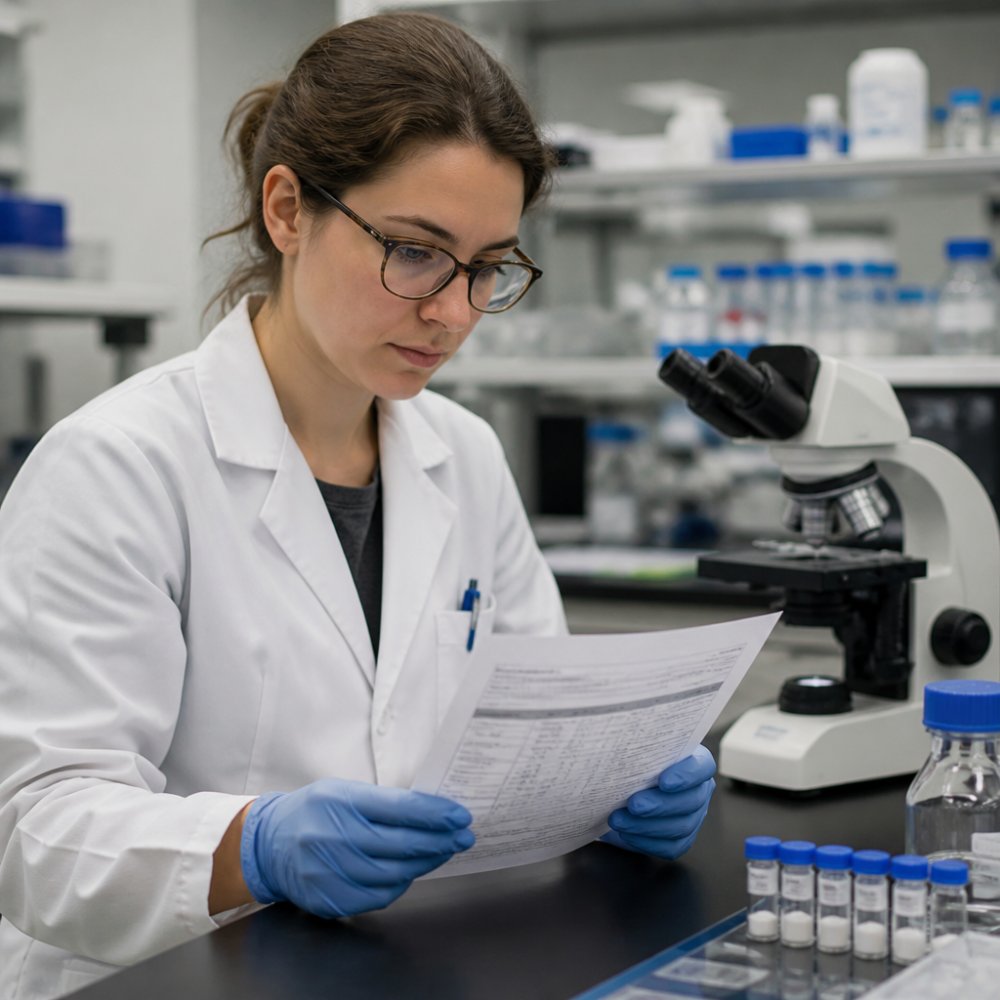
The COA typically includes:
- Batch/Lot number, ties the document to your specific shipment
- Product name and sequence, confirms you received what you ordered
- Purity percentage, the main quality metric
- Testing date, when the analysis was performed
- Method used, which lab technique verified the results
- Molecular weight, confirms correct synthesis
- Appearance and solubility notes, physical characteristics
Match the batch number to your shipment label and verify purity against your purchase specification. Flag any mismatches immediately.
The certificate lists detected impurities by percentage. Water content, residual solvents, and synthesis byproducts are common, lower percentages mean cleaner peptide.
Understanding HPLC and Mass Spec Data
HPLC (high-performance liquid chromatography) separates your sample into individual components based on column interaction, then detects each one.
HPLC data shows a chromatogram with peaks, each peak represents a different compound. The largest peak is your target peptide; smaller peaks are impurities.
Peak area correlates to concentration. If your main peak covers 99% of total area, that's your purity percentage.
Mass spectrometry (MS) identifies peaks by measuring exact molecular weight, confirming you received the correct peptide.
When interpreting third party lab results that include mass spec data, look for:
- Molecular ion peak (M+) at your expected mass
- Fragmentation pattern matching known peptide structure
- Signal intensity indicating abundance
HPLC and mass spec together provide comprehensive verification: HPLC assesses purity, and mass spec helps confirm identity.
Distinguishing False Positives and False Negatives
A false positive indicates a problem that doesn't exist; a false negative misses a real problem.
False positives occur when labs detect measurement artifacts; false negatives occur when impurities fall below detection limits.
No test is 100% accurate. Every method has a sensitivity threshold, the smallest amount it can reliably detect.
Common sources of false results: equipment drift, sample degradation, calibration error, cross-contamination, and operator error.
Trends matter more than single data points. Repeat testing confirms whether unusual results are real or artifacts.
Common Mistakes When Interpreting Third Party Lab Results
Mistake 1: Ignoring the reference range source and methodology. Different labs use different equipment and detection thresholds. A purity value of 98.5% from Lab A might correspond to 99.1% from Lab B. Before comparing results across labs, verify the testing method on each certificate. Always use the reference range provided by the testing lab that generated your result.
Mistake 2: Treating a single result as definitive. Batch-to-batch variation is common in peptide synthesis. Request raw chromatogram data and ask whether the lab ran replicate analyses. Compare multiple batches over time to establish your supplier's baseline. A trend of declining purity signals a real problem; a one-time dip is normal variation.
Mistake 3: Overlooking the testing date and storage conditions. Peptides degrade over time, especially if stored improperly. Check the testing date and cross-reference it against your storage conditions. If you suspect degradation, request retesting before critical experiments. Document storage conditions alongside the COA.
Mistake 4: Not understanding detection limits. "Not detected" means the impurity is below the method's detection limit, not that it's absent. Look for a "limit of detection" (LOD) line on your certificate. If absent, ask the lab to provide it. Understand that "ND" reflects the method's capability, not absolute purity.
Mistake 5: Confusing precision with accuracy. A test can be precise but inaccurate if the calibration standard is degraded. Ask whether the lab runs positive and negative controls alongside your samples. Request calibration dates and control results. For critical experiments, ask for split-sample testing at an independent lab.
Mistake 6: Forgetting about synthesis and storage variability. Batch-to-batch variation is normal. Review your supplier's historical data to understand their typical purity performance over multiple batches. Establish realistic specification ranges based on actual performance data, not theoretical ideals.
Mistake 7: Not requesting raw data when results seem inconsistent. Ask the lab for the actual chromatogram file and method parameters (column type, mobile phase, flow rate, wavelength). Compare these to your in-house method. Keep a copy of the raw chromatogram file with your COA for troubleshooting.
When and How to Follow Up With Your Healthcare Provider
If interpreting third party lab results for clinical purposes, discuss out-of-range values with your healthcare provider. The challenge is distinguishing genuine abnormality from false alarms caused by lab methodology differences or equipment variance.
Your provider understands your medical history and can interpret results in clinical context. However, many providers receive only summary values without methodology or reference range source, creating a blind spot for measurement artifacts caused by lab-to-lab differences.
The same test produces different values at different facilities due to different analyzers, reagents, reference ranges, calibration drift, and pre-analytical variables.
Addressing the anxiety of self-interpretation (cyberchondria).
- Resist the urge to self-diagnose. An out-of-range value has many possible explanations. A single abnormal result is rarely diagnostic of anything serious.
- Schedule an appointment with your provider promptly, but not emergently. If the result were truly urgent, the lab would have flagged it as critical and contacted your provider directly. Most out-of-range results can wait a few days for a scheduled appointment.
- Avoid Dr. Google. Online symptom checkers and health forums will amplify anxiety. Wait for your provider's interpretation.
- Remember that normal variation exists. Lab results are not perfect. A value just outside the reference range is often still clinically normal.
For research applications: following your institution's protocol.
- Retesting the sample
- Running positive and negative controls
- Comparing to historical data from the same supplier
- Consulting with the lab about methodology
Frequently Asked Questions
What is a Certificate of Analysis (COA) and why does it matter?
A Certificate of Analysis is a third-party lab document that confirms the identity, purity, and composition of a research compound. For peptides and biochemical materials, a COA provides analytical evidence, typically from HPLC or Mass Spectrometry, that the product meets stated specifications. It matters because it gives you objective proof that what you ordered matches what you received, reducing experimental variability and supporting reproducibility in your research.
How do I know if a third-party lab report is authentic?
Verify that the testing was performed by an independent, accredited laboratory, not by the supplier itself. Look for the lab's name, accreditation credentials, and contact information on the report. Cross-reference the lab's credentials through industry databases or regulatory bodies. Authentic reports include specific methodology (HPLC, Mass Spec), equipment details, analyst signatures, and report dates. Be cautious of vague language or missing technical details, which may indicate the report is incomplete or not genuinely independent.
What purity level should I expect for research-grade peptides?
Research-grade peptides typically meet ≥95% purity, though higher-purity batches (≥99%) are available for applications requiring exceptional consistency. The appropriate purity depends on your specific experimental needs: basic research may tolerate 95%, while sensitive assays or therapeutic development often require 99% or higher. Your COA will state the exact purity percentage. If you're unsure what purity your research requires, consult your protocol or speak with your institution's laboratory manager.
Why might the same test show different results at different labs?
Lab variance occurs due to differences in analytical methodology, equipment calibration, reference standards, and pre-analytical handling. Two labs using different HPLC systems or Mass Spec instruments may report slightly different purity percentages for the same sample. This is why baseline values matter: establish your baseline at one trusted lab and request ongoing testing at that same facility when possible. If you must change labs, compare results carefully and account for methodological differences rather than assuming discrepancies indicate a quality problem.