 ultimate-guide
Peptide Procurement for Academic Labs: A 2026 Guide
Table of Contents
- Why Peptide Procurement Is a Scientific Decision
- The Role of Third-Party Lab Testing for Peptides
- How to Read a Peptide Certificate of Analysis
- Key Criteria for Evaluating Peptide Suppliers
- Custom Synthesis vs. Catalog Sourcing for Research
- How to Buy Research Grade Peptides Online
- Integrating Procurement Workflows, Budgets, and Cold Chain
- Conclusion: Building a Reproducible Research Foundation
- Frequently Asked Questions
Last Updated: September 4, 2026
Why Peptide Procurement Is a Scientific Decision
Peptide procurement for academic labs is too often treated as a routine purchasing task when it should be treated as a scientific decision with direct consequences for data integrity. The choice between suppliers can determine whether your ELISA results reflect biology or contamination, and whether your binding assay measures your target or a degraded fragment. At BlueWaveCompound, we work with principal investigators and lab managers who treat sourcing as part of experimental design, not an afterthought.
The gap between a peptide that performs and one that sabotages your work rarely shows up in the price. It shows up in the documentation, the handling protocols, and the verified purity data behind each batch. For academic labs operating under tight timelines and limited budgets, a failed experiment from a bad peptide costs far more than the vial itself. Below, we'll walk through the specific criteria that separate reliable peptide procurement from guesswork.
The Role of Third-Party Lab Testing for Peptides
Third-party lab testing for peptides is the only way to verify that a supplier's purity claims reflect actual batch composition. When a vendor tests its own product, the conflict of interest is obvious: the company has a financial incentive to report favorable results. Independent testing removes that bias and provides analytical evidence you can trust for your research.
A reputable third-party analysis typically includes high-performance liquid chromatography (HPLC) for purity assessment and mass spectrometry to confirm molecular weight and sequence integrity (peer-reviewed research). These methods catch common issues such as truncated sequences, deletion impurities, and residual trifluoroacetate or acetate salts from the synthesis process. Without this independent verification, you are relying on the supplier's word for the quality of a reagent that can derail months of work.
How to Read a Peptide Certificate of Analysis
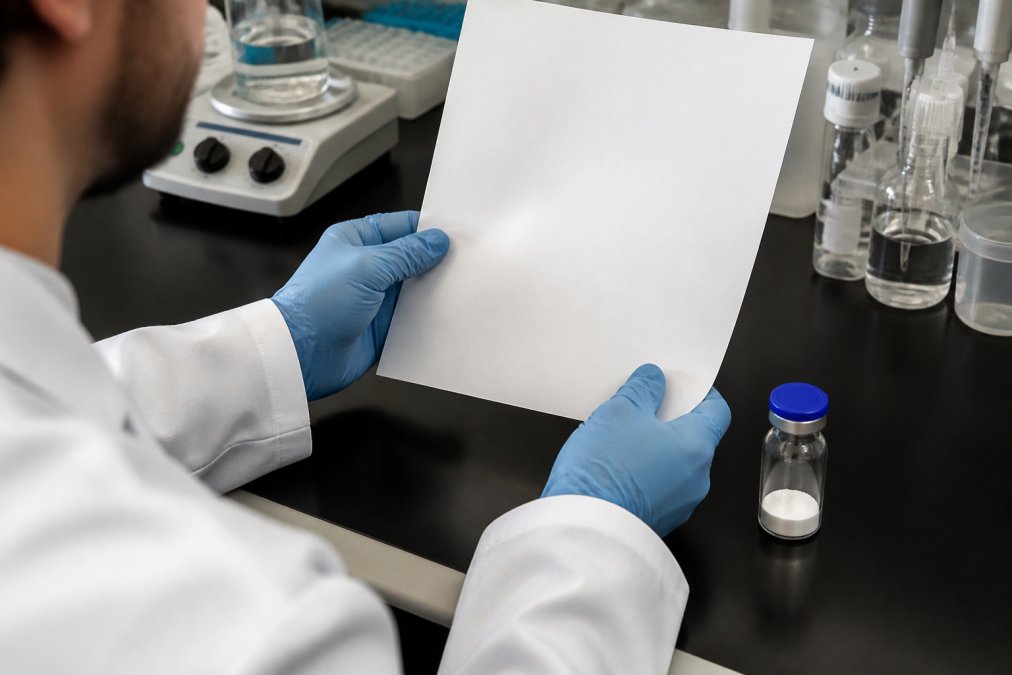
A peptide Certificate of Analysis (COA) is the document that translates a supplier's quality claims into verifiable data. The COA should report the peptide's sequence, molecular weight, and the results of HPLC analysis showing purity percentage and retention time. Look for the actual chromatogram or detailed peak data, not just a single number claiming high purity.
You should also check the storage conditions and the date of analysis. Peptides degrade over time, and a COA from six months ago does not guarantee the same quality today. For lyophilized powder stored properly at the recommended temperature, stability is generally good, but the documentation should reflect when the analysis was performed and under what conditions the product was handled (the NIH).
Key Criteria for Evaluating Peptide Suppliers
Purity Claims vs. Verified Data
The most common mistake in evaluating suppliers is accepting a purity claim at face value. A supplier stating "≥99% purity" without providing a COA with actual HPLC data is asking you to trust rather than verify. For academic research where results will face peer review, verified data is non-negotiable. Request the COA before you commit to an order and confirm that the purity analysis matches the batch you are purchasing.
Documentation and Regulatory Compliance
Research-use-only (RUO) compliance matters for institutional approval (the FDA). Your procurement office will want documentation that the supplier is registered and compliant with relevant standards. Academic institutions typically require vendors to provide certificates of analysis, batch consistency records, and evidence of quality assurance protocols. A supplier that cannot produce these documents will stall your purchasing workflow or fail institutional review entirely.
Custom Synthesis vs. Catalog Sourcing for Research
The choice between custom synthesis and catalog sourcing depends on your sequence requirements and timeline. Catalog peptides are ideal for well-established sequences with published protocols, offering faster delivery and lower cost. Custom synthesis becomes necessary when you need specific modifications, such as phosphorylation, acetylation, or non-standard amino acids that are not available off the shelf.
| Sourcing Option | Best For | Lead Time | Documentation |
|---|---|---|---|
| Catalog Peptides | Standard sequences, pilot experiments | Days to 1 week | COA with each batch |
| Custom Synthesis | Modified sequences, epitope mapping | 2-4 weeks typically | COA plus synthesis report |
For drug discovery and biochemical assays requiring consistent batch-to-batch reproducibility, custom synthesis from a single supplier ensures continuity. However, confirm that the supplier maintains detailed records of synthesis conditions so future batches match your original specifications.
How to Buy Research Grade Peptides Online
Buying research grade peptides online requires a systematic approach to vendor qualification. Start by verifying that the supplier provides third-party lab testing documentation and a COA with every order. Check whether the company ships lyophilized powder or pre-solubilized solutions, as lyophilized powder generally offers better stability during transport and longer shelf life.
Confirm the supplier's cold chain logistics for temperature-sensitive compounds. Many academic labs have received degraded peptides from suppliers that ship without adequate thermal protection. Ask about packaging protocols and whether the supplier uses temperature monitors during transit. A supplier with documented cold chain procedures demonstrates that they understand the stability requirements of their products.
Integrating Procurement Workflows, Budgets, and Cold Chain
Academic procurement operates within institutional constraints that commercial labs often avoid. Your purchasing workflow likely requires vendor registration, compliance review, and approval from multiple stakeholders. Choosing a supplier that understands these requirements and provides the necessary documentation upfront shortens the entire cycle.
Grant budgeting for peptide procurement should account for more than the unit price. Factor in shipping, potential customs delays, and the cost of reordering if a batch fails quality checks. A slightly higher per-vial cost from a supplier with verified quality and reliable cold chain logistics often proves more economical than a cheaper option that risks experimental failure.
For labs running parallel experiments, batch consistency becomes critical. Document the lot numbers and COA data for each peptide you receive, and maintain a record of which batch was used in each experiment. This practice supports reproducibility and gives you the data needed to troubleshoot if results vary between batches.
Conclusion: Building a Reproducible Research Foundation
Peptide procurement for academic labs demands the same rigor as any other aspect of experimental design. By requiring third-party lab testing, verifying certificates of analysis, and selecting suppliers with documented quality assurance, you protect the integrity of your research and the investment of your grant funding. The extra time spent on vendor qualification pays dividends in reproducible results and publications that withstand scrutiny.
At BlueWaveCompound, we support this standard of scientific excellence. Every batch we provide is third-party lab tested with high purity of ≥99%, accompanied by a Certificate of Analysis to verify quality. Our fast and discreet shipping includes proper handling protocols, and our money-back guarantee reflects our confidence in batch consistency and stability. For researchers who treat sourcing as a scientific decision, we offer a reliable foundation for biochemical studies, drug discovery, and academic advancement. Visit https://bluewavecompounds.com to learn more.
Frequently Asked Questions
What documentation is required when purchasing research-grade peptides for an academic lab?
The core document is the Certificate of Analysis (CoA) from the supplier, which should include the peptide's amino acid sequence, molecular weight, and purity percentage verified by HPLC analysis. You also need mass spectrometry data to confirm the molecular structure. For institutional approval, your procurement office may require the vendor's business registration and proof of research-use-only labeling. BlueWaveCompound provides a CoA with every batch, and all products are explicitly labeled for research purposes only, not for human or veterinary use.
How do academic labs verify that a supplier's 99% purity claim is real?
Do not accept a purity percentage on a website as sufficient evidence. Request the actual third-party lab testing reports or HPLC analysis chromatograms for the specific batch you plan to order. A reputable supplier will share these documents before purchase. Check that the report comes from an independent laboratory, not the supplier's own in-house equipment. The chromatogram should show a single dominant peak with minimal impurities. If a vendor hesitates to provide batch-specific data, that is a sign their claims may not withstand scrutiny.
Why is a Certificate of Analysis critical for peptide procurement in academic research?
A CoA is the primary evidence that the peptide you receive matches the specifications required for reproducible experiments. It confirms the peptide's identity through mass spectrometry and its purity through HPLC analysis. Without this documentation, your lab cannot verify that experimental results are due to the peptide itself rather than unknown impurities or degradation products. For published research, reviewers increasingly expect documentation of reagent quality. The CoA also serves as the official record your procurement department needs for vendor qualification and audit trails.
What should labs consider when budgeting for custom peptide synthesis?
Custom synthesis costs more than catalog peptides because it requires dedicated production time, purification, and quality control. When planning a grant budget, factor in the full cost of the synthesis service plus shipping, especially if cold chain logistics are required for stability. Request quotes from multiple providers and compare what is included: HPLC analysis, mass spectrometry, the CoA, and the quantity of lyophilized powder. Consider the total cost of ownership; a lower-priced peptide that fails quality checks wastes far more in researcher time and materials.
Building a reproducible research foundation starts with materials you can trust. BlueWaveCompound delivers research-grade peptides with third-party lab testing, certificates of analysis, and a money-back guarantee on every order. Get started with BlueWaveCompound and ensure your next experiment rests on verified quality. Visit https://bluewavecompounds.com to explore our catalog and request documentation before you commit.
This article was written using GrandRanker
Frequently Asked Questions
Q: What documentation is required when purchasing research-grade peptides for an academic lab?
A: The core document is the Certificate of Analysis (CoA) from the supplier, which should include the peptide's amino acid sequence, molecular weight, and purity percentage verified by HPLC analysis. You also need mass spectrometry data to confirm the molecular structure. For institutional approval, your procurement office may require the vendor's business registration and proof of research-use-only labeling. BlueWaveCompound provides a CoA with every batch, and all products are explicitly labeled for research purposes only, not for human or veterinary use.
Q: How do academic labs verify that a supplier's 99% purity claim is real?
A: Do not accept a purity percentage on a website as sufficient evidence. Request the actual third-party lab testing reports or HPLC analysis chromatograms for the specific batch you plan to order. A reputable supplier will share these documents before purchase. Check that the report comes from an independent laboratory, not the supplier's own in-house equipment. The chromatogram should show a single dominant peak with minimal impurities. If a vendor hesitates to provide batch-specific data, that is a sign their claims may not withstand scrutiny.
Q: Why is a Certificate of Analysis critical for peptide procurement in academic research?
A: A CoA is the primary evidence that the peptide you receive matches the specifications required for reproducible experiments. It confirms the peptide's identity through mass spectrometry and its purity through HPLC analysis. Without this documentation, your lab cannot verify that experimental results are due to the peptide itself rather than unknown impurities or degradation products. For published research, reviewers increasingly expect documentation of reagent quality. The CoA also serves as the official record your procurement department needs for vendor qualification and audit trails.
Q: What should labs consider when budgeting for custom peptide synthesis?
A: Custom synthesis costs more than catalog peptides because it requires dedicated production time, purification, and quality control. When planning a grant budget, factor in the full cost of the synthesis service plus shipping, especially if cold chain logistics are required for stability. Request quotes from multiple providers and compare what is included: HPLC analysis, mass spectrometry, the CoA, and the quantity of lyophilized powder. Consider the total cost of ownership; a lower-priced peptide that fails quality checks wastes far more in researcher time and materials.