 ultimate-guide
Peptide Purity in Drug Discovery: Why It Matters
Table of Contents
- What Is Peptide Purity and Why It Matters in Drug Discovery
- How Impurities Impact Experimental Accuracy and Reproducibility
- How to Verify Peptide Purity in Your Laboratory
- Impact of Peptide Purity on Bioassays and Experimental Results
- Peptide Quality Assurance Standards and Analytical Methods
- Batch-to-Batch Variability and Regulatory Compliance
- Frequently Asked Questions
Last Updated: September 21, 2026
What Is Peptide Purity and Why It Matters in Drug Discovery
Peptide purity is the measure of how much of your peptide sample consists of the desired target molecule versus unwanted byproducts, impurities, and degradation products. In peptide purity drug discovery, this distinction is everything. When you're running experiments to validate a therapeutic candidate, every contaminant introduces noise into your data. A 95% pure peptide sounds acceptable until you realize that 5% of your sample is doing something completely different from what you intended to measure.
How Impurities Impact Experimental Accuracy and Reproducibility
Impurities don't just add noise, they introduce systematic bias. When you're measuring the potency of a peptide therapeutic, you're typically quantifying a response: receptor binding, enzyme inhibition, or cell activation. Your assay is calibrated to detect the pure compound. But if 10% of your sample is a truncated version with different binding kinetics, you're measuring a mixture, not your target.
How to Verify Peptide Purity in Your Laboratory
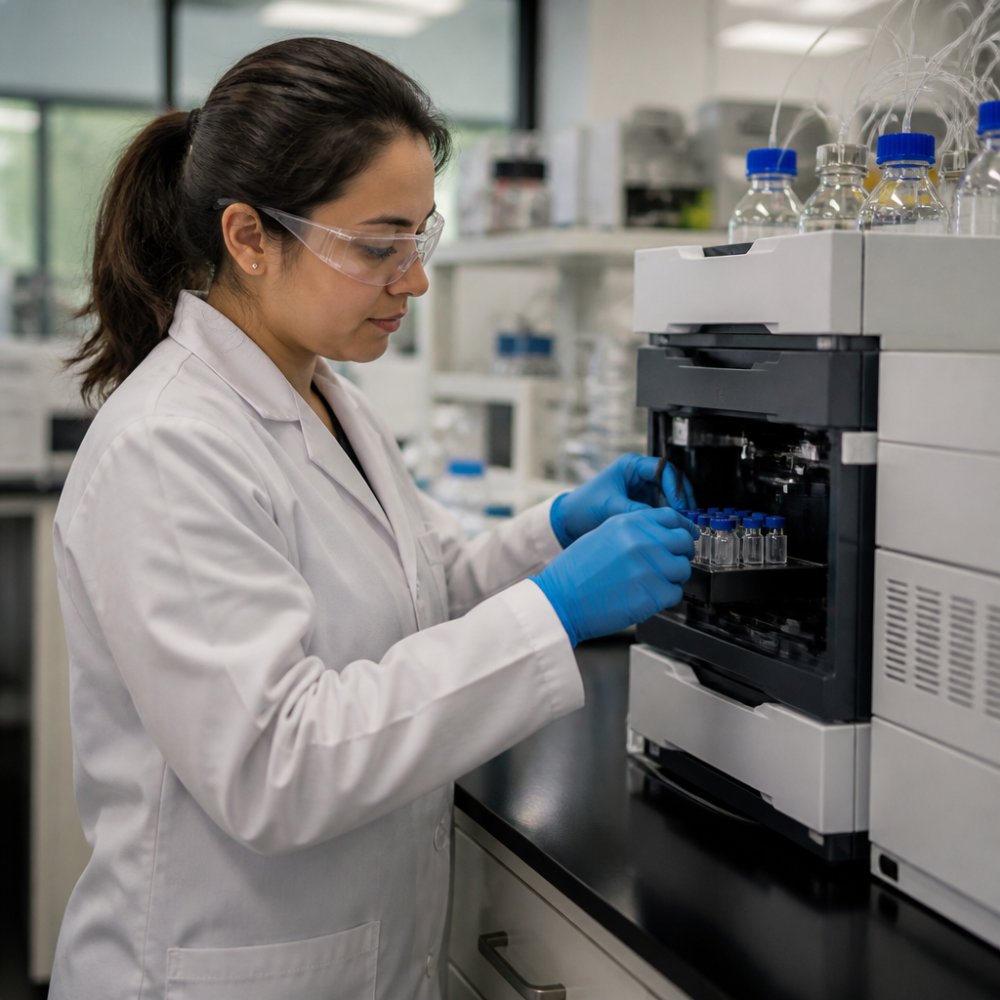
Verifying peptide purity requires analytical methods that separate and quantify components. The most common approach is High-Performance Liquid Chromatography (HPLC), which separates peptides based on hydrophobicity. Your sample flows through a column; different molecules elute at different times. A detector measures the signal intensity for each peak. The area under each peak represents the relative abundance of that component.
Impact of Peptide Purity on Bioassays and Experimental Results
Bioassays measure biological activity, how your peptide affects cells, proteins, or organisms. The assay's output is only as good as the input. Feed it an impure peptide, and you're measuring the combined effect of multiple compounds.
Peptide Quality Assurance Standards and Analytical Methods
Quality assurance in peptide synthesis follows established standards. The United States Pharmacopeia (USP) and European Pharmacopoeia (Ph.Eur.) define reference standards for peptide characterization. While these are primarily for pharmaceutical-grade materials, research-grade peptides benefit from the same analytical rigor.
Purity Benchmarks and Their Application
Common purity targets vary by discovery stage:
-
>95% purity: Acceptable for initial library screening, hit identification, and structure-activity relationship (SAR) optimization. At this level, you're trading some analytical certainty for cost efficiency. Most impurities are byproducts of synthesis (truncated sequences, deletion variants) that are structurally similar to your target. The 5% contamination introduces noise but rarely causes false positives in screening assays.
-
>98% purity: Required for binding kinetics studies, cellular assays, and lead compound characterization. Here, you need confidence that dose-response curves reflect your target peptide's true potency. At 98%, residual impurities are typically <2%, often single-digit nanomolar contaminants that won't significantly skew EC50 values. This is the sweet spot for most preclinical development work.
-
>99% purity: Necessary for regulatory submissions, dose-escalation studies, and therapeutic candidates entering IND-enabling studies. Regulatory agencies expect this level for drug substances. The FDA and EMA require detailed characterization of all impurities present at >0.1% relative abundance. At 99%+, you have fewer unknowns and can provide comprehensive safety data on minor components.
Selecting the Right Analytical Method
The analytical method you choose depends on your peptide's chemical properties and your experimental stage.
-
Specificity: The method must resolve your peptide from truncated sequences (missing N-terminus, C-terminus, or internal segments), oxidized forms (methionine and tryptophan oxidation are common), and any known synthesis byproducts.
-
Linearity: Detector response must be proportional to peptide concentration across your working range (typically 10-1000 µg/mL).
-
Accuracy: Measured purity must agree with a reference standard within ±2%.
-
Precision: Replicate injections must vary by <2% relative standard deviation.
-
Hydrophilic Interaction Liquid Chromatography (HILIC) uses a polar stationary phase and reversed-polarity mobile phase, providing orthogonal separation from standard HPLC.
-
Aqueous-organic gradients with different pH buffers can improve resolution of cyclic variants.
-
Size-exclusion chromatography (SEC) separates by molecular weight, useful if your impurities differ significantly in size from the target.
Reference Standards and Traceability
Reference standards are essential for method validation and purity quantification. You need a pure sample of your target peptide to confirm retention time, response factor, and identity. Without a reference standard, you cannot definitively say that the major HPLC peak is actually your compound, it could be a major impurity and your target could be a minor peak.
Residual Solvent and Salt Analysis
Often overlooked but critical: residual solvent analysis. Peptides are synthesized in organic solvents (acetonitrile, dimethylformamide, N-methyl pyrrolidone) and purified using trifluoroacetic acid (TFA). If these aren't completely removed, they contaminate your sample and affect biological activity.
Batch-to-Batch Variability and Regulatory Compliance
Lot-to-lot variability is inherent to peptide synthesis. Even when using the same sequence, same equipment, and same supplier, purity can fluctuate by 1-3 percentage points between batches. Solid-phase peptide synthesis is a multi-step process, typically 20-100 coupling cycles depending on peptide length, and small variations in temperature, humidity, reagent quality, or reaction time cascade into differences in the final product.
Sources of Batch-to-Batch Variability
The primary sources of variability include:
- Coupling efficiency: Each amino acid coupling step is not 100% efficient. If coupling efficiency drops from 99.5% to 99.2% at even one step in a 50-residue peptide, the cumulative effect is a 10-15% loss in full-length product yield. The remaining material is truncated sequences (missing C-terminal residues).
- Oxidation during synthesis and purification: Methionine and tryptophan residues are susceptible to oxidation, especially during storage or if exposed to light. One batch might be synthesized under nitrogen atmosphere; another might not. The oxidized forms are structurally similar but have different biological activity.
- Residual solvent and salt carryover: Purification efficiency varies with column condition, solvent composition, and drying protocols. One batch might be dried under vacuum for 4 hours; another for 2 hours. Residual TFA or acetonitrile levels differ accordingly.
- Epimerization: For peptides containing serine, threonine, or other amino acids with chiral centers, incomplete protection during synthesis can lead to epimerization (formation of D-amino acid forms). This is rare but batch-dependent.
- Aggregation during storage: Even if two batches are synthesized identically, storage conditions (temperature, humidity, light exposure) affect stability. A batch stored at 4°C for 6 months may show 1-2% aggregation; one stored at room temperature may show 5%.
From a regulatory standpoint, this variability is expected and acceptable as long as it's controlled and documented. The FDA does not require zero variability; it requires that you establish acceptance criteria and demonstrate that your manufacturing process consistently meets them.
Regulatory Documentation Requirements
When developing a therapeutic peptide and moving from preclinical studies to clinical trials (IND application), the FDA expects comprehensive documentation of your drug substance. This includes:
Certificate of Analysis (CoA)
Every batch must have a CoA that documents:
- Identity confirmation: HPLC retention time, LC-MS molecular weight, amino acid composition. This proves the batch is actually your intended sequence.
- Purity (HPLC): Percentage of main component and identification of all impurities >0.1% relative abundance.
- Residual solvent analysis: GC or GC-MS results showing levels of acetonitrile, dimethylformamide, and other solvents used in synthesis and purification.
- Water content: Karl Fischer titration result, typically reported as % w/w.
- Salt/inorganic content: Ion chromatography or inductively coupled plasma (ICP) analysis if metal impurities are a concern.
- Microbial limits: For peptides intended for injection, USP <2023> or Ph.Eur. 2.6.12 microbial testing (total aerobic microbial count, absence of specified pathogens).
- Endotoxin content: For injectable peptides, LAL (Limulus Amebocyte Lysate) test result in endotoxin units per milligram.
BlueWaveCompound provides comprehensive Certificates of Analysis with every shipment, including HPLC purity, LC-MS confirmation, and residual solvent data. This documentation is suitable for regulatory submissions and streamlines your IND application process. You can find more information at https://bluewavecompounds.com.
HPLC Method Validation Report
For regulatory submissions, you must provide evidence that your HPLC purity method is validated. This includes:
- Specificity: Demonstration that the method separates your target peptide from known impurities (truncated sequences, oxidized forms, synthesis byproducts).
- Linearity: Calibration curve showing detector response is proportional to peptide concentration (typically R² >0.99).
- Accuracy: Recovery of known amounts of reference standard (typically 90-110%).
- Precision: Intra-assay and inter-assay reproducibility (relative standard deviation <2%).
- Range: The concentration range over which the method is valid (e.g., 10-1000 µg/mL).
Impurity Characterization
For any impurity present at >0.1% relative abundance, the FDA expects characterization:
- Structural identification: What is the impurity? Is it a truncated sequence (which residues are missing?), an oxidized form, a deamidated variant, or something else?
- Relative abundance: Quantified by HPLC or LC-MS.
- Safety assessment: Is this impurity likely to be toxic or immunogenic? For truncated sequences, you may need to run a toxicology study on the impurity itself if it's present at >1%.
Stability Data
The FDA requires stability data demonstrating that your drug substance remains within specification over its proposed shelf life. This includes:
- Real-time stability: Samples stored at the proposed storage condition (e.g., 2-8°C, protected from light) tested at 0, 3, 6, 9, and 12 months.
- Accelerated stability: Samples stored at elevated temperature (e.g., 25°C/60% relative humidity) tested at 0, 3, and 6 months to predict long-term stability.
- Testing: HPLC purity, residual solvent, water content, and microbial limits at each timepoint.
Practical Implications for Research
For research use, the practical implication is straightforward: verify purity for each batch you receive. Don't assume that because your last shipment was 99.1% pure, this one will be too. A Certificate of Analysis isn't just documentation, it's proof that you're working with a known, characterized material.
Documentation Checklist for Regulatory Submissions
When preparing an IND application or similar regulatory submission, ensure your peptide supplier provides:
- ☐ Certificate of Analysis (identity, purity, residual solvents, water, salts, microbial limits, endotoxin)
- ☐ HPLC method validation report (specificity, linearity, accuracy, precision, range)
- ☐ LC-MS data identifying all impurities >0.1%
- ☐ Amino acid analysis confirming sequence composition
- ☐ Stability data (real-time and accelerated) demonstrating shelf life
- ☐ Batch manufacturing record (BMR) or summary documenting synthesis conditions, yields, and in-process controls
- ☐ Reference standard characterization (if using an in-house standard)
Frequently Asked Questions
What does 99% peptide purity actually mean for my research?
99% purity means that 99% of the sample is the intended peptide sequence, with 1% consisting of by-products, residual solvents, counter-ions, and other impurities from synthesis and purification. For drug discovery applications, this level ensures high-quality experimental results and reliable bioassay data. Third-party lab testing with HPLC and mass spectrometry confirms this specification. Always request a Certificate of Analysis to verify the actual purity of your batch before using it in critical experiments.
How do I know the purity claims are real and not just marketing?
Request third-party lab test results and a Certificate of Analysis before committing to an order. Legitimate suppliers provide documented analytical data showing HPLC traces, mass spectrometry results, and sequence verification. Look for suppliers who use independent testing facilities and provide lot-specific documentation. BlueWaveCompound, for example, includes third-party lab testing and a Certificate of Analysis with every batch, giving you verifiable proof of purity and composition.
Is 95% purity sufficient for drug discovery work, or do I need higher?
95% purity may be acceptable for some screening applications, but most drug discovery projects require 98-99% purity or higher. Impurities at the 5% level can introduce experimental noise, skew bioassay results, and compromise reproducibility across batches. Higher purity reduces variability and increases confidence in your findings. For regulatory submissions and pharmacological efficacy studies, 99%+ purity is typically the standard.
Why is a Certificate of Analysis essential when sourcing research peptides?
A Certificate of Analysis documents the actual purity, sequence verification, and impurity profile of your specific batch through third-party testing. It provides traceability for regulatory compliance, supports reproducibility in your research, and protects your institution's credibility. When you cite results in publications or regulatory filings, a COA proves your starting materials met the stated specifications. Without it, you have no objective evidence that purity claims are accurate.