 ultimate-guide
Why Peptide Purity Matters for Research
Table of Contents
- Defining Peptide Purity and Its Role in Research
- How to Read a Peptide Certificate of Analysis
- Common Peptide Contaminants and Their Sources
- Impact of Peptide Impurities on Cell Culture
- Third-Party Testing vs. In-House Verification
- Peptide Synthesis Methods Comparison for Purity
- What 99%+ Purity Actually Signifies for Your Research
- Batch-to-Batch Consistency and Storage Stability
Last Updated: August 24, 2026
Defining Peptide Purity and Its Role in Research
Peptide purity is the percentage of the desired peptide sequence present in a sample, measured against unwanted byproducts, contaminants, and degradation products. For researchers, this metric determines whether experimental results reflect actual biological activity or noise introduced by impurities. The difference between 95% and 99% purity can mean the difference between reproducible findings and wasted months of troubleshooting.
Impurities act as confounding variables. They bind to cell receptors, interfere with assay readouts, and degrade faster than pure peptides, introducing time-dependent artifacts into your data. A contaminated batch doesn't just produce one bad experiment; it poisons your entire experimental pipeline, forcing you to repeat work and question results you thought were solid.
BlueWaveCompound focuses on this exact problem. Every batch is third-party lab tested and accompanied by a Certificate of Analysis, ensuring that the purity number on the label matches what's actually in the vial. This commitment to verification separates research-grade peptides from commodity-grade alternatives. Batch-to-batch consistency and documented analytical validation are prerequisites for reproducible science.
How to Read a Peptide Certificate of Analysis
A Certificate of Analysis documents the analytical methods used, the purity percentage, the identity of impurities, and batch-specific testing conditions. Understanding how to interpret this document separates informed purchasing from blind trust.
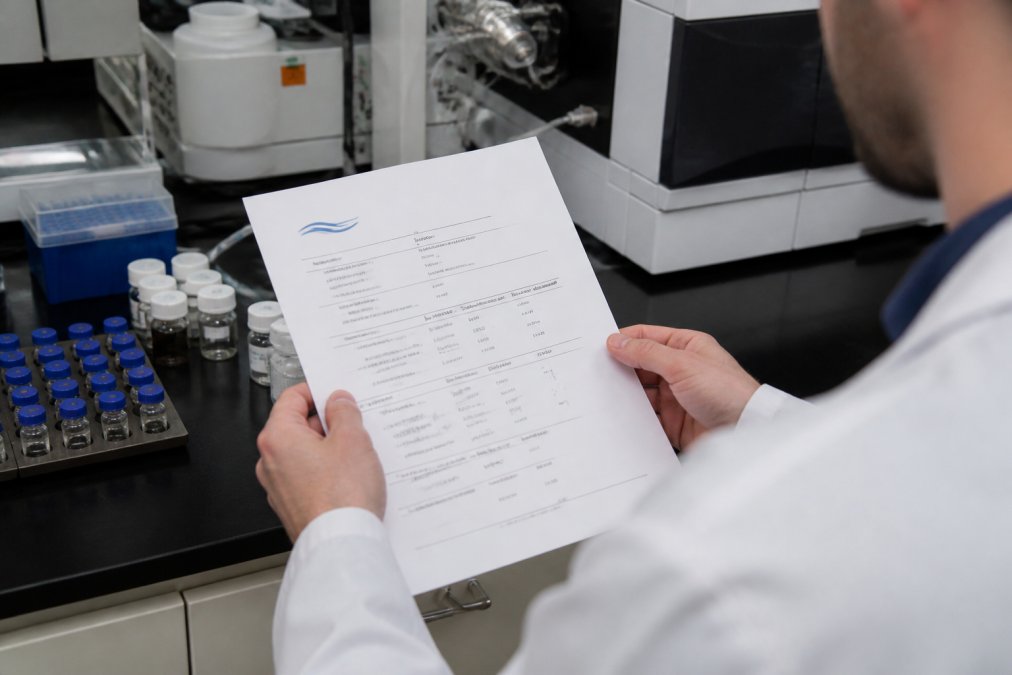
Start with the purity percentage, typically reported as a percentage by high-performance liquid chromatography (HPLC). This figure represents the area under the curve (AUC) of your desired peptide peak relative to all peaks in the chromatogram. A 99.2% purity reading means your target peptide accounts for 99.2% of the total material.
Next, examine the impurity profile. A quality COA lists each detected impurity by retention time and molecular weight. Common contaminants include trifluoroacetic acid (TFA) residue from synthesis, water content, and salt byproducts. TFA is particularly important to track; residual TFA can affect cell culture work and animal studies, making its quantification critical for downstream applications.
Check the analytical method itself. HPLC with UV detection at 214 nm is standard for peptide analysis because peptide bonds absorb strongly at this wavelength (peer-reviewed research). Some providers use mass spectrometry for additional confirmation. The method section should specify the column type, gradient, and detection parameters.
Look for the date of analysis and batch number. Peptides degrade over time, especially under poor storage conditions. A COA dated months before purchase suggests old inventory or suboptimal storage. Finally, note the storage recommendations. Peptides stored at -20°C in the dark remain stable for years; those stored at 4°C degrade faster.
Common Peptide Contaminants and Their Sources
Peptide synthesis generates byproducts at multiple stages. Understanding where contaminants originate helps you interpret your COA and predict how they'll behave in your experiments.
Trifluoroacetic acid (TFA) is the most prevalent contaminant, used during peptide cleavage from the resin. Even after purification, trace TFA persists and can alter pH, affect cell viability, and confound dose-response curves. Reputable suppliers report TFA content explicitly on the COA.
Water content is another major contaminant, especially in lyophilized peptides. Peptides are hygroscopic and absorb moisture from air. A peptide stored in a non-desiccated vial can gain 5-10% water weight within weeks. This dilutes your effective peptide concentration, so a vial labeled "99% purity" with 8% water content is really only 91% peptide by weight.
Salt byproducts from synthesis and purification accumulate as sodium chloride, ammonium acetate, and other inorganic salts. These are generally inert but can interfere with mass spectrometry assays and affect osmolarity in cell culture.
Partial sequences and truncated peptides arise when synthesis fails at a particular amino acid position. These truncated variants often have different biological activity, creating variability in experimental results. High-performance liquid chromatography separates these by retention time, and mass spectrometry confirms their molecular weight.
Oxidized methionine and cysteine variants form when these amino acids are exposed to oxygen during synthesis or storage. Methionine oxidation can alter peptide-receptor binding, while cysteine oxidation can lead to disulfide bond formation and aggregation. These are detected via mass spectrometry and should be quantified if your peptide contains these residues.
Impact of Peptide Impurities on Cell Culture
Cell culture experiments are uniquely sensitive to peptide purity. Cells respond to trace contaminants in ways that whole-animal models sometimes mask, making cell-based assays an early warning system for purity problems.
Residual TFA alters intracellular pH and can trigger stress responses unrelated to your peptide of interest. At concentrations above 0.1%, TFA measurably reduces cell viability and skews dose-response curves (peer-reviewed research). A dose-response study conducted with a peptide containing 0.5% TFA will show apparent toxicity at concentrations where pure peptide shows none.
Water content and salt byproducts change osmolarity. Cells in hyperosmotic media experience water loss and stress. A peptide preparation that is 8% water and 3% salt creates a hypertonic environment that confounds your results.
Truncated peptide variants compete for the same receptors as your full-length peptide. If your 20-amino acid peptide is contaminated with 5% 19-amino acid truncated variant, your dose-response curve becomes a mixture of two sigmoid curves that doesn't match any single peptide's expected behavior.
Oxidized variants often have reduced or altered binding affinity. Methionine oxidation can disrupt the peptide's 3D conformation, changing how it interacts with cell surface receptors. In a cell culture assay, a 5% oxidized fraction means your effective peptide concentration is 95% of what you think it is.
Aggregated peptides, formed when impure batches sit at room temperature, are biologically inert or trigger off-target inflammatory responses. The practical consequence: a 95% pure peptide batch can produce results that look like complete biological inactivity, even though the 95% pure fraction is fully active.
Third-Party Testing vs. In-House Verification
Third-party testing and in-house verification serve different purposes. Understanding the trade-offs helps you decide what level of validation your research demands.
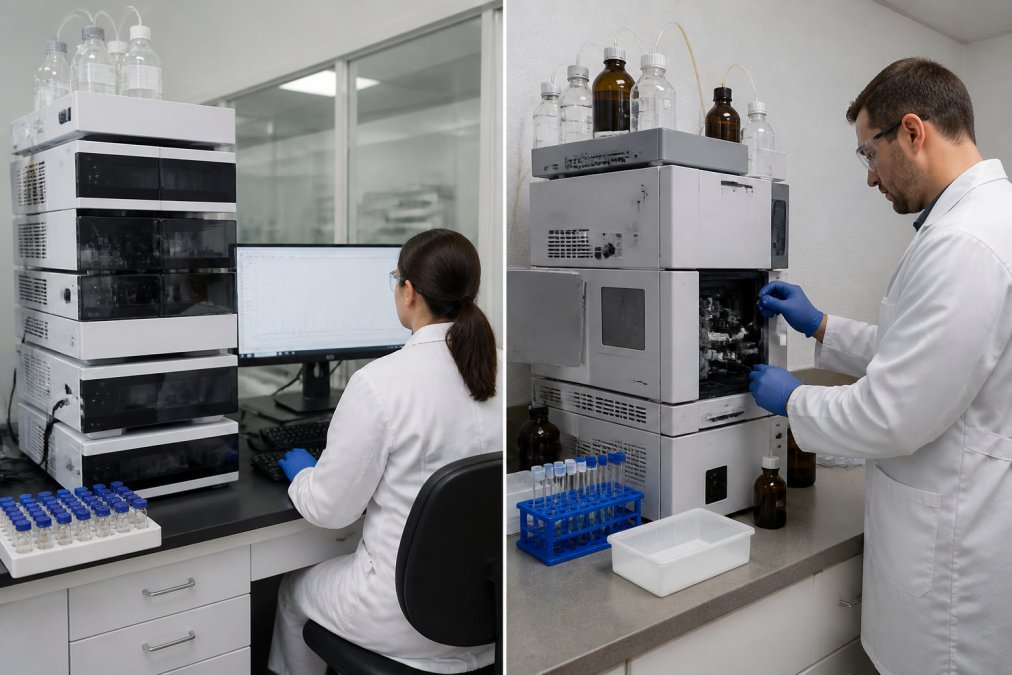
Third-party testing means an independent analytical laboratory performs HPLC, mass spectrometry, or other analytical methods and reports results on a Certificate of Analysis. The advantages are clear: the testing lab has no financial incentive to overstate purity, regulatory compliance is built in, and the results are defensible in publications and regulatory submissions. If your research is destined for an FDA submission or a peer-reviewed journal, third-party COAs are the standard.
The disadvantage is cost and turnaround time. Third-party testing adds 2-4 weeks to manufacturing. For large-volume orders, this is negligible; for small academic labs ordering occasional peptides, the cost premium can be significant.
In-house verification means your lab performs analytical testing on received peptides. This approach gives you immediate feedback and lets you test under your exact experimental conditions. The disadvantage is that in-house testing requires equipment and trained personnel. Many academic labs lack this infrastructure. In-house testing also doesn't resolve disputes if your measurement differs from the supplier's COA.
Best practice is a hybrid approach: purchase from suppliers who provide third-party COAs, then conduct spot-check in-house verification on a subset of batches. This gives you the credibility of third-party testing with the assurance of in-house confirmation.
BlueWaveCompound uses third-party lab testing for every batch, providing COAs that document analytical methods, purity percentages, and impurity profiles.
Peptide Synthesis Methods Comparison for Purity
The method used to synthesize a peptide significantly impacts the final purity and impurity profile.
Solid-phase peptide synthesis (SPPS) is the most common method for peptides under 50 amino acids. In SPPS, amino acids are added one at a time to a growing chain anchored to a resin bead. Each coupling step has an efficiency of 95-99%, meaning 1-5% of chains fail to add the next amino acid at each step (peer-reviewed research). For a 20-amino acid peptide, this compounds: even at 99% efficiency per step, you end up with roughly 82% of chains reaching full length. The remaining 18% are truncated variants. Purification removes most truncated variants, but some always remain. A final purity of 99% on a 20-residue peptide synthesized via SPPS is realistic.
Liquid-phase peptide synthesis (LPPS) is an older method where peptides are synthesized in solution rather than on a resin. This approach can produce very high purity (99.5%+) but is labor-intensive and rarely used today.
Recombinant expression involves producing the peptide as part of a larger protein in bacteria or yeast, then cleaving it out. This method can achieve extremely high purity (99.9%+) because the expression system produces the exact sequence genetically. The disadvantage is that this approach only works for peptides that can be expressed in cells; post-translationally modified peptides or non-natural amino acids cannot be made this way.
Fragment condensation synthesizes two or more peptide fragments separately via SPPS, then chemically joins them. This approach can produce very long peptides (50+ amino acids) with high purity because each fragment is purified before joining.
For most research applications, SPPS-derived peptides at 95-99% purity are appropriate. For applications requiring maximum reproducibility or regulatory submissions, recombinant expression or fragment condensation methods may be justified.
What 99%+ Purity Actually Signifies for Your Research
A peptide labeled "99% purity" means the area under the curve of your target peptide in an HPLC chromatogram represents 99% of the total area of all peaks detected. This distinction matters because HPLC detection has limits. Contaminants present at very low concentrations may not be detected at all, especially if they don't absorb strongly at 214 nm. A peptide can be labeled 99% pure and still contain undetected contaminants. This is why mass spectrometry is valuable; it detects peptides by molecular weight, revealing contaminants that HPLC might miss.
Additionally, 99% purity assumes the peptide was analyzed immediately after synthesis and purification. Peptides degrade during storage. A batch that was 99% pure on the day of manufacture might be 97% pure six months later if stored improperly.
For cell culture work, 99% purity is generally sufficient. For in vivo animal studies, 99% purity is the standard expectation. For regulatory submissions or pharmaceutical development, 99.5%+ purity is often required.
The practical implication: a 99% purity COA is meaningful only if the analysis was recent and storage conditions documented. A six-month-old COA from a peptide stored at room temperature is less reassuring than a fresh COA from a peptide stored at -20°C.
BlueWaveCompound provides COAs dated at or near the time of shipment, with storage recommendations that preserve purity.
Batch-to-Batch Consistency and Storage Stability
Reproducibility across batches is as important as purity within a single batch. If batch one of your peptide is 99% pure and batch two is 97% pure, you have two different materials, and your experimental results may not replicate.
Batch-to-batch consistency depends on manufacturing process control. The best indicator of process control is consistency across multiple COAs from the same supplier. If you examine COAs from five batches of the same peptide and see purity values of 99.1%, 99.3%, 98.8%, 99.2%, and 99.0%, that supplier is demonstrating consistency.
Storage stability determines how long a batch remains usable. Peptides degrade through hydrolysis, oxidation, and aggregation. The rate of degradation depends on temperature, humidity, light exposure, and the peptide's sequence composition. Peptides containing methionine and cysteine degrade faster than those without these residues.
A peptide stored at -20°C in the dark in a desiccated vial remains stable for years. The same peptide stored at room temperature degrades measurably within weeks. Lyophilization (freeze-drying) improves stability by removing water, which accelerates hydrolysis. Lyophilized peptides are more stable during storage and shipping than peptides in solution.
A supplier who provides clear storage recommendations and uses desiccated, light-protective packaging helps you maintain purity after purchase. Research institutions often encounter peptide degradation during shipping, especially in warm months. Suppliers who use insulated packaging, ice packs, or priority overnight shipping reduce this risk.
Peptide purity is not an abstract quality metric; it's the foundation of reproducible research. When impurities confound your results, you lose data and confidence in your hypothesis. The cost of purity verification is trivial compared to the cost of pursuing false leads.
BlueWaveCompound addresses this directly. Every batch is third-party lab tested, accompanied by a detailed Certificate of Analysis, and shipped with storage protocols that preserve purity. For research institutions that cannot afford experimental failures, this documentation and consistency provide the assurance needed to move research forward with confidence. Shop all peptides and experience the difference that verified purity brings to your research outcomes.
Frequently Asked Questions
Q: Is 99% purity good for research peptides?
A: Yes, 99% purity is considered high-quality for research-grade peptides and is the standard threshold for rigorous biochemical studies. At this level, impurities are minimal enough that they rarely introduce significant experimental noise. However, the specific purity requirement depends on your application, some sensitive assays may benefit from higher purity, while others function well at 95-98%. Always verify that the purity specification matches your experimental design and check the Certificate of Analysis to confirm the reported purity is backed by third-party analytical validation.
Q: What are the most common impurities found in synthetic peptides?
A: The most frequent contaminants in synthetic peptides include trifluoroacetic acid (TFA), water, residual salts, and incomplete synthesis byproducts. TFA is used during peptide synthesis and purification but can remain in the final product if not fully removed. Water content varies depending on lyophilization efficiency, and salts accumulate from buffer systems used during synthesis. Incomplete sequences and truncated peptides also appear as impurities. A comprehensive Certificate of Analysis will detail these contaminants using methods like high-performance liquid chromatography and mass spectrometry to quantify each impurity profile.
Q: How does peptide purity affect experimental reproducibility?
A: Peptide purity directly determines batch-to-batch consistency and experimental reproducibility. Lower purity introduces variable impurities that act as uncontrolled experimental variables, making it difficult to isolate the true effects of your target peptide. When purity is high and consistent, researchers can replicate results across experiments and across multiple batches. This consistency is essential for peer review, regulatory submissions, and building confidence in research findings. Third-party lab-tested peptides with documented purity levels provide the analytical validation needed to support reproducible science.
Q: Why is a Certificate of Analysis essential for research peptides?
A: A Certificate of Analysis (COA) provides third-party analytical documentation that validates the peptide's purity, molecular weight, sequence verification, and impurity profile. It serves as proof that the compound meets stated specifications and has been tested using standardized analytical methods such as high-performance liquid chromatography and mass spectrometry. For researchers, a COA enables you to justify your material choices in publications, meet institutional procurement requirements, and troubleshoot experimental outcomes with confidence. Without a COA, purity claims are unverified marketing statements rather than scientific facts.
This article was written using GrandRanker