 how-to
Peptide Reconstitution Best Practices for Researchers
Table of Contents
- Why Reconstitution Method Dictates Experimental Success
- Essential Equipment and Supplies for Aseptic Reconstitution
- Step-by-Step Peptide Reconstitution Protocol
- Calculating Peptide Concentration and Dosage Units
- Safe Handling Procedures for Research Grade Peptides
- Peptide Storage Temperature Requirements and Stability
- Troubleshooting Common Reconstitution Problems
- Conclusion: Standardize Your Protocol for Reliable Data
- Frequently Asked Questions
Last Updated: September 5, 2026
Why Reconstitution Method Dictates Experimental Success
Peptide reconstitution is the process of dissolving lyophilized peptide powder into a liquid solvent to create a usable stock solution. The method you choose directly determines whether your peptide retains its structural integrity or degrades before it ever touches your assay. Even a high-purity product can yield unreliable data if the solubilization process damages the compound.
At BlueWaveCompound, the difference between reproducible results and experimental noise often comes down to technique, not the peptide itself. A poor reconstitution protocol can cause denaturation, precipitation, or partial aggregation that no downstream analysis can correct.
The core tension is simple: peptides are fragile molecules, yet the standard workflow demands aggressive handling. Most guides gloss over this, but the reality is that your solvent choice, injection speed, and mixing method all influence peptide integrity. Below, we walk through a protocol for consistent, reliable results.
Essential Equipment and Supplies for Aseptic Reconstitution
Before touching a vial, assemble everything you need in a clean workspace. Peptide reconstitution demands strict aseptic technique because research grade peptides contain no preservatives and are vulnerable to microbial contamination once rehydrated.
| Supply | Purpose | Key Consideration |
|---|---|---|
| Bacteriostatic water or sterile diluent | Solvent for dissolving lyophilized powder | Match pH and composition to your peptide |
| Insulin syringe with needle | Precise volume measurement and injection | Use 0.5 mL or 1 mL for accuracy |
| Alcohol swabs | Sanitize vial stopper and work surface | 70% isopropyl alcohol standard |
| Sharps container | Safe disposal of needles and glass vials | Biohazard-compliant, puncture-resistant |
| Gloves and lab coat | Personal protection and contamination control | Powder-free nitrile recommended |
A common mistake is using standard sterile water when your peptide requires a specific pH balance. Many peptides dissolve poorly in unbuffered solutions and may precipitate. Bacteriostatic water works for many compounds, but acetic acid or other diluents may be necessary for acidic peptides.
Step-by-Step Peptide Reconstitution Protocol
This protocol assumes you are working with lyophilized peptide in a vacuum-sealed vial. Work slowly and deliberately; rushing this process is the leading cause of ruined preparations.
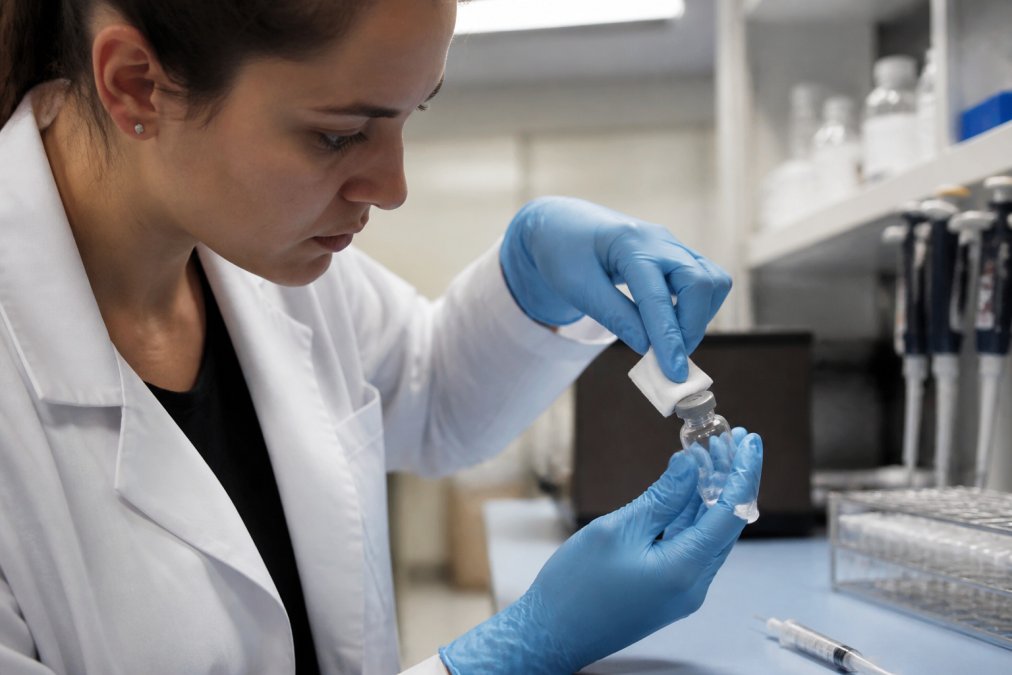
Step 1: Prepare Your Sterile Work Area
Clean your bench surface with 70% alcohol and allow it to dry completely. Lay out all supplies within easy reach. Remove the plastic flip-top from your peptide vial and wipe the rubber stopper thoroughly with a fresh alcohol swab. Let the stopper dry for 30 seconds; residual alcohol can degrade the peptide on contact.
Step 2: Select the Correct Solvent
Draw your chosen diluent into the syringe. The reconstitution ratio depends on your target concentration, which we cover in the next section. For most research grade peptides, bacteriostatic water is the default choice, but always consult your Certificate of Analysis for specific recommendations. Some peptides require a buffer solution or dilute acetic acid for complete solubilization.
Steps 3-6: Injection, Dissolution, and Mixing
Inject the diluent slowly against the inner glass wall of the vial, not directly onto the lyophilized powder. Direct impact can cause foaming and denaturation. Angle the needle so the liquid runs down the side.
Remove the syringe and gently swirl the vial. Do not shake or vortex vigorously; this introduces air bubbles and can damage peptide structure. Most peptides dissolve within a few minutes at room temperature. If your peptide requires cold chain handling, keep the vial on ice during this step.
Calculating Peptide Concentration and Dosage Units
Calculating peptide concentration is straightforward once you understand the relationship between peptide mass, diluent volume, and desired molarity. The basic formula is: concentration equals peptide mass divided by diluent volume.
For example, if you have a 5 mg vial and add 1 mL of bacteriostatic water, your stock concentration is 5 mg/mL. For insulin syringe measurements, remember that 1 mL equals 100 insulin units on a standard U-100 syringe. If you need 250 mcg per dose from a 5 mg/mL solution, draw 5 units on the syringe.
Let the peptide fully dissolve before calculating your final concentration. Undissolved particulate matter will skew your dosage calculations and compromise experimental accuracy.
Safe Handling Procedures for Research Grade Peptides
Safe handling procedures for research grade peptides extend beyond personal protection to preserving sample integrity and ensuring the safe lifecycle management of all materials that contact the compound. These compounds are for laboratory use only and require responsible management from the moment the vial is opened to the moment the waste is disposed of.
Personal Protective Equipment (PPE) and Technique
Always wear powder-free nitrile gloves and a lab coat when handling vials and syringes. A face shield or safety goggles are recommended when working with lyophilized powder, as accidental aerosolization can occur if a vial is dropped or the vacuum seal is broken forcefully. Work in a dedicated clean area, ideally a laminar flow hood, to protect both you and the sample from contamination.
Managing the Waste Stream: A Three-Tier Approach
Proper waste disposal is a critical safety component that is often overlooked in basic guides. The waste generated from peptide reconstitution falls into three distinct categories, each with its own handling requirements.
Tier 1: Sharps Waste
This includes all needles, syringes, and broken glass vials. These items must be placed immediately into a puncture-resistant, leak-proof sharps container that meets OSHA standards for bloodborne pathogens. Never recap a needle, bend it, or attempt to remove it from the syringe by hand. When the container is three-quarters full, seal it according to your institution's protocol and dispose of it as regulated medical waste. The OSHA Bloodborne Pathogens Standard provides the federal framework for this process.
Tier 2: Trace Chemo Waste
Many research peptides are considered hazardous drugs due to their biological activity. Any materials that directly contact the peptide solution, such as empty vials, transfer pipettes, and the alcohol swabs used to wipe the vial stopper, should be treated as trace chemo waste. This waste stream must be segregated from standard laboratory trash and placed in a designated, labeled container (typically a yellow chemo waste bag or bin) for incineration. Your institution's environmental health and safety (EHS) department can provide the specific container and pickup schedule.
Tier 3: Liquid Waste
Do not pour unused peptide solutions down the sink. Liquid waste containing peptides should be inactivated and disposed of according to your institution's chemical hygiene plan. A common method is to collect the liquid in a sealed container with an appropriate deactivating agent, such as a dilute bleach solution (typically 10% sodium hypochlorite), allowing sufficient contact time before disposal. Always check the Safety Data Sheet (SDS) for your specific peptide to confirm chemical compatibility with your chosen deactivation method. The OSHA Laboratory Safety Guidance outlines the requirements for a Chemical Hygiene Plan.
Preventing Cross-Contamination and Sample Loss
Beyond safety, proper handling preserves your sample. Peptides can adsorb to plastic surfaces, so minimize transfer steps. Use glass vials or low-binding tubes for storage whenever possible. When working with multiple peptides, change gloves between each compound to prevent cross-contamination. Label all waste containers clearly with the date and contents, and never leave needles or vials unattended on the bench.
By implementing a rigorous waste management protocol, you not only comply with federal safety regulations but also contribute to a safer laboratory environment and more reliable experimental data.
Peptide Storage Temperature Requirements and Stability
Peptide storage temperature requirements vary by compound, but the general rule is colder is safer. Lyophilized peptides are most stable when stored desiccated at -20°C or below, where they can maintain their stability profile for extended periods.
Once reconstituted, peptides degrade rapidly. Most solutions remain stable for only a few weeks at 2-8°C and should never be frozen, as ice crystal formation can damage the peptide structure. Always check the stability data provided with your specific compound.
The National Institutes of Health peptide storage recommendations emphasize that repeated freeze-thaw cycles are particularly damaging. Aliquot your reconstituted peptide into single-use portions before freezing to avoid this issue entirely.
Room temperature exposure accelerates degradation significantly. Minimize time out of cold storage during handling, and always return vials promptly to their designated temperature zone.
Troubleshooting Common Reconstitution Problems
Even with meticulous technique, you will occasionally encounter a vial that does not behave as expected. A cloudy solution, visible particulates, or a gel-like consistency are not necessarily signs of a bad peptide, often, they point to a specific, correctable misstep in your protocol. Here is a practical decision tree for the most common failure modes.
Problem: Cloudy Solution or Visible Precipitate
Likely Cause: Solvent pH or Ionic Strength Mismatch.
Most research peptides are formulated with a specific solvent in mind, and this is detailed on the Certificate of Analysis. A classic example is a peptide with a high isoelectric point (pI) that is readily soluble in pure water but will precipitate in a phosphate-buffered saline (PBS) due to the salt concentration. If you used a standard buffer and see cloudiness, the fix is often to dilute the solution with a small volume of the recommended solvent (e.g., bacteriostatic water) to lower the ionic strength and encourage dissolution.
Step-by-Step Remediation:
- Do Not Agitate: Gently swirl the vial. Do not vortex or shake, as this can cause irreversible aggregation.
- Add Solvent: Using a fresh syringe, add a volume of the recommended diluent equal to 10-20% of the original volume. For a 1 mL reconstitution, this means adding 100-200 µL.
- Slow Re-Dissolution: Place the vial on a gentle rocker or in a refrigerator at 2-8°C for 15-30 minutes. Cold temperatures often help solubilize certain peptides more effectively than room temperature.
- Assess: If the solution clears, your concentration has dropped slightly. Recalculate your dosing volumes based on the new total volume. If it remains cloudy, proceed to the next step.
Problem: Gel Formation or High Viscosity
Likely Cause: Peptide Concentration Too High or Hydrophobic Interactions.
Some peptides, particularly those with a high proportion of hydrophobic amino acids, can form a viscous gel at high concentrations. This is a physical phenomenon, not a chemical degradation.
Step-by-Step Remediation:
- Dilute Further: The most effective solution is to add more solvent to reduce the concentration below the gelation threshold. A 2x dilution is often sufficient.
- Use a Different Solvent: If dilution fails, the peptide may require a solvent with a slightly different polarity. For hydrophobic peptides, a small amount of a co-solvent like DMSO (dimethyl sulfoxide), typically 5-10% of the final volume, can be added to break up the hydrophobic interactions. Important: DMSO is not compatible with all downstream assays, so this is a last resort for stock solutions that will be further diluted.
Problem: Peptide Will Not Dissolve at All
Likely Cause: Degraded Product or Damaged Vacuum Seal.
If you have tried pH adjustment, dilution, and cold incubation with no effect, the lyophilized peptide itself may have lost its structural integrity. A broken vacuum seal in the vial allows moisture to enter, which can cause the peptide to form insoluble aggregates over time.
Step-by-Step Remediation:
- Inspect the Vial: Check the crimp seal and the rubber stopper for any signs of damage or movement. A compromised seal is a strong indicator of product failure.
- Contact Your Supplier: If you suspect a damaged product, contact your supplier with the lot number and Certificate of Analysis. A reputable vendor will often replace a product that fails to reconstitute if the seal was compromised.
Problem: Low Yield or Missing Peptide
Likely Cause: Non-Specific Binding to Surfaces.
Peptides can adsorb to the walls of plastic tubes and syringes, especially at low concentrations (below 1 mg/mL). This is a silent loss that skews your final concentration.
Step-by-Step Remediation:
- Use Low-Binding Plastics: For storage and transfer, use polypropylene tubes that are certified low-binding or siliconized.
- Rinse and Recover: When transferring a reconstituted peptide, rinse the original vial with a small volume of the storage buffer and add this rinse to your final tube to recover any adsorbed material.
- Minimize Transfers: Every transfer step is an opportunity for loss. Combine your peptide and solvent directly in the final storage vial whenever possible.
Conclusion: Standardize Your Protocol for Reliable Data
Standardizing your reconstitution protocol is the single most effective way to improve experimental reproducibility. Document every variable: solvent type, volume, mixing method, and storage conditions. Consistency across batches eliminates a major source of experimental noise.
Quality peptides make the difference easier to see. BlueWaveCompound provides third-party lab tested, high-purity peptides with Certificates of Analysis, so you start with material you can trust. Our compounds arrive lyophilized and stable, ready for your carefully executed reconstitution. For more information on peptide handling and to explore our product range, visit BlueWaveCompound and shop our full catalog of research grade peptides.
Frequently Asked Questions
What is the best solvent for reconstituting peptides?
Sterile bacteriostatic water is the standard first choice for most peptides because it maintains a stable pH. For peptides with poor solubility or that are prone to aggregation, sterile acetic acid or a specified buffer solution may be required. Always refer to the Certificate of Analysis from your supplier for specific recommendations. Using the wrong diluent can cause precipitation or denaturation, ruining the peptide integrity before you begin your experiment.
How much bacteriostatic water do I add to a 10 mg vial of peptide?
The volume depends on your target concentration. For a 10 mg vial, adding 1 mL of bacteriostatic water yields a concentration of 10 mg/mL. Adding 2 mL yields 5 mg/mL. Use the formula: peptide mass (mg) divided by desired concentration (mg/mL) equals the volume of diluent (mL). Accurate calculation prevents errors in dosage calculation for your downstream assays, ensuring experimental reproducibility.
Why did my peptide solution turn cloudy after adding water?
Cloudiness typically indicates the peptide has precipitated out of solution. This can happen if the pH of the diluent is incompatible with the peptide or if the peptide was exposed to extreme temperatures. First, try allowing the vial to sit at room temperature for a few minutes and swirl gently. If it remains cloudy, the peptide may be degraded. Proper handling and using the correct solvent are critical for maintaining peptide integrity.
Can I store reconstituted peptides at room temperature?
No. Once reconstituted, peptides are far less stable. You should aliquot the solution into sterile vials and store them frozen, typically at -20°C or lower, depending on the peptide's stability profile. Repeated freeze-thaw cycles cause degradation, so aliquoting is essential. Always check the storage guidelines provided by the manufacturer, as some peptides have specific peptide storage temperature requirements to prevent denaturation.
This article was written using GrandRanker
Frequently Asked Questions
Q: What is the best solvent for reconstituting peptides?
A: Sterile bacteriostatic water is the standard first choice for most peptides because it maintains a stable pH. For peptides with poor solubility or that are prone to aggregation, sterile acetic acid or a specified buffer solution may be required. Always refer to the Certificate of Analysis from your supplier for specific recommendations. Using the wrong diluent can cause precipitation or denaturation, ruining the peptide integrity before you begin your experiment.
Q: How much bacteriostatic water do I add to a 10 mg vial of peptide?
A: The volume depends on your target concentration. For a 10 mg vial, adding 1 mL of bacteriostatic water yields a concentration of 10 mg/mL. Adding 2 mL yields 5 mg/mL. Use the formula: peptide mass (mg) divided by desired concentration (mg/mL) equals the volume of diluent (mL). Accurate calculation prevents errors in dosage calculation for your downstream assays, ensuring experimental reproducibility.
Q: Why did my peptide solution turn cloudy after adding water?
A: Cloudiness typically indicates the peptide has precipitated out of solution. This can happen if the pH of the diluent is incompatible with the peptide or if the peptide was exposed to extreme temperatures. First, try allowing the vial to sit at room temperature for a few minutes and swirl gently. If it remains cloudy, the peptide may be degraded. Proper handling and using the correct solvent are critical for maintaining peptide integrity.
Q: Can I store reconstituted peptides at room temperature?
A: No. Once reconstituted, peptides are far less stable. You should aliquot the solution into sterile vials and store them frozen, typically at -20°C or lower, depending on the peptide's stability profile. Repeated freeze-thaw cycles cause degradation, so aliquoting is essential. Always check the storage guidelines provided by the manufacturer, as some peptides have specific peptide storage temperature requirements to prevent denaturation.