 ultimate-guide
Recombinant Peptide Production: Techniques Explained
Table of Contents
- What Is Recombinant Peptide Production?
- Synthetic Peptides vs. Recombinant Proteins for Assays
- Recombinant Peptide Expression Systems: Host Organisms and Vectors
- Challenges in Recombinant Peptide Purification and Downstream Processing
- Peptide Synthesis Quality Control Protocols
- Scalability, Cost-Effectiveness, and Regulatory Standards
- Frequently Asked Questions
Last Updated: September 23, 2026
Recombinant Peptide Production: Techniques Explained
Recombinant peptide production has become essential for researchers who need high-purity compounds for biochemical assays and drug discovery. At BlueWaveCompound, we understand that the choice between synthetic and recombinant approaches fundamentally shapes your experimental outcomes. This guide breaks down the techniques, host systems, and quality standards that separate reliable peptide production from unreliable sources.
What Is Recombinant Peptide Production?
Recombinant peptide production is the process of using living cells to manufacture peptides by expressing cloned DNA sequences. Unlike chemical synthesis, which builds peptides atom by atom, recombinant methods use biological expression systems, bacteria, yeast, or mammalian cells, to generate peptides through protein expression and subsequent purification.
Synthetic Peptides vs. Recombinant Proteins for Assays
This comparison is where many researchers make their first critical decision. Synthetic peptides and recombinant proteins address different experimental needs, and choosing the wrong approach wastes time and budget.
| Characteristic | Synthetic Peptides | Recombinant Peptides |
|---|---|---|
| Production time | 3-7 days | 2-4 weeks |
| Sequence length | Up to 50 amino acids | 50+ amino acids easily |
| Post-translational modifications | Limited or absent | Native-like modifications possible |
| Scalability | Moderate | Excellent |
| Cost per gram (small quantities) | Lower | Higher |
| Cost per gram (large quantities) | Higher | Lower |
| Batch reproducibility | Good | Excellent |
Recombinant Peptide Expression Systems: Host Organisms and Vectors
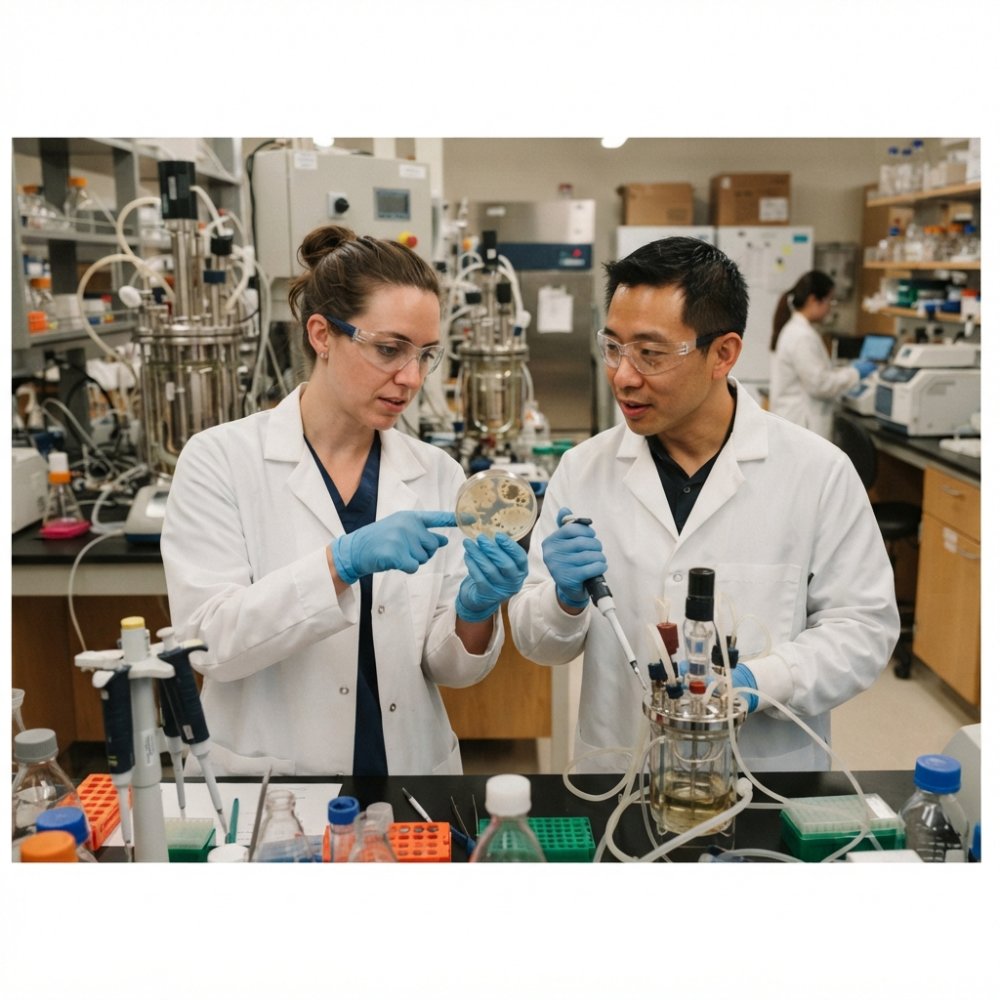
Recombinant peptide expression systems depend on two critical components: the host organism and the expression vector. Together, they determine production efficiency, peptide yield, and final product quality.
Bacterial Expression Systems
Bacterial hosts, primarily Escherichia coli, remain the workhorse of recombinant peptide production. Bacteria replicate rapidly, reaching high cell densities in fermentation, and they tolerate genetic engineering well. A plasmid (circular DNA vector) carrying your target peptide sequence is introduced into bacterial cells via transfection or transformation.
Yeast and Mammalian Expression Systems
Yeast (Saccharomyces cerevisiae and Pichia pastoris) bridges the gap between bacterial and mammalian systems. Yeast cells secrete expressed peptides into the culture medium, simplifying downstream purification. They also perform basic post-translational modifications, though not with the sophistication of mammalian cells.
Challenges in Recombinant Peptide Purification and Downstream Processing
Recombinant peptide production doesn't end at fermentation. Downstream processing, purification and polishing, determines final product purity, yield, and stability. However, the path from fermentation broth to pure peptide is fraught with technical obstacles that separate successful projects from costly failures.
Inclusion Body Formation and Refolding
The most significant challenge in recombinant peptide production, particularly in bacterial systems, is inclusion body formation. When E. coli or other bacterial hosts express recombinant peptides at high levels, the protein often accumulates as insoluble aggregates in the cytoplasm rather than folding into native, soluble structures. This occurs because rapid translation outpaces the cell's protein-folding machinery, and hydrophobic peptide regions aggregate to minimize water contact.
Common refolding failures include:
- Aggregation during dilution: Peptide precipitates before refolding completes, reducing final yield by 30-60%.
- Incomplete disulfide bond formation: Peptides with multiple cysteines require oxidizing conditions (air exposure, hydrogen peroxide, or redox-active buffers) to form native disulfide pairs. Incorrect disulfide bonds produce misfolded isoforms that contaminate the final product.
- Off-pathway aggregation: The peptide forms kinetically trapped structures that are thermodynamically unfavorable but kinetically stable, preventing conversion to native form.
Chromatographic Purification and Multi-Stage Workflows
After refolding (or for soluble-expression systems, directly after cell lysis), the target peptide exists within a complex mixture of host cell proteins, nucleic acids, endotoxins, and media components. A single chromatography step cannot achieve research-grade purity. Most recombinant peptides require sequential purification stages.
A typical three-stage purification workflow looks like:
- Capture: Ion-exchange or affinity chromatography removes bulk contaminants (host proteins, nucleic acids).
- Intermediate purification: Size-exclusion or second ion-exchange step removes remaining protein contaminants and aggregates.
- Polishing: Affinity chromatography (if not used earlier) or reverse-phase HPLC achieves final purity >95%.
Stability, Aggregation, and Storage
Purified recombinant peptides are biochemically fragile. Proteases (residual host proteases or environmental contamination) cleave peptide bonds. Oxidation damages methionine and cysteine residues, altering peptide charge and hydrophobicity. Freeze-thaw cycles cause aggregation and precipitation. Exposure to light, heat, or alkaline pH accelerates degradation.
Endotoxin and Sterility Challenges
Bacterial expression systems inherently produce endotoxins (lipopolysaccharides from gram-negative bacteria like E. coli). Endotoxins are pyrogenic and trigger strong immune responses in mammalian cells, confounding cell-based assays. Standard chromatography steps remove most endotoxin, but trace amounts persist. Limulus amebocyte lysate (LAL) assay detects endotoxin at nanogram-per-milliliter levels; research-grade peptides typically target <0.1 EU/mL (endotoxin units per milliliter).
Peptide Synthesis Quality Control Protocols
Quality control separates research-grade peptides from unreliable products. Rigorous testing at multiple stages ensures batch consistency and experimental reproducibility.
Scalability, Cost-Effectiveness, and Regulatory Standards
Recombinant peptide production scales predictably, but scalability and regulatory compliance are intertwined. A process that works at milliliter scale may fail at liter scale, and a process that works for research may not meet regulatory requirements for clinical use. Understanding both dimensions is essential for long-term project success.
Scalability and Process Economics
Recombinant peptide production exhibits favorable scaling characteristics. A bacterial fermentation that produces milligrams in a 50-mL shake flask scales to grams in a 5-liter bioreactor, and to kilograms in a 100-liter or larger vessel. The core process remains identical: inoculation, growth, induction, fermentation, harvest, and purification. Only the volume and equipment change.
However, scaling introduces new challenges:
- Heat transfer: Large fermentation vessels generate metabolic heat. Poor temperature control causes cell stress, reduced expression, and inclusion body formation.
- Oxygen transfer: Aerobic bacteria require dissolved oxygen. Large vessels have lower surface-area-to-volume ratios, making oxygen transfer a bottleneck. Inadequate aeration shifts metabolism toward anaerobic pathways, reducing peptide yield.
- Mixing: Inhomogeneous mixing in large bioreactors creates local pH and nutrient gradients, reducing expression uniformity.
- Chromatography column scaling: Purification columns must be scaled proportionally. A 1-liter column used for small batches becomes a 50-liter column for large batches, requiring different resin, different flow rates, and different equilibration times.
Regulatory Framework for Clinical-Grade Peptides
Peptides intended for research use face minimal regulatory burden. But if your peptide will eventually support a therapeutic development program, regulatory agencies impose strict requirements on manufacturing, quality, and documentation.
FDA Guidance and GMP Requirements
Key CMC requirements include:
- Manufacturing process validation: The process must be documented in detail and validated to consistently produce peptide meeting all specifications. Validation requires three consecutive batches meeting all acceptance criteria.
- Process controls: Critical parameters (fermentation temperature, pH, dissolved oxygen, induction timing, harvest timing) must be monitored and controlled within defined ranges. Out-of-specification deviations must be investigated and documented.
- In-process testing: Samples taken during fermentation and purification are tested for identity, purity, and potency. Results are documented in batch records.
- Stability testing: Peptide samples are stored under defined conditions (typically 25°C/60% RH, 5°C, and −20°C) and periodically tested by HPLC, mass spectrometry, and other methods. Stability data establishes shelf life and storage recommendations.
- Batch records: Every batch is documented from raw materials through final product. Records include equipment used, personnel, parameters, test results, and deviations. Batch records are retained for the product's lifetime plus additional years as specified by regulations.
Good Manufacturing Practice (GMP)
- Personnel: Manufacturing staff must be trained in GMP and their specific roles. Training records are maintained.
- Facilities and equipment: Facilities must be designed, constructed, and maintained to prevent contamination. Equipment must be validated and calibrated. Environmental monitoring (air quality, surface cleanliness) is performed regularly.
- Materials and components: Raw materials and reagents must be tested for identity and purity. Suppliers must be qualified and audited.
- Production and process controls: Procedures for each manufacturing step must be documented and followed. Deviations are investigated and documented.
- Quality control and testing: In-process and final-product testing is performed by qualified personnel using validated methods. Test results are documented and reviewed.
- Documentation and record-keeping: All manufacturing activities are documented. Records are retained and made available for regulatory inspection.
EMA Requirements
Quality-by-Design (QbD) and Process Analytical Technology (PAT)
Modern regulatory guidance emphasizes Quality-by-Design (QbD), a proactive approach to ensuring product quality. Rather than testing quality into the product at the end, QbD builds quality into the process from the start.
QbD involves:
- Defining the target product profile (TPP): What are the critical quality attributes (CQAs) of your peptide? Examples: purity >95%, endotoxin <0.1 EU/mL, moisture content <5%, identity confirmed by mass spectrometry.
- Understanding the process: Which process parameters most strongly influence CQAs? This is determined through design-of-experiments (DoE) studies at small scale.
- Defining the design space: The range of process parameters that consistently produce peptide meeting all CQAs. Operating within the design space provides assurance of quality.
- Implementing process analytical technology (PAT): Real-time or near-real-time monitoring of critical process parameters (fermentation pH, dissolved oxygen, cell density) allows rapid detection of deviations and corrective action.
Choosing Between Research-Grade and GMP-Grade Peptides
Visit https://bluewavecompounds.com to explore research-grade peptides backed by Certificates of Analysis, stability data, and third-party lab testing. Our peptides are designed to meet the rigorous standards of scientific excellence and provide the documentation your institution requires for vendor approval and procurement.
Frequently Asked Questions
What are the primary steps in recombinant peptide production?
Recombinant peptide production involves six core steps: designing the target peptide sequence and selecting an appropriate expression vector; cloning the cDNA into a plasmid; transfecting the host organism (bacteria, yeast, or mammalian cells); cultivating cells in a bioreactor under optimized conditions; harvesting and lysing cells to release expressed peptides; and purifying the product using chromatography and other downstream processing techniques. Each step directly impacts final purity and yield.
How do recombinant production techniques differ from chemical synthesis?
Recombinant methods use living cells to synthesize peptides through genetic engineering and bioprocessing, making them ideal for long polypeptide chains and complex post-translational modifications. Chemical synthesis builds peptides amino acid by amino acid using solid-phase methods, offering precise control for shorter sequences but becoming impractical beyond 50-70 amino acids. Recombinant approaches typically achieve higher scalability and lower per-unit costs at large volumes, while chemical synthesis excels in speed and customization for shorter peptides.
Which host organisms are most commonly used in recombinant peptide expression?
Bacteria (especially E. coli) are the most widely used due to rapid growth, low cost, and established molecular cloning techniques. Yeast and mammalian cell lines are chosen when post-translational modifications or proper protein folding is critical. Each host has trade-offs: bacteria offer speed and yield but may produce inclusion bodies; mammalian cells provide authentic modifications but require more complex fermentation and longer culture times. Selection depends on the target peptide's complexity and required biological activity.
What role does third-party lab testing play in ensuring peptide purity?
Third-party lab testing provides independent verification that recombinant peptides meet stated purity claims, typically ≥99% for research-grade compounds. Testing includes high-performance liquid chromatography (HPLC) for purity assessment, mass spectrometry for molecular weight confirmation, and endotoxin screening. A Certificate of Analysis documenting these results ensures reproducibility in your experiments and provides the documentation required by institutional procurement and regulatory compliance processes.
What are the main challenges in recombinant peptide purification?
Key purification challenges include removing host cell proteins and contaminants, recovering peptides from inclusion bodies when they form, maintaining peptide stability during chromatography, and achieving consistent batch-to-batch reproducibility. Inclusion bodies are particularly problematic in bacterial systems and require solubilization and refolding steps. Chromatography methods must balance recovery yield with purity, and downstream processing must preserve the peptide's biological activity and shelf-life stability throughout the process.
How does batch-to-batch reproducibility affect research outcomes?
Inconsistent peptide batches introduce experimental noise that obscures true biological signals, forcing researchers to repeat experiments and waste time and resources. Batch-to-batch variation in purity, potency, or stability can invalidate comparisons across studies and undermine confidence in published results. Rigorous quality control protocols, consistent fermentation parameters, and standardized purification procedures ensure that each batch meets the same specifications, enabling reproducible results and reliable data interpretation across multiple experiments.
What regulatory standards apply to recombinant peptide production for research?
Research-grade recombinant peptides are subject to quality standards suitable for scientific use. Institutions typically require vendors to document compliance with relevant quality management systems. Certificates of Analysis demonstrating purity, sterility, and endotoxin levels satisfy institutional procurement requirements and ensure your materials meet regulatory expectations for research integrity.