 blog
blog
Reliable Peptide Synthesis for Research: 2026 Buyer's Guide
Table of Contents
- What Defines Reliable Peptide Synthesis for Research
- Comparison Framework: How to Evaluate Peptide Synthesis Providers
- Custom Peptide Synthesis Quality Control: What to Expect
- The Importance of a Certificate of Analysis for Peptides
- How to Buy Research Grade Peptides Online Without Getting Burned
- Troubleshooting Synthesis Challenges: When Results Do Not Match the COA
- Regulatory Compliance Roadmap for Research Peptide Procurement
- Frequently Asked Questions
Last Updated: September 16, 2026
What Defines Reliable Peptide Synthesis for Research
Reliable peptide synthesis for research means producing a peptide whose sequence, purity, and batch-to-batch consistency match what the certificate of analysis promises, every time you reorder. Most procurement headaches trace back to one gap: the material arrives, and you have no independent way to confirm it is what the label says.
Comparison Framework: How to Evaluate Peptide Synthesis Providers
Evaluate any peptide synthesis provider against five criteria: documented purity, sequence verification method, batch reproducibility, turnaround time, and the completeness of the certificate of analysis. Price per milligram tells you almost nothing on its own.
| Criterion | What to Ask For | Red Flag |
|---|---|---|
| Purity documentation | HPLC chromatogram per batch | Purity stated without a trace |
| Sequence verification | Mass spectrometry data | No mass spec reported |
| Batch consistency | Retention samples or reorder guarantee | No policy on reorders |
| Analytical transparency | Full COA, third-party testing | COA on request only |
| Turnaround | Quoted lead time in writing | Vague delivery windows |
Custom Peptide Synthesis Quality Control: What to Expect
Quality control in custom peptide synthesis rests on two independent checks: one confirming the sequence is correct, and one confirming how much of the material is the target peptide. Skipping either leaves you guessing.
Analytical Methods That Verify Sequence and Purity
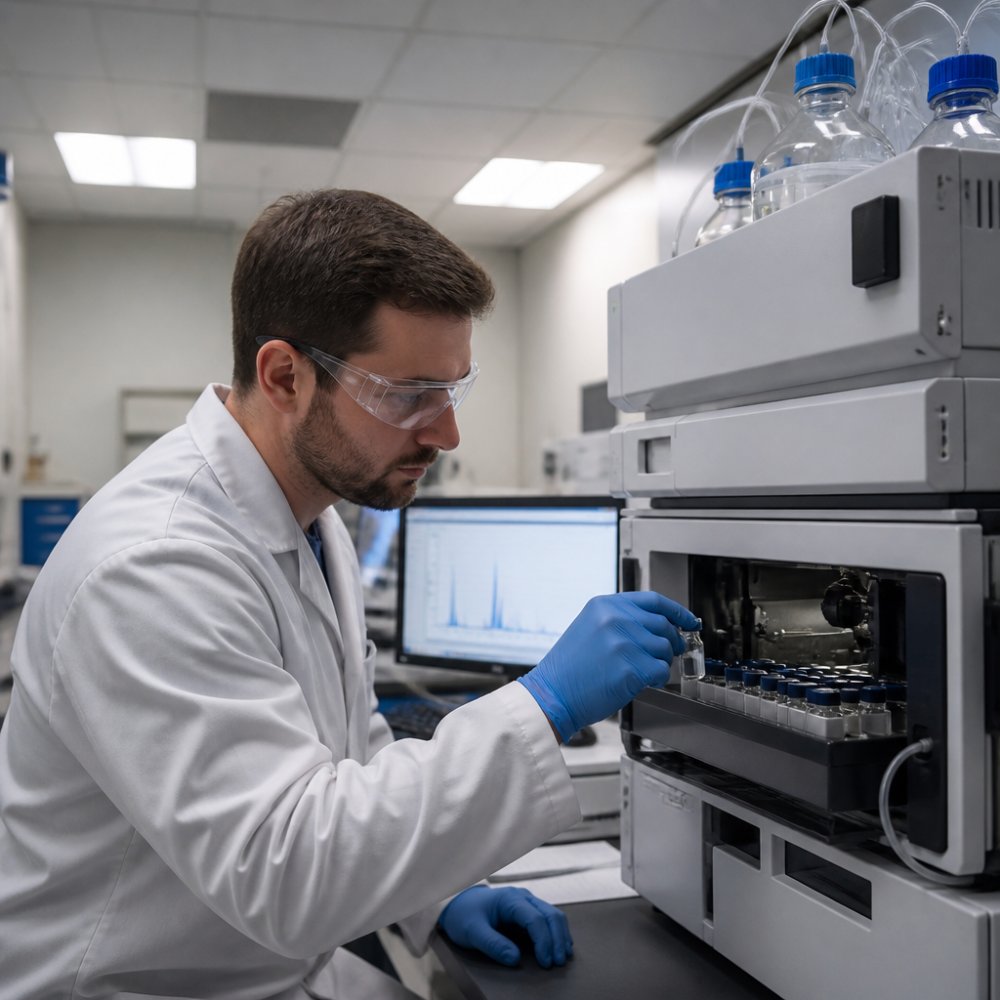
High-performance liquid chromatography (HPLC) separates the target peptide from impurities on a column, producing a chromatogram with a main peak plus any shoulders or satellite peaks. Purity is calculated from relative peak areas, typically the percentage of total integrated area under the main peak at 214 nm. When reading a chromatogram, check three things: retention time of the main peak, number and size of impurity peaks, and baseline cleanliness.
A Neutral Rubric for Judging Analytical Data
Most vendor pages say they test; few say what passing looks like. Use this rubric to evaluate any batch's documentation on its own merits:
| Check | What to Look For | Why It Matters |
|---|---|---|
| HPLC purity | Main peak area at or above the stated spec, with the wavelength and method noted | A percentage without a method cannot be reproduced or compared |
| Chromatogram quality | Clean baseline, single dominant peak, no unexplained shoulders | Shoulders can indicate deletion or truncation impurities |
| Mass confirmation | Observed mass within a tight tolerance of theoretical | Confirms identity, not just homogeneity |
| Method transparency | Column type, gradient, and detection wavelength disclosed | Lets you judge whether the method suits your peptide |
| Lot traceability | Data tied to the specific lot number on the vial | Prevents reference-batch data from standing in for yours |
Where Synthesis Gets Difficult
Some sequences are simply harder to make well. Hydrophobic-rich sequences aggregate on the resin, suppressing coupling and inflating deletion impurities. Long sequences accumulate truncation products. Cysteine-containing sequences can form disulfide-linked dimers if oxidation is uncontrolled, and histidine and cysteine are prone to racemization under certain coupling conditions.
The Importance of a Certificate of Analysis for Peptides
A certificate of analysis ties a specific lot of peptide to its test results. It should name the peptide, lot number, purity figure, analytical methods, and testing date. Without a lot-specific COA, you cannot trace a result back to the material that produced it.
A COA worth trusting includes:
- Peptide name and sequence as synthesized
- Lot or batch number matching the vial label
- Purity percentage with the HPLC method noted
- Mass spectrometry confirmation of molecular weight
- Appearance, solubility, and storage recommendations
- Testing date and, where applicable, third-party lab identification
How to Buy Research Grade Peptides Online Without Getting Burned
Buying research grade peptides online comes down to verifying three things before you pay: the vendor tests independently, the documentation is lot-specific, and the shipping method protects the compound in transit. Get those right and most of the risk disappears.
A practical checklist before you click buy:
- Confirm the vendor provides a lot-specific COA with HPLC and mass spec data
- Ask whether testing is done in-house or by an independent lab
- Verify the shipping method and expected transit time
- Check the reorder and batch-consistency policy
- Confirm the guarantee terms in writing, including any conditions
Troubleshooting Synthesis Challenges: When Results Do Not Match the COA
When results do not match the certificate of analysis, work through the problem in order: confirm the peptide is what the COA says, confirm it survived shipping and storage, then confirm your assay conditions. Most discrepancies resolve at one of those three steps.
Regulatory Compliance Roadmap for Research Peptide Procurement
Research peptide procurement sits in a different regulatory space than peptide therapeutics, and mixing the two creates real problems. Research-grade peptides are sold for laboratory investigation, not human or veterinary use, and your documentation should reflect that distinction. The roadmap below covers the compliance habits that keep a lab audit-ready and the transition points that matter when a project moves toward clinical work.
The Research-Grade Baseline
Build your compliance habits around documentation rather than assumption:
- Intended use: State clearly in your records that material is for research purposes only. This labeling is what keeps a reagent outside the definition of a regulated drug or biological product.
- Vendor documentation: Retain the COA, lot number, and testing records for every order. Store them where they can be retrieved years later, not in a single purchaser's inbox.
- Institutional review: Confirm your institution's procurement requirements for research reagents before ordering, not after. Environmental health and safety, purchasing, and the office of research administration often each have a say.
- Chain of custody: Keep records of receipt, storage conditions, and internal transfers. If a peptide moves between freezers or labs, the record should move with it.
- Third-party testing: Where your institution requires independent verification, request it and file the results alongside the vendor COA.
Requirements vary by institution and funding source, so check your own organization's policies and any applicable federal guidance rather than relying on a vendor's summary. The FDA guidance on drug and biological product definitions is a useful starting point for understanding where research reagents sit relative to regulated products. For institutional requirements, your office of research administration is the authority that matters.
When Research Moves Toward Clinical Work
This is the transition most commercial pages skip, and where projects get into trouble. A peptide adequate for a cell-based assay is not automatically suitable for a toxicology study or first-in-human trial, the material, documentation, and manufacturing controls all change.
A practical sequence for a project approaching clinical work:
- Define the intended use early. Determine whether the peptide will be used in animals, in humans, or only in vitro. The answer drives every downstream requirement.
- Identify the regulatory pathway. A peptide intended as a therapeutic candidate generally falls under drug or biological product oversight, which brings requirements for manufacturing controls and documentation that research-grade material does not meet.
- Plan the grade transition before you need it. Sourcing GMP-grade material takes longer and costs more than research-grade, and the analytical and stability work cannot be compressed at the last minute.
- Bridge the analytical data. When you move from a research batch to a GMP batch, you need comparability data showing the two materials behave the same in your assays. Plan for this rather than assuming equivalence.
- Engage your regulatory affairs group early. They can tell you which documentation your specific pathway requires, and it is far cheaper to learn this before a study than after.
Keeping the Paper Trail Clean
The most common compliance failure is not a bad peptide, it is a missing record. A reviewer asking two years later what was in a specific tube needs a lot number, COA, and storage history that connect. File that documentation at receipt and the audit question answers itself.
Frequently Asked Questions
What criteria define reliable peptide synthesis for laboratory research?
Reliable peptide synthesis for research comes down to verified purity (typically 95% or higher for most biochemical assays), confirmed sequence integrity through mass spectrometry, and batch-to-batch consistency you can document. Providers should supply a Certificate of Analysis with every lot, run third-party testing rather than only in-house QC, and offer traceable analytical data such as HPLC chromatograms and LC-MS spectra. Turnaround time and shipping conditions also matter because degraded peptides produce noisy results regardless of how pure they were at release.
Why is a Certificate of Analysis critical when sourcing research peptides?
A Certificate of Analysis is the only document that ties a specific batch to its measured purity, molecular weight, and test methods. Without it, you cannot verify that what arrived matches what you ordered, and your institution's procurement office has no paper trail for compliance. When you buy research grade peptides online, insist on a COA that lists HPLC purity percentage, mass spectrometry confirmation, the testing laboratory, and a lot number that matches the vial label. If a provider cannot produce that, the purity claim is unverifiable.
How do third-party lab tests ensure the quality of research-grade peptides?
Third-party testing removes the conflict of interest that exists when a manufacturer grades its own material. An independent laboratory runs HPLC to measure purity, LC-MS to confirm molecular mass, and often amino acid analysis to verify composition. Because the testing lab has no stake in the sale, its results are more defensible in a publication or an audit. Ask whether the COA comes from an accredited external lab and whether you can request the raw chromatogram, not just a summary percentage.
What are common challenges in peptide synthesis and how do providers mitigate them?
Common problems include incomplete coupling during solid-phase synthesis, which creates truncated sequences; aggregation that lowers yield; and oxidation of sensitive residues like methionine or cysteine. Reputable providers mitigate these by using excess reagents and extended coupling times, running in-process Kaiser tests to confirm each addition, and purifying by preparative HPLC after cleavage. They also lyophilize the final product to improve stability and test solubility before release. If you see unexpected peaks in your own HPLC run, request the synthesis batch record and the original chromatogram from your supplier.