 ultimate-guide
Third-Party Peptide Testing: Why It Matters
Table of Contents
- What Third-Party Peptide Testing Actually Is
- Why Independent Verification Matters for Research Integrity
- How to Verify Peptide Purity: The Science Behind Testing Methods
- Understanding Certificate of Analysis (COA) Reports
- Red Flags in Fraudulent COAs and How to Spot Them
- Chain of Custody: Protecting Sample Integrity From Lab to Your Bench
- Cost-Benefit Analysis for Small-Scale Research Labs
- Choosing a Reliable Testing Provider and Verifying Results
- Frequently Asked Questions
Last Updated: September 2, 2026
What Third-Party Peptide Testing Actually Is
Third-party peptide testing is the independent analytical verification of a peptide sample's identity, purity, and composition by a laboratory that has no financial stake in the sale or use of that compound. Unlike supplier-provided test results, which can introduce bias, third-party testing creates an objective record of what's actually in your sample.
When you order research-grade peptides, the manufacturer could theoretically claim anything about purity. A third-party lab removes that conflict of interest. They run standardized analytical testing methods, document their findings in a Certificate of Analysis (COA), and provide you with verifiable data about your compound's real characteristics.
This matters because experimental results depend on material quality. If your peptide batch contains impurities, degradation products, or inconsistent molecular composition, your research data becomes unreliable. You might spend months chasing results that fail to reproduce because the compound itself was the variable, not your methodology.
At BlueWaveCompound, we understand that researchers need more than marketing claims. Every batch of our research-grade peptides undergoes third-party lab testing, and we provide the complete COA with every order. This transparency allows you to verify purity before committing your research time and resources.
Why Independent Verification Matters for Research Integrity
The foundation of reproducible science rests on material consistency. If two labs run identical experiments with peptides from different sources, or even different batches from the same source, and get different results, how do you know which data is trustworthy?
Independent verification solves this problem. A third-party laboratory has no incentive to inflate purity claims or downplay contamination. Their reputation depends on accuracy, not on making sales. When they report that your peptide sample is 99.2% pure, that number comes from standardized analytical methodology, not marketing optimism.
This is especially critical for academic research. Your institution's credibility and your own publication record depend on experimental integrity. Peer reviewers and journal editors increasingly scrutinize the quality of materials used in published research. A documented third-party COA demonstrates that you took material verification seriously and that your results are built on a foundation of known, verified compound characteristics.
The risk of skipping this step is real. Contaminated or mislabeled peptides have derailed research projects, wasted grant funding, and in some cases led to retracted publications (peer-reviewed research). A small investment in independent verification upfront prevents far larger costs downstream.
How to Verify Peptide Purity: The Science Behind Testing Methods
Verifying peptide purity requires analytical testing methods that can identify the target peptide, quantify how much is present, and detect what else is in the sample. Two primary techniques dominate this field: HPLC and mass spectrometry. Each answers different questions about your compound.
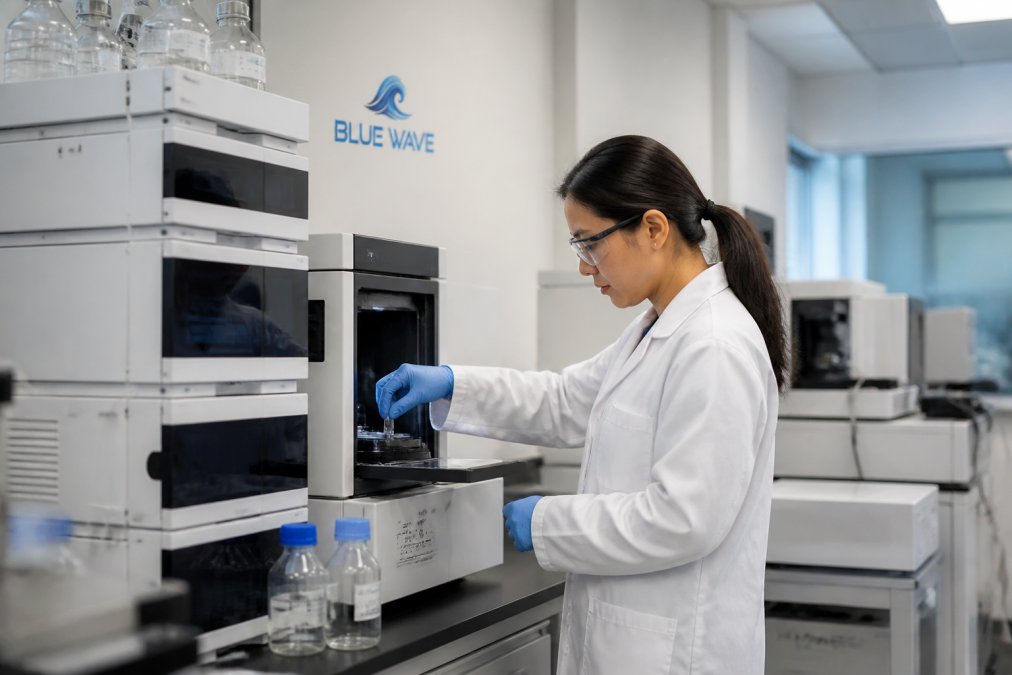
HPLC and Mass Spectrometry for Peptides
High-Performance Liquid Chromatography (HPLC) separates peptide molecules based on their chemical properties as they move through a specialized column. The detector measures how much material elutes at each time point, creating a chromatogram, a visual record showing peaks that represent different compounds in your sample.
For peptides, HPLC tells you several things: it confirms the presence of your target peptide by comparing its retention time to a known standard, it quantifies the percentage of that peptide relative to the total sample weight, and it reveals the presence of related impurities or degradation products. A pure peptide sample shows one dominant peak; contaminated samples show multiple peaks of varying heights.
Mass spectrometry takes this further by measuring the exact molecular weight of compounds in your sample. This technique ionizes peptide molecules and sorts them by their mass-to-charge ratio. For identity confirmation, mass spectrometry is powerful because peptides have unique molecular weights. If your sample contains the expected mass, the identity is confirmed. If unexpected masses appear, you've detected contaminants or synthesis byproducts.
Many rigorous testing protocols use both methods together. HPLC provides purity percentage and identifies degradation products. Mass spectrometry confirms molecular identity and detects unexpected compounds. Combined, they create a comprehensive picture of sample quality.
Contaminant Screening and Purity Standards
Beyond identifying the target peptide, independent labs screen for common contaminants that affect research validity. These include endotoxin levels, bacterial byproducts that trigger immune responses in cell culture experiments, heavy metal contamination from synthesis or storage, and residual solvents from the manufacturing process.
Purity standards vary by application. For most research applications, a minimum of 95% purity is acceptable (peer-reviewed research). However, for sensitive experiments, particularly those involving cell signaling, receptor binding, or immunological responses, many labs require 98% or higher. Some specialized applications demand 99%+ purity to eliminate even minor contaminants that might confound results.
A credible third-party lab reports these standards explicitly in the COA. They don't just state "99% pure." They specify which analytical method was used, what the acceptance criteria were, and what contaminants were screened for. This level of detail allows you to assess whether the testing matched your experimental needs.
Understanding Certificate of Analysis (COA) Reports
A Certificate of Analysis is your documentary proof that third-party testing occurred and what the results showed. It's not a marketing document; it's a technical record that should include specific data points you can evaluate and interpret to assess whether the material meets your research requirements.
What a Complete COA Must Contain
A legitimate COA includes these essential elements:
- Compound identification: The peptide name, molecular formula, and sequence (if applicable)
- Batch and lot number: A unique identifier tied to your specific order, not a generic batch code
- Date of analysis: The exact date testing was performed, not just the month or year
- Testing laboratory credentials: The lab's name, address, accreditation status (ISO 17025 or equivalent), and the analyst's name or initials
- Analytical methods used: Specific techniques (HPLC, mass spectrometry, etc.) with parameters (column type, wavelength, temperature, flow rate for HPLC; ionization method for mass spec)
- Quantitative results: Purity percentage with decimal precision (e.g., "98.7%" not "~99%"), identity confirmation data, and molecular weight if mass spectrometry was used
- Contaminant screening results: Specific tests performed (endotoxin, heavy metals, residual solvents, water content) with numerical results and detection limits
- Acceptance criteria: The threshold values used to determine pass/fail (e.g., "Purity ≥98% by HPLC"; "Endotoxin <10 EU/mg")
- Storage and handling notes: Recommended storage conditions and shelf-life stability data
- Analyst signature or certification: Evidence that a qualified person reviewed and approved the results
How to Interpret Purity Data
When you see "98.7% purity" on a COA, that number comes from a specific calculation. For HPLC, the lab integrates the area under the peak corresponding to your target peptide, divides it by the total area of all peaks, and multiplies by 100. This means:
- A single dominant peak at 98.7% indicates high purity with minor impurities making up 1.3% of the sample
- Multiple peaks suggest the presence of related compounds, degradation products, or synthesis byproducts
- The retention time of your peptide's peak should match the retention time of a reference standard analyzed on the same day, confirming identity
For mass spectrometry, look for the molecular ion peak (M+H or M+Na, depending on ionization) at the expected mass. If your peptide has a theoretical molecular weight of 1,234.56 Da, the mass spec should show a peak at that mass (within 0.01 Da for high-resolution instruments). Unexpected peaks at different masses indicate contaminants or incomplete synthesis.
Comparing Results Across Batches
If you order the same peptide multiple times, you'll receive multiple COAs. Comparing them reveals consistency:
- Purity should be stable: If batch 1 is 98.5% pure and batch 2 is 97.2% pure, the variation is acceptable (within typical analytical variation). If batch 3 drops to 94%, that's a red flag suggesting manufacturing or storage issues.
- Impurity profiles should be similar: The same degradation products or byproducts should appear in similar proportions across batches. If batch 1 shows a 0.8% impurity peak and batch 2 shows a completely different impurity, the manufacturing process may have changed.
- Molecular weight should be identical: Mass spectrometry results should show the same molecular ion peak across all batches. Variation suggests different synthesis routes or contamination.
Keep COAs from previous orders and compare them when you reorder. This practice catches manufacturing drift before it affects your research.
Red Flags in Fraudulent or Inadequate COAs
Not all COAs are created equal, and some are fabricated entirely. Knowing what to look for protects you from unknowingly purchasing untested or mislabeled compounds.
Red flag: The COA comes from the supplier's own in-house lab. If the company that manufactured the peptide is also the company that tested it, you don't have independent verification. This introduces the exact bias that third-party testing is designed to eliminate. Legitimate suppliers use external laboratories with no financial stake in the sale.
Red flag: The COA lacks specific analytical methodology. Vague language like "tested for purity" or "meets quality standards" without naming the method is a warning sign. Real COAs specify "HPLC analysis with UV detection at 214 nm" or "electrospray ionization mass spectrometry" or other recognized techniques with parameters.
Red flag: Missing or generic batch numbers. A legitimate COA ties results to a specific batch with a traceable number. If the COA doesn't reference a batch number that matches your order, or if the batch number is suspiciously generic ("Batch 2026-A" or "Standard Batch"), question it. Legitimate batch numbers typically include date codes or sequential identifiers.
Red flag: No testing laboratory name, location, or credentials. A real COA identifies the lab that performed the analysis by name and location. You should be able to verify that lab's existence, accreditation, and contact information. If the COA lists no lab name, lists a lab you can't find online, or provides only a generic "Certified Laboratory" label, it's likely fabricated.
Red flag: Suspiciously perfect results. A COA claiming 99.9% purity with zero contaminants detected across all screening methods is unrealistic. Real analytical results show minor variations. Even high-purity peptides typically show trace impurities (0.1-0.5%) when analyzed by sensitive methods. Perfection is a sign of fraud or inadequate testing.
Red flag: The COA date doesn't match your order timeline. If you ordered a peptide in September 2026 but the COA is dated March 2026, the sample may have degraded during storage, or the COA may belong to a different batch. Always verify that the testing date is recent relative to your shipment. A gap of more than a few weeks between analysis and receipt warrants investigation.
Red flag: Acceptance criteria are missing or vague. A legitimate COA states the criteria used to evaluate results. For example: "Identity confirmed by mass spectrometry. Purity ≥98% by HPLC. Endotoxin <10 EU/mg. Residual solvents <5000 ppm." If the COA doesn't specify what "acceptable" means, you can't assess whether the testing was rigorous enough for your needs.
Red flag: No detection limits or sensitivity data. For contaminant screening, the COA should state the detection limit (the lowest concentration the method can reliably detect). If a COA says "No heavy metals detected" without stating the detection limit, you don't know if the lab was sensitive enough to catch trace contamination.
Verifying the Testing Laboratory Directly
When you receive a COA, verify the testing laboratory independently. Look up their website, check their accreditations on the ISO 17025 registry or relevant regulatory databases, and if you're uncertain, contact them directly to confirm they performed the analysis. This extra step costs nothing and prevents costly mistakes.
Ask the lab these questions:
- Can you confirm you analyzed batch [batch number] on [date]?
- What is your ISO 17025 accreditation scope? (This tells you which methods they're certified for.)
- Who is the analyst of record for this COA?
- What is your detection limit for [specific contaminant]?
Legitimate labs will answer these questions promptly. If a lab is evasive or claims they can't discuss specific COAs due to confidentiality, that's suspicious.
Red Flags in Fraudulent COAs and How to Spot Them
Not all COAs are created equal, and some are fabricated entirely. Knowing what to look for protects you from unknowingly purchasing untested or mislabeled compounds.
Red flag: The COA comes from the supplier's own in-house lab. If the company that manufactured the peptide is also the company that tested it, you don't have independent verification. This introduces the exact bias that third-party testing is designed to eliminate. Legitimate suppliers use external laboratories.
Red flag: The COA lacks specific analytical methodology. Vague language like "tested for purity" or "meets quality standards" without naming the method is a warning sign. Real COAs specify "HPLC analysis," "mass spectrometry," or other recognized techniques.
Red flag: Missing or generic batch numbers. A legitimate COA ties results to a specific batch with a traceable number. If the COA doesn't reference a batch number that matches your order, or if the batch number is suspiciously generic ("Batch 2026-A"), question it.
Red flag: No testing laboratory name or credentials. A real COA identifies the lab that performed the analysis. You should be able to verify that lab's existence and accreditation. If the COA lists no lab name or lists a lab you can't find online, it's likely fabricated.
Red flag: Suspiciously perfect results. A COA claiming 99.9% purity with zero contaminants detected across all screening methods is unrealistic. Real analytical results show minor variations and typically detect trace contaminants even in high-purity samples. Perfection is a sign of fraud.
Red flag: The COA date doesn't match your order. If you ordered a peptide in September 2026 but the COA is dated March 2026, the sample may have degraded, or the COA may belong to a different batch. Always verify that the testing date is recent relative to your shipment.
When you receive a COA, verify the testing laboratory directly. Look up their website, check their accreditations, and if you're uncertain, contact them to confirm they performed the analysis. This extra step costs nothing and prevents costly mistakes.
Chain of Custody: Protecting Sample Integrity From Lab to Your Bench
A COA tells you what the peptide was like when the testing lab received it. But what happened between synthesis and testing? What happened between testing and your lab? Chain of custody protocols document the sample's journey and ensure it hasn't been contaminated, mislabeled, or substituted.
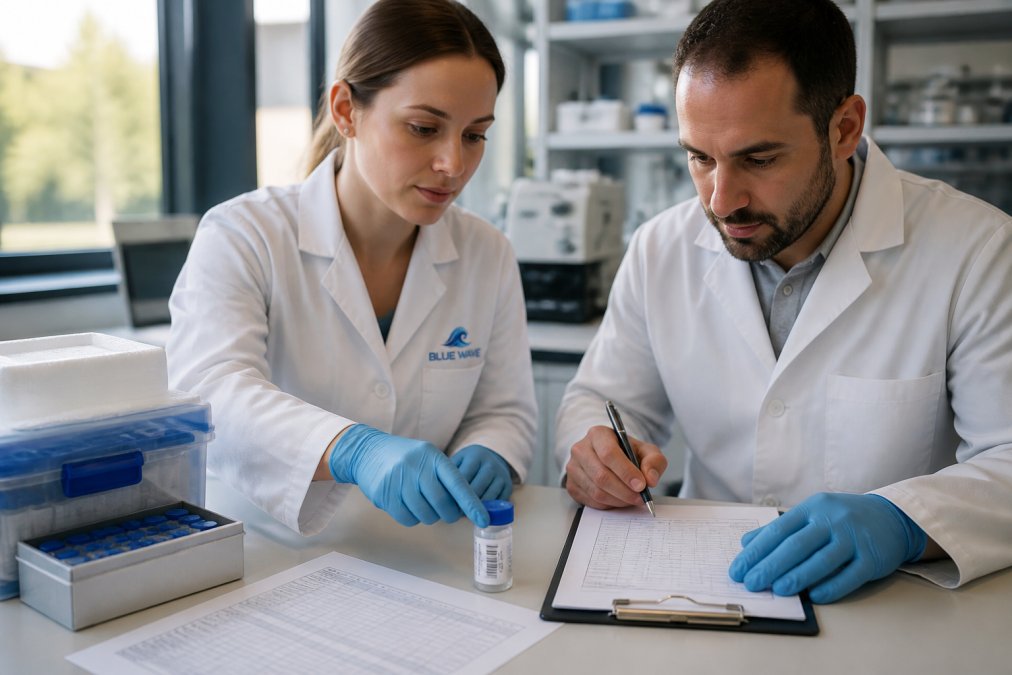
Proper chain of custody includes documented transfer records at each step. When the peptide leaves the manufacturer, there's a record. When it arrives at the testing lab, there's a record. When it ships to you, there's a record. Each transfer is timestamped and signed. If the sample is stored, storage conditions (temperature, humidity, light exposure) are logged.
This matters because peptides degrade over time, especially under poor storage conditions. A peptide that was 99% pure on the day of testing might be 96% pure three months later if stored improperly. Chain of custody documentation proves that your sample was handled correctly and that the COA results reflect the condition of the material you actually received.
When evaluating a peptide supplier, ask about their chain of custody protocols. Do they use temperature-controlled shipping? Do they seal samples to prevent tampering? Do they provide documentation of storage conditions? Do they use tracking systems that record the sample's location at each step? Suppliers who take these steps seriously will have detailed answers.
BlueWaveCompound maintains rigorous chain of custody protocols for every shipment. Your peptide is sealed, tracked, and stored under controlled conditions from our facility to your lab. This commitment to sample integrity is documented in the materials we provide with every order.
Cost-Benefit Analysis for Small-Scale Research Labs
Budget constraints are real for academic labs and small research teams. Third-party testing adds cost to your peptide purchase. The question becomes: does the benefit justify the expense?
Consider the alternative cost of working with untested or low-confidence material. If your peptide is contaminated and you don't know it, you might spend weeks running experiments that fail to produce expected results. You'll repeat the work, troubleshoot your methodology, and eventually (if you're thorough) test the peptide itself, discovering the problem only after wasting time and resources.
For most research applications, the cost of third-party testing, typically a modest addition to the peptide purchase price, is far less than the cost of wasted experimental time. If your research depends on material quality, third-party verification is not a luxury; it's a requirement.
Small labs can also negotiate with testing providers. Some labs offer tiered pricing based on the scope of testing. You don't need every possible contaminant screen if your application has specific known risks. Talk to your supplier about customizing the testing to match your actual needs, which can reduce costs while still providing the verification you require.
Additionally, spreading the cost across multiple researchers or multiple projects makes it negligible per experiment. If five researchers in your lab each use peptides monthly, the cost per researcher per year is minimal.
Choosing a Reliable Testing Provider and Verifying Results
Not all testing laboratories are equal. Some are accredited by recognized bodies; others operate without formal credentials. Accreditation matters because it means the lab has been independently audited for accuracy, methodology, and record-keeping.
When selecting a testing provider, or evaluating a supplier's choice of testing lab, look for these credentials: ISO 17025 accreditation, which certifies the lab's competence in specific analytical methods (iso.org); membership in recognized industry organizations; and published standard operating procedures that you can review.
Ask your supplier these questions: Which lab performs the testing? Can you provide their accreditation documentation? How long has this lab been in business? Can you provide references from other researchers who've used their services? What is their turnaround time? What happens if results fall outside acceptable ranges?
A reputable supplier will answer these questions transparently. They'll be proud of their testing partnerships and willing to share details. If a supplier is vague or defensive about their testing procedures, that's a warning sign.
BlueWaveCompound partners with accredited third-party laboratories that specialize in peptide analysis. We provide the full COA with every order, and we're transparent about our testing standards and the labs we work with. If you have questions about our testing protocols, our team can connect you directly with the laboratory for additional details.
Choosing research-grade peptides without independent verification is a gamble with your experimental integrity. The cost of third-party testing is small compared to the cost of unreliable data. When you work with a supplier who commits to transparency, providing detailed COAs, maintaining rigorous chain of custody, and partnering with accredited laboratories, you're investing in reproducible, publishable research.
Visit bluewavecompounds.com to explore our peptide catalog and review the third-party testing documentation that comes with every batch. Our commitment to analytical transparency means you can trust your materials and focus on your science.
Frequently Asked Questions
What does third-party peptide testing actually verify?
Third-party peptide testing confirms the identity, purity, and potency of peptide samples through independent laboratory analysis. Testing detects the presence of impurities, degradation products, and contaminants while verifying molecular weight and composition. Independent labs use standardized analytical methodologies like HPLC and mass spectrometry to provide unbiased verification that suppliers cannot manipulate. This independent verification protects research integrity by ensuring your experimental materials match their labeled specifications.
How do I verify the authenticity of a Certificate of Analysis (COA)?
Verify COA authenticity by confirming the testing laboratory's accreditation, checking that the report includes specific analytical data (not just pass/fail statements), and confirming the lab's contact information is legitimate. Authentic COAs show batch-specific results with quantitative values, methodology descriptions, and analyst signatures. Request direct contact with the testing lab to confirm they performed the analysis. Watch for red flags: vague language, missing data, inconsistent formatting, or supplier-issued reports rather than independent lab letterhead. Cross-reference the lab's credentials with recognized accreditation bodies.
Why is third-party testing considered the gold standard for peptide quality?
Third-party testing eliminates analytical bias because independent laboratories have no financial incentive to overstate purity or hide contaminants. Supplier-provided testing creates conflict of interest: they benefit from reporting high purity regardless of actual results. Independent labs follow standardized testing protocols, maintain chain of custody documentation, and provide reproducible results. Their reputation depends on accuracy, not on pleasing customers. For research integrity and regulatory compliance, independent verification ensures your data reflects the actual quality of your materials, not marketing claims.
What should I look for in a peptide testing provider?
Choose providers with recognized accreditation, experience in peptide analysis, and transparent methodology documentation. Verify they perform identity confirmation via mass spectrometry and quantitative purity analysis via HPLC. Request sample reports to assess data quality and detail level. Confirm they maintain proper chain of custody protocols and provide batch-specific results, not generic templates. Check turnaround times and pricing structures that align with your research schedule and budget. Ask about stability testing capabilities if your research requires long-term shelf-life verification. Visit https://bluewavecompounds.com to see how quality-focused providers document their testing standards.
This article was written using GrandRanker