 ultimate-guide
Why Peptide Purity Matters in 2026: A Research Guide
Table of Contents
- Why Peptide Purity Matters in 2026
- How to Verify Peptide Purity Before You Order
- Understanding Certificate of Analysis (CoA) Documents
- Analytical Methods Behind Purity Testing: HPLC and Mass Spectrometry
- Peptide Impurity Thresholds 2026: What Regulators Expect
- Long-Term Stability and the Cost-Purity Trade-Off
- Frequently Asked Questions
Last Updated: September 13, 2026
Why Peptide Purity Matters in 2026
Peptide purity is the percentage of the target peptide present in a sample, measured against all other material in that vial. In 2026, this number decides whether your experiment produces clean data or noise, and it is the single figure most often misread by researchers ordering materials. This guide from BlueWaveCompound covers how to verify purity before you buy, how to read a Certificate of Analysis, and why the cost-purity trade-off is rarely what it seems. (Source: FDA's guidance on analytical methods)
Here's the uncomfortable part: a label claiming 99% purity tells you almost nothing on its own. It doesn't tell you who ran the test, whether the result applies to the batch in your hand, or what the remaining 1% actually contains. Those three gaps cause more failed experiments than any other purchasing mistake.
The 2026 picture has shifted. Purchasing agents now request batch-specific documentation as standard, and principal investigators increasingly refuse vendors who can't produce independent analytical data. That's a reasonable position, and it's one more labs should adopt.
Below, we'll show you exactly how to verify purity, spot a weak CoA, and decide when paying more actually buys you better results.
How to Verify Peptide Purity Before You Order
Verification starts before money changes hands. Ask for batch-specific third-party test results, and treat any vendor who deflects as a vendor you don't need.
Requesting Third-Party Test Results
Third-party testing means an independent laboratory, not the manufacturer, ran the analysis. Ask for the report by batch number, not a generic sample document. A legitimate supplier will send it without friction.
What to request:
- The full analytical report, not a summary line
- The testing laboratory's name and the date of analysis
- The specific method used for each test
- Confirmation the batch number matches your order
If a supplier sends a CoA for a different batch, that's not verification. It's marketing.
Checking Batch-Specific Documentation
Batch consistency is where most quality problems hide. Two vials from the same vendor can differ meaningfully if quality control is loose.
Ask these questions before ordering:
- Does the CoA carry a batch or lot number that matches the vial label?
- Is there a retest or expiry date?
- Can the supplier show results from a previous batch for comparison?
At BlueWaveCompound, every batch is third-party lab tested and shipped with its own Certificate of Analysis, so the document in your inbox describes the material in your vial. That distinction sounds small. It isn't.
Understanding Certificate of Analysis (CoA) Documents
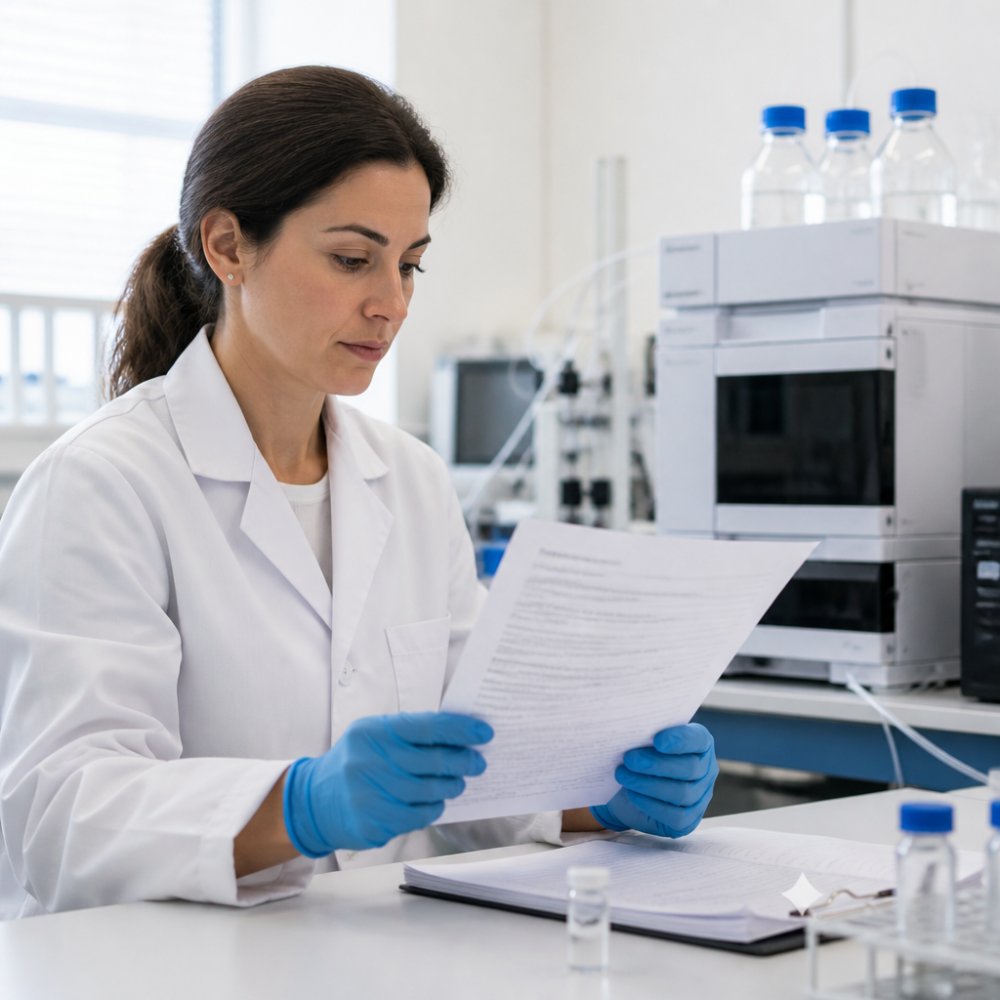
A Certificate of Analysis is a formal document reporting the analytical results for a specific batch of material, including its identity, purity, and test methods. It is the primary evidence a supplier can offer, and it's also the document most researchers skim rather than read.
Key Sections of a CoA
Most CoAs follow a similar structure. Knowing what each section should contain makes weak documents obvious.
| Section | What It Should Show | Why It Matters |
|---|---|---|
| Batch identification | Lot number, manufacture date | Ties results to your vial |
| Identity test | Mass spectrometry result | Confirms the correct molecule |
| Purity test | HPLC chromatogram and percentage | Quantifies the main peak |
| Appearance | Lyophilized powder description | Flags handling problems |
| Storage guidance | Temperature and light conditions | Protects shelf life |
| Authorization | Analyst name and lab details | Establishes accountability |
Red Flags in CoA Documentation
Some warning signs are subtle. Others are not subtle at all.
Watch for these:
- No chromatogram image, only a stated percentage
- Purity listed without the method used to obtain it
- Missing batch number or a number that doesn't match the label
- No testing laboratory identified
- Results dated years ago with no retest
- A single "purity" figure with no impurity profile
A CoA that can't tell you how the number was produced isn't documentation. It's a claim.
Analytical Methods Behind Purity Testing: HPLC and Mass Spectrometry
Two methods carry most of the weight in peptide quality control: HPLC for purity and mass spectrometry for identity. Together they answer the two questions that matter, which are how much of the target peptide is present and whether it is the right molecule at all.
HPLC (High-Performance Liquid Chromatography) separates the components of a sample as they pass through a column, producing a chromatogram with distinct peaks. The main peak represents your target peptide; smaller peaks represent impurities. Purity percentage is calculated from the area under the main peak relative to total peak area.
Mass spectrometry measures the molecular weight of the sample and compares it against the theoretical mass of the intended amino acid sequence. If the measured mass matches, identity is confirmed. If it doesn't, you're holding the wrong compound.
What the combination reveals:
- A clean single peak on HPLC plus an accurate mass means a well-made batch
- A correct mass with multiple HPLC peaks suggests synthesis by-products
- A single HPLC peak with the wrong mass means a pure sample of the wrong thing
That last scenario is rare, and it's exactly why identity verification exists as a separate step from purity measurement.
Peptide Impurity Thresholds 2026: What Regulators Expect
Impurity thresholds depend on the grade of material and its intended use, and research-grade peptides are not held to the same standard as clinical-grade material. That gap is real, and it's frequently misunderstood.
The categories researchers encounter most often:
- Research grade: intended for laboratory work, not human use
- Clinical grade: manufactured under stricter controls for therapeutic applications
Clinical-grade material is produced under current Good Manufacturing Practices, and the FDA guidance on drug substance impurities sets out the framework regulators apply to active pharmaceutical ingredients. That framework separates impurities into three buckets, and the distinction matters when you read a CoA:
- Organic impurities, starting materials, synthesis by-products, and degradation products. These are the peaks you see on an HPLC chromatogram.
- Inorganic impurities, residual salts, heavy metals, and catalysts carried over from synthesis or purification.
- Residual solvents, organic liquids left behind from manufacturing steps, each with its own exposure limit.
For organic impurities, the framework applies reporting, identification, and qualification thresholds that scale with the daily dose of the drug. A common pattern is that any impurity above a set reporting threshold must be listed, any impurity above a higher identification threshold must be structurally characterized, and any impurity above a qualification threshold must have its biological safety established. The exact numbers depend on dose, which is why a single "purity percentage" never tells the whole story.
Research-grade peptides sit outside that framework by design, which is precisely why independent testing and a complete CoA carry so much weight for laboratory buyers. A research-grade CoA may report a single purity figure without ever listing individual impurity peaks, and that omission is legal, but it leaves you unable to judge whether the remaining percentage is water, salt, or a truncated sequence.
The practical takeaway: don't assume a percentage means the same thing across vendors. Two suppliers can both print "≥99%" while testing to different methods, against different reference standards, with different impurity detection limits. The number is only comparable when the method behind it is.
For most biochemical research, the impurity profile matters more than the headline figure. A batch at 98% purity with a clean, well-characterized impurity profile is often a better experimental material than a 99% batch with an unexplained shoulder peak.
When you compare two CoAs, compare the detection method and the limit of detection, not just the percentage. A method that can only detect impurities above 1% will report a clean 99% result even when sub-1% deletion sequences are present. Ask what the assay can see, not just what it found.
Long-Term Stability and the Cost-Purity Trade-Off
Two factors separate careful buyers from everyone else: how the material survives storage, and whether higher purity is worth the higher price. Both deserve more scrutiny than they usually get, and most guides stop at the initial certificate, which is exactly where the useful analysis begins.
How Purity Degrades After the Certificate Is Issued
A CoA describes the batch on the day it was tested. It says nothing about the vial six months later. Purity loss after release follows a few predictable pathways:
- Hydrolysis, water attacks the peptide backbone, cleaving it into fragments. This is the dominant degradation route for peptides held in solution.
- Oxidation, susceptible residues, particularly methionine and cysteine, react with oxygen and change the molecule's mass and activity.
- Deamidation, asparagine and glutamine residues lose an amide group over time, shifting the peptide's charge and its behavior on HPLC.
- Aggregation, peptides clump into higher-order structures that may not appear as a distinct impurity peak but change how the material behaves in assay.
Each pathway runs faster under specific conditions. Heat accelerates all of them. Moisture accelerates hydrolysis. Light drives oxidation. Repeated freeze-thaw cycles concentrate salts and stress the peptide with every transition.
Lyophilized peptides are generally more stable than solutions, but they still degrade when exposed to warmth, light, or repeated temperature swings (peer-reviewed research). Storage conditions on the CoA are not boilerplate; they're instructions. A vial left at room temperature for a week may not match the purity on its certificate when you finally open it.
A practical stability protocol most labs converge on:
- Store lyophilized powder at the temperature the CoA specifies, typically well below freezing for long-term holds.
- Aliquot before reconstituting so you thaw only what you need.
- Avoid repeated freeze-thaw cycles; each one costs you measurable purity.
- Protect reconstituted solutions from light and use them within the window the supplier states.
- Re-test if a batch has been in storage beyond its retest date.
Why Higher Purity Costs More: The Yield Curve
The cost-purity trade-off is where budgets and data quality collide. Higher purity costs more because purification is expensive and yield drops as you push impurities lower. The relationship is not linear, it's a curve that gets steeper near the top.
Here's the mechanism. After synthesis, the crude peptide contains the target sequence plus truncated sequences, deletion products, and other by-products. Purification by preparative HPLC separates these by running the mixture through a column and collecting the fraction containing the target. To reach 95% purity, you collect a relatively wide slice of the main peak. To reach 99%, you collect a narrower slice and discard the shoulders, which means discarding material you already paid to synthesize. The higher the purity target, the more of the batch you throw away, and the more synthesis runs you need to fill the same order.
That is why a jump from 95% to 98% often costs far less than a jump from 98% to 99%. The last percentage point is the most expensive one, because it requires the tightest cut and the greatest yield loss.
The question isn't whether purer is better. It's whether the extra purity changes your result.
| If your work involves... | Purity priority | Reasoning |
|---|---|---|
| Quantitative assays and kinetics | High | Impurities skew rate data |
| Receptor binding studies | High | Off-target binding muddies results |
| Exploratory screening | Moderate | Small impurity effects tolerated |
| Method development | Moderate | Focus is on protocol, not precision |
Purity Is Not Bioavailability
One misconception worth correcting: a pure peptide is not automatically a bioavailable one. Purity describes how much of the target molecule is present. Bioavailability describes how much of it reaches its target in active form. A 99% pure peptide can still perform poorly if it aggregates, if it's degraded before it reaches the assay system, or if its formulation prevents it from dissolving properly. When a clean CoA doesn't translate into clean results, the problem is usually downstream of purity, in handling, reconstitution, or assay design.
This is where independent third-party verification earns its place. A vendor's internal testing is a claim; an outside laboratory's report is evidence. When you're weighing a price difference between suppliers, you're really weighing how much you trust their documentation.
BlueWaveCompound builds its process around that idea. Every batch is third-party lab tested, purity targets ≥99%, and each order ships with a Certificate of Analysis covering identity, purity, and storage guidance. If you need to see test results before committing, you can request them at https://bluewavecompounds.com.
Frequently Asked Questions
Is 98% purity good for a peptide?
For most research applications, 98% purity is the minimum acceptable threshold. However, sensitive assays like receptor binding studies or in vivo work often require 99% or higher. The remaining 1-2% consists of truncated sequences, deletion products, and synthesis by-products that can introduce experimental noise. Always match the purity specification to your assay sensitivity, and request batch-specific CoA documentation to confirm the actual measured value.
What is the industry standard for acceptable peptide purity?
Research-grade peptides typically require 95% or higher chromatographic purity, while clinical-grade material often exceeds 98%. The acceptable threshold depends on your application: screening assays tolerate lower purity, but quantitative studies demand higher. Reputable suppliers like BlueWaveCompound provide third-party lab-tested compounds with full documentation. Always verify the specification matches your experimental requirements before ordering.
How do FDA impurity thresholds impact peptide research?
The FDA sets impurity limits for peptide drugs under current Good Manufacturing Practice regulations, typically requiring individual impurities below 0.5% and total impurities under 2%. Research-grade peptides are not FDA-approved drugs, but these thresholds provide a useful benchmark. When evaluating research materials, check whether the impurity profile documented in the CoA aligns with these standards. For regulated studies, consult your institutional review board for specific requirements.
Why is third-party testing essential for peptide verification?
Third-party testing removes the conflict of interest inherent in self-reported purity claims. An independent laboratory using HPLC and mass spectrometry can verify the molecular weight, amino acid sequence, and impurity profile without bias. When a supplier provides only in-house results, you cannot confirm the data reflects the actual batch. Requesting third-party documentation, like the CoAs provided by BlueWaveCompound at https://bluewavecompounds.com, ensures the purity percentage is real and not marketing language.